Not that long ago, digital audio was considered perfect if all the bits could be stored and retrieved without data errors. If the data coming off the disc were the same as what went on the disc, how could there be a sound-quality difference with the same digital/analog converter? This "bits is bits" mentality scoffs at sonic differences between CD transports, digital interfaces, and CD tweaks. Because none of these products or devices affects the pattern of ones and zeros recovered from the disc, any differences must be purely in the listener's imagination. After all, they argued, a copy of a computer program runs just as well as the original. As our knowledge of digital audio has become more sophisticated, however, we've learned that the timing of those ones and zeros is of utmost importance. It isn't enough to get the bits right; those bits have to be converted back into music with the same timing reference as when the music was first digitized. It turns out that timing errors in the picosecond (ps) range—the time it takes light to travel inches—can audibly degrade digitally reproduced music. These timing errors—called jitter—are only now beginning to be understood (footnote 1). Although I have a pretty good feel for how jitter in a digital processor can degrade sound quality, what I don't begin to understand is why CD transports sound so different. Some have a smooth treble, soft bass, and a deep soundstage, while others are bright, have tight and extended bass, and poor soundstaging. My auditioning of the C.E.C. TL 1 belt-drive transport (reviewed in Vol.16 No.7) deepened the mystery: The TL 1 had the most distinctive sonic signature of any transport I've heard, with an extremely smooth treble, lushly liquid midrange, and a soft, somewhat sluggish bass. The TL 1's presentation was in sharp contrast to the Mark Levinson No.31 transport's tight, punchy, highly detailed rendering. If jitter is the cause of these sonic differences, why don't poor (high-jitter) transports all have the same sonic signature? What mechanisms create such a broad palate of sonic flavors?
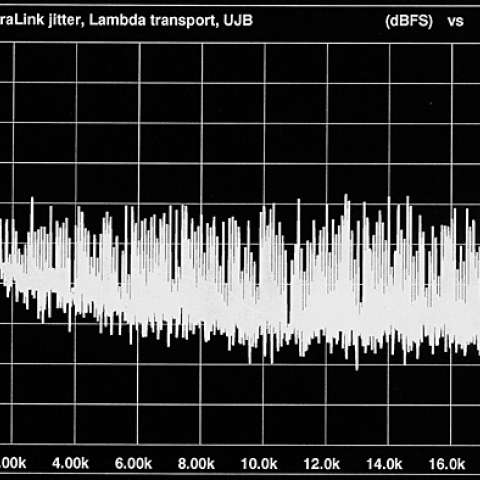
There are two possible answers. The first is that, besides the bits and the timing of those bits, sound quality is influenced by a third, unknown factor. The second—and much more likely—answer is that the jitter's spectral content affects certain sonic aspects differently. Jitter can be randomly distributed in frequency (like white noise), or have most of its energy concentrated at specific frequencies. The jitter's characteristics probably determine each transport's sound. Is this the mechanism behind the different sonic signatures of CD transports? We may have taken the first step toward answering that question. Stereophile has acquired a unique test instrument that measures jitter in a CD transport's digital output. The analyzer takes in an S/PDIF or AES/EBU signal from a transport and outputs the transport's jitter content. The jitter can be looked at on an oscilloscope, measured with an RMS-reading voltmeter, listened to through an amplifier and loudspeakers, analyzed with FFT techniques, or plotted as a function of frequency with 1/3-octave spectral analysis. The jitter test instrument, designed by UltraAnalog's Dr. Rémy Fourré and described in his Stereophile article last month ("Jitter and the Digital Interface," Vol.16 No.10, p.80), is a powerful tool for revealing the different jitter performances of various CD transports (footnote 2). I used the analyzer to measure the jitter in a wide range of CD transports, most of them previously reviewed in these pages. The Stereophile test bench and surrounding area looked like "transport city," with more than a dozen high-end models awaiting testing. Also on hand for measurement was a "jitter-reduction" device, Audio Alchemy's Digital Transmission Interface (DTI). Because Stereophile has already reported on the sound of many of these products, we can look at the measurements and see if there's a correlation between a transport's sound quality and its measured jitter.
I'll report on the test methods and results later in this article. First, let's look at how a transport's jitter affects the sound quality of a digital processor connected to it. How transport jitter affects DAC sound quality
In "The Jitter Game" (Stereophile, January 1993, p.114), I explained how jitter in a digital processor's word clock affects the processor's sound quality. The word clock is the timing signal that controls when the digital-to-analog converter (DAC) converts the digital audio samples into an analog output. Timing errors in the clock produce voltage errors in the DAC's analog output signal, degrading the processor's sonic and technical performance. That article focused on jitter in digital processors; at the time, we had no way of measuring transport jitter. Since then, we've learned much more about the relationship between word-clock jitter, the digital processor, and the CD transport. It turns out that word-clock jitter in a digital processor—the point where jitter becomes audible—is a result of many variables, including the transport, the digital interface, and the digital processor itself.
The transport's S/PDIF digital output drives the digital processor's input receiver. The input receiver generates a new clock by locking to the incoming clock in the S/PDIF datastream with a Phase-Locked Loop (PLL). This so-called "recovered" clock then becomes the timing reference for the digital processor. When your digital processor's "lock" or "44.1kHz" LED illuminates, the processor has locked to the incoming clock signal. If this recovered clock is jittered, the word clock at the DAC will also be jittered. It is commonly believed that transport jitter is rejected by the input receiver and not passed to the recovered clock. Unfortunately, that's true only above a certain frequency, called the "jitter attenuation cutoff frequency." Below this cutoff frequency, the input receiver and PLL simply pass the incoming jitter to the recovered clock. The popular Crystal CS8412 chip has a jitter attenuation cutoff frequency of 25kHz, meaning that the device is transparent to transport jitter below 25kHz. (This specification is clearly stated in the CS8412's data sheet [downloadable as a PDF file---Ed.].) The input receiver essentially acts as a low-pass filter to jitter. Note that jitter energy with a frequency between DC and 40kHz produces audible degradation. A second source of word-clock jitter is the input receiver's intrinsic jitter. Input receivers vary greatly in their intrinsic jitter, from 40 picoseconds in the UltraAnalog AES 20 input receiver, 200ps for the Crystal CS8412, up to 5000ps (5ns) in the Yamaha YM3623 chip. (The Yamaha receiver's jitter can be reduced with a few circuit tricks.)
We can quickly see that the sonically degrading word-clock jitter in a digital processor is influenced by several variables: 1) the transport's jitter;
2) S/PDIF or AES/EBU interface-induced jitter (the digital interconnect);
3) how well the digital processor's input receiver rejects transport and interface jitter;
4) the input receiver's intrinsic jitter; and
5) how well the clock is recovered and handled inside the digital processor.
Footnote 1: For a good introduction to jitter, see "Jitter, Bits, and Sound Quality," by John Atkinson, in Vol.13 No.12; "The Jitter Game" in Vol.16 No.1; and "Jitter and the Digital Interface," by Dr. Rémy Fourré, in Vol.16 No.10.—Robert Harley
Footnote 2: Many thanks to Richard Powers and Rémy Fourré of UltraAnalog for their loan of the Jitter Analyzer.—John Atkinson
In "The Jitter Game" (Stereophile, January 1993, p.114), I explained how jitter in a digital processor's word clock affects the processor's sound quality. The word clock is the timing signal that controls when the digital-to-analog converter (DAC) converts the digital audio samples into an analog output. Timing errors in the clock produce voltage errors in the DAC's analog output signal, degrading the processor's sonic and technical performance. That article focused on jitter in digital processors; at the time, we had no way of measuring transport jitter. Since then, we've learned much more about the relationship between word-clock jitter, the digital processor, and the CD transport. It turns out that word-clock jitter in a digital processor—the point where jitter becomes audible—is a result of many variables, including the transport, the digital interface, and the digital processor itself.
2) S/PDIF or AES/EBU interface-induced jitter (the digital interconnect);
3) how well the digital processor's input receiver rejects transport and interface jitter;
4) the input receiver's intrinsic jitter; and
5) how well the clock is recovered and handled inside the digital processor.
Footnote 1: For a good introduction to jitter, see "Jitter, Bits, and Sound Quality," by John Atkinson, in Vol.13 No.12; "The Jitter Game" in Vol.16 No.1; and "Jitter and the Digital Interface," by Dr. Rémy Fourré, in Vol.16 No.10.—Robert Harley