Back in the Spring of 1990, Stereophile introduced its first Test CD. Featuring a mixture of test signals and musical tracks recorded by the magazine's editors and writers, it sold in large numbers—around 50,000 had been produced at last count. Even as we were working on that first disc, however, we had plans to produce a second disc that would expand on the usefulness of the first and feature a more varied selection of music. The result is our Test CD 2, introduced this month for just $7.95 plus postage and handling. With a playing time of over 74 minutes, the new disc should prove an invaluable tool to help audiophiles optimally set up their systems and rooms by ear—and the music's pretty good, too!—John Atkinson  Track Information, Tracks 1-2 [1] Channel Identification (DDD) 0:37
Left then Right, John Atkinson (Fender Precision bass guitar), with spoken introduction by Richard Lehnert[2] Channel Phasing (DDD) 0:46
Out-of-phase, then in-phase, John Atkinson (Fender Precision bass guitar fitted with Rotosound round-wound strings), with spoken introduction by Richard Lehnert
Instrument amplifier: Fender Bassman 50, fitted with ARS tubes
Microphone (voice): B&K 4006 omnidirectional
Microphone preamplifier: EAR 824M
Recorder: Manley Analogue to Digital Converter, Aiwa HD-S1 DAT, AudioQuest Lapis balanced interconnects No matter how purist the engineer's approach, all recordings are at least one step removed from the real thing in that the sound has to be picked up by a microphone. An electric instrument, however, allows the opportunity of recording its electrical output without any original sound being produced. In this way, the low-frequency phase integrity of the original "sound" would be preserved absolutely, something audiophile playback systems almost never have to deal with. The result is a reference sound with a high peak:mean ratio, meaning that even though it requires a system with a large dynamic-range capability to be passed through without distortion, it doesn't sound very loud. JA therefore decided to use a Fender Precision bass guitar for this disc's traditional channel and phasing checks. He ran off a couple of riffs, recording the instrument's output in mono in three different ways: taking a direct feed from the instrument; taking a tap from the Fender Bassman amplifier's output terminals; and, as a check, miking the speaker cabinet. The second version was the one which ended up on the CD, the amplifier's tone controls being used to add a degree of treble bite to the sound and boosting the level of the instrument's bottom octave but not otherwise significantly changing its fundamental character.
Fig.1 shows the first 4s of the final "pop" on the instrument's E string in Track 2, produced by slapping the string hard with the right thumb, while fig.2 shows the first 40ms (1/25s). (The scale has been expanded in fig.1, cutting off the top of the initial transient, to show more clearly the way in which the note's envelope changes as it decays.) You can see that the waveform starts with an almost square, positive-going pulse, running nearly all the way up to the 0dBFS level. This enharmonic, positive-going click is the sound of the string hitting against the fretboard, and is followed by a complicated waveform, the low-frequency (41.2Hz) fundamental being overlaid with considerable and slowly changing amounts of higher harmonics (each harmonic has a frequency an integer—whole number—multiple of the fundamental: 2x, 3x, 4x, 5x, etc.). The Fender Precision bass, tuned one octave lower than the lower four strings of the regular guitar, was introduced in 1951 by the late Leo Fender as a more portable, less unwieldy substitute for the double bass or bass fiddle. In the ensuing 40 years the Fender has solidly established itself in virtually every field of music, its combination of percussive transients coupled with a unique, woody tone becoming one of the foundation stones of rock music. JA bought the instrument used on these tracks secondhand in 1968; it served him faithfully during his career as a session musician. It was actually made in 1964, before Fender was bought by CBS, and has been re-fretted twice in that time. (The wide vibrato JA uses on the phasing track riff is anathema to long fret life, particularly when the bass is fitted with "round-wound" strings.)  Fig.1 Fender Precision bass guitar, E-string transient at end of Track 2 (4s time window)
  Fig.2 Fender Precision bass guitar, E-string transient at end of Track 2 (40ms time window)
 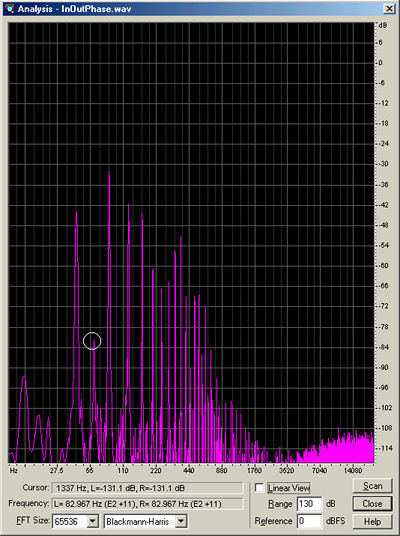 Fig.3 Fender Precision bass guitar, spectrum of E-string transient during initial decay period (10Hz-22kHz) Despite what might be thought, the frequency spectra of electric (as opposed to electronic) instruments is complex. Fig.3 shows the spectrum of the low E string of the Fender bass, taken directly from the instrument's output. The fundamental frequency is 41.2Hz—the left-most peak—but the second harmonic at 82.4Hz is actually 11.8dB higher in level! (You can also see that the bass, being a high-impedance, inductive source, picks up a little 60Hz hum—the small peak at -80dB circled in white, between the fundamental and second harmonic.) Harmonics sticking up above the FFT analyzer's noise floor can be seen all the way up the 17th at 700Hz, which lies 65dB below the fundamental level; as with any instrument, it is the precise ratio of the harmonics, detailed in Table 1, that gives the Fender bass its characteristic tone.
It is important for a hi-fi system to be able to pass the harmonics of recorded sounds with the ratio of their levels, which corresponds to the "timbre" of the sound, intact. As Ron Streicher and F. Alton Everest say in their 1992 book, The New Stereo Soundbook, "Preservation of spectrum is essential to the presentation of timbre...to maintain the illusion for the listener." (footnote 1) Later along in this CD, you'll be able to hear how much of each of various kinds of distortion are audible. It's not giving any secrets away to reveal that second-harmonic distortion—ie, the distorting component is adding a tone one octave above every note of the music—is inaudible even in large quantities. Fig.3 shows you why: a real instrument like the bass guitar already has large amounts of second harmonic present in its spectrum; adding a little more can hardly be expected to change the instrument's basic tonal quality. But because adding even small amounts of high-order harmonics changes the ratio of harmonics—hence the timbre of the instrument—by a relatively large amount, they will be more audible. Table 1:
Fig.3 Fender Precision bass guitar, spectrum of E-string transient during initial decay period (10Hz-22kHz) Despite what might be thought, the frequency spectra of electric (as opposed to electronic) instruments is complex. Fig.3 shows the spectrum of the low E string of the Fender bass, taken directly from the instrument's output. The fundamental frequency is 41.2Hz—the left-most peak—but the second harmonic at 82.4Hz is actually 11.8dB higher in level! (You can also see that the bass, being a high-impedance, inductive source, picks up a little 60Hz hum—the small peak at -80dB circled in white, between the fundamental and second harmonic.) Harmonics sticking up above the FFT analyzer's noise floor can be seen all the way up the 17th at 700Hz, which lies 65dB below the fundamental level; as with any instrument, it is the precise ratio of the harmonics, detailed in Table 1, that gives the Fender bass its characteristic tone.
It is important for a hi-fi system to be able to pass the harmonics of recorded sounds with the ratio of their levels, which corresponds to the "timbre" of the sound, intact. As Ron Streicher and F. Alton Everest say in their 1992 book, The New Stereo Soundbook, "Preservation of spectrum is essential to the presentation of timbre...to maintain the illusion for the listener." (footnote 1) Later along in this CD, you'll be able to hear how much of each of various kinds of distortion are audible. It's not giving any secrets away to reveal that second-harmonic distortion—ie, the distorting component is adding a tone one octave above every note of the music—is inaudible even in large quantities. Fig.3 shows you why: a real instrument like the bass guitar already has large amounts of second harmonic present in its spectrum; adding a little more can hardly be expected to change the instrument's basic tonal quality. But because adding even small amounts of high-order harmonics changes the ratio of harmonics—hence the timbre of the instrument—by a relatively large amount, they will be more audible. Table 1:
Fender Precision bass guitar, round-wound strings:
Harmonic Spectrum of open E string (fundamental = 41.203Hz)
Musicians will notice that, with the exceptions of the second, fourth, eighth, sixteenth, etc., harmonics, the frequencies of the other harmonics are not the frequencies of the notes in the Equal Tempered Scale, which divides the octave into 12 equal intervals, the frequency of each being that of the previous note multiplied by the 12th root of 2. (These frequencies are shown in brackets.) The 7th, 13th and 14th harmonics, in particular, (D, C#, and D) are noticeably flat compared with the equivalent note produced by equal temperament tuning, while the Bs are all slightly sharp. A stretched string, knowing nothing of mathematics, gives a "natural" harmonic series where each note is an integer multiple of the fundamental. Once you have heard music played with such a "natural" tuning, equal temperament will always sound out of tune. So why doesn't everyone use natural tuning? Because you need to retune your instrument for every key you need to play it in, which is hardly convenient for music composed after the time of Scarlatti. Because many of the distortion harmonics will not be in tune with those naturally occurring in the music, assuming it has been played on instruments with equal-temperament tuning, this might well lead to a more-than-expected increase in perceived "graininess" to the sound of the distorting device.
Footnote 1: Published by TAB, this book is an excellent guide to the pros and cons of the various microphone techniques used on this CD.
Track Information, Tracks 1-2 [1] Channel Identification (DDD) 0:37Left then Right, John Atkinson (Fender Precision bass guitar), with spoken introduction by Richard Lehnert[2] Channel Phasing (DDD) 0:46
Out-of-phase, then in-phase, John Atkinson (Fender Precision bass guitar fitted with Rotosound round-wound strings), with spoken introduction by Richard Lehnert
Microphone (voice): B&K 4006 omnidirectional
Microphone preamplifier: EAR 824M
Recorder: Manley Analogue to Digital Converter, Aiwa HD-S1 DAT, AudioQuest Lapis balanced interconnects No matter how purist the engineer's approach, all recordings are at least one step removed from the real thing in that the sound has to be picked up by a microphone. An electric instrument, however, allows the opportunity of recording its electrical output without any original sound being produced. In this way, the low-frequency phase integrity of the original "sound" would be preserved absolutely, something audiophile playback systems almost never have to deal with. The result is a reference sound with a high peak:mean ratio, meaning that even though it requires a system with a large dynamic-range capability to be passed through without distortion, it doesn't sound very loud. JA therefore decided to use a Fender Precision bass guitar for this disc's traditional channel and phasing checks. He ran off a couple of riffs, recording the instrument's output in mono in three different ways: taking a direct feed from the instrument; taking a tap from the Fender Bassman amplifier's output terminals; and, as a check, miking the speaker cabinet. The second version was the one which ended up on the CD, the amplifier's tone controls being used to add a degree of treble bite to the sound and boosting the level of the instrument's bottom octave but not otherwise significantly changing its fundamental character.
Fig.1 Fender Precision bass guitar, E-string transient at end of Track 2 (4s time window) Fig.2 Fender Precision bass guitar, E-string transient at end of Track 2 (40ms time window) Fig.3 Fender Precision bass guitar, spectrum of E-string transient during initial decay period (10Hz-22kHz) Despite what might be thought, the frequency spectra of electric (as opposed to electronic) instruments is complex. Fig.3 shows the spectrum of the low E string of the Fender bass, taken directly from the instrument's output. The fundamental frequency is 41.2Hz—the left-most peak—but the second harmonic at 82.4Hz is actually 11.8dB higher in level! (You can also see that the bass, being a high-impedance, inductive source, picks up a little 60Hz hum—the small peak at -80dB circled in white, between the fundamental and second harmonic.) Harmonics sticking up above the FFT analyzer's noise floor can be seen all the way up the 17th at 700Hz, which lies 65dB below the fundamental level; as with any instrument, it is the precise ratio of the harmonics, detailed in Table 1, that gives the Fender bass its characteristic tone. Fender Precision bass guitar, round-wound strings:
Harmonic Spectrum of open E string (fundamental = 41.203Hz)
| Harmonic | Note | Frequency | Level/Percentage of fundamental | ||
| 1st | E | 41.2Hz | 0.0dB | 100.00% | |
| 2nd | E | 82.4Hz | +11.8dB | 390% | |
| 3rd | B | 123.6Hz (123.471Hz) | -5.8dB | 51.5% | |
| 4th | E | 164.8Hz | -7.8dB | 40.8% | |
| 5th | G# | 206Hz (207.652Hz) | -13.3dB | 21.5% | |
| 6th | B | 247.2Hz (246.942Hz) | -23.0dB | 7.1% | |
| (Middle C, the note on the ledger line between the bass and treble staves, has a frequency of 261.626Hz) | |||||
| 7th | D | 288.4Hz (293.665Hz) | -26.6dB | 4.6% | |
| 8th | E | 329.6Hz | -7.3dB | 43.0% | |
| 9th | F# | 370.8Hz (369.994Hz) | -15.8dB | 16.6% | |
| 10th | G# | 412Hz (415.305Hz) | -24.7dB | 5.7% | |
| 11th | A | 453.2Hz (440Hz) | -52.6dB | 0.23% | |
| 12th | B | 494.4Hz (493.883Hz) | -52.4dB | 0.24% | |
| 13th | C# | 535.6Hz (554.365Hz) | -32.6dB | 2.35% | |
| 14th | D | 576.8Hz (587.33Hz) | -59.5dB | 0.1% | |
| 15th | D# | 618Hz (622.254Hz) | -51.9dB | 0.26% | |
| 16th | E | 659.2Hz | -58.8dB | 0.12% | |
| 17th | F | 700.4Hz (698.456Hz) | -64.5dB | 0.06% | |
Footnote 1: Published by TAB, this book is an excellent guide to the pros and cons of the various microphone techniques used on this CD.