The High End is a tidily ordered world. There are CD players, transports, and processors used to play stereo recordings and drive stereo preamplifiers. There are stereo or mono amplifiers used to drive a pair of speakers. And then there is the British high-end company Meridian, run by one J. Robert Stuart, one of audio's deeper thinkers and a Fellow of the Audio Engineering Society. Meridian does it their way. They put their amplifiers inside their speakers. Heck, Meridian even puts their D/A processors inside their speakers when they can. And two speakers to play back stereo recordings? Meridian believes in re-creating the original soundfield no matter how many speakers and channels it takes to do it right. And they do it sufficiently successfully that their Digital Theatre system, which does all of the above, was one of Stereophile's joint Home Theater products of 1995. [See also the 2000 review of their Series 800 Digital Theatre.—Ed.] 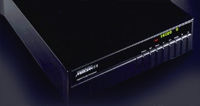 Then, at the 1995 June CES, I saw a press release for a new Meridian product that seemed even more perverse. The $1650 518 offers digital inputs and outputs only (though it can be expanded to include analog inputs with the 562V switcher/ADC that J. Gordon Holt reviewed last June). It can digitally perform gain and source selection; it can change data with one digital word length to data with another; and it does all these things with 72-bit internal precision. How does the 518 fit within a conventional high-end audio system? The 518 is a successor to Meridian's 618 Mastering Processor, which has gained no small reputation in professional audio circles for the way it reduces 20-bit audio data to the 16 mandated by the CD standard without sacrificing sound quality. It adds considerable functionality, however, and in its most fundamental role can be used as a digital replacement for a system's conventional preamplifier, accepting the outputs of digital sources, allowing for volume control, and feeding its output either to a D/A processor/amplifier/speaker combination, or to a system based on Meridian's DSP-series powered loudspeakers, which have digital data inputs. (Bob Stuart: "At Meridian, we say there is no preamp like no preamp!") Or it can be used like the 618: to make 16-bit recordings with resolution and sound quality approaching those of true 18- or 20-bit recordings.
Or it can be used as a sophisticated jitter-reduction unit that also allows the user to increase resolution, change the gain of the digital signal, and even to add or remove pre-emphasis. I immediately asked for a review sample. Innards
Then, at the 1995 June CES, I saw a press release for a new Meridian product that seemed even more perverse. The $1650 518 offers digital inputs and outputs only (though it can be expanded to include analog inputs with the 562V switcher/ADC that J. Gordon Holt reviewed last June). It can digitally perform gain and source selection; it can change data with one digital word length to data with another; and it does all these things with 72-bit internal precision. How does the 518 fit within a conventional high-end audio system? The 518 is a successor to Meridian's 618 Mastering Processor, which has gained no small reputation in professional audio circles for the way it reduces 20-bit audio data to the 16 mandated by the CD standard without sacrificing sound quality. It adds considerable functionality, however, and in its most fundamental role can be used as a digital replacement for a system's conventional preamplifier, accepting the outputs of digital sources, allowing for volume control, and feeding its output either to a D/A processor/amplifier/speaker combination, or to a system based on Meridian's DSP-series powered loudspeakers, which have digital data inputs. (Bob Stuart: "At Meridian, we say there is no preamp like no preamp!") Or it can be used like the 618: to make 16-bit recordings with resolution and sound quality approaching those of true 18- or 20-bit recordings.
Or it can be used as a sophisticated jitter-reduction unit that also allows the user to increase resolution, change the gain of the digital signal, and even to add or remove pre-emphasis. I immediately asked for a review sample. Innards
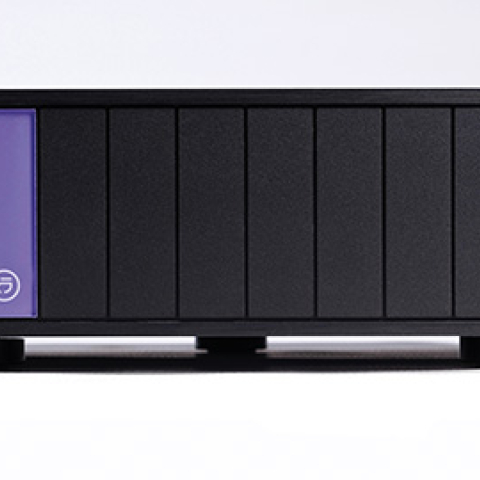
The 518 is housed in a smart black enclosure identical to that of Meridian's other 500-series components. The circuitry is based on a Motorola DSP-56002 24-bit digital signal processing chip running at 40 or 60MHz (the specs. are unclear here). The selected input signal—there are five inputs and, in Meridian fashion, these have to be assigned to a display alias to become operational—is dejittered using a dual Phase-Locked Loop circuit and a crystal oscillator similar to those in the well-regarded Meridian D/A processors. The reclocked data are then fed to the DSP engine, which performs three main functions, all under the control of front-panel buttons, of other Meridian components via a Comms. socket on the rear, or of a computer via a rear RS-232 port. First, the 518 can adjust the gain in 1dB steps up to +12dB or -99dB. This volume control operates with 72-bit internal precision, and dither is used to minimize round-off errors. Second, the input and output word lengths can be set to be different. A typical application, for example, would be when a 20-bit A/D converter was used to feed a DAT or CD-R recorder, both of which can only store 16-bit data. In such a case the 518 offers a choice of seven noise-shaping/redithering algorithms, these psychoacoustically optimized to give as audibly transparent a data reduction as possible. Finally, the 518 can add pre-emphasis to the digital data to increase resolution when the analog signal is finally reconstructed. The data output is in both AES/EBU (XLR) and S/PDIF (RCA) formats.
The well-written manual goes into much detail on how to set up and use the very flexible 518 in a number of different situations. I would suggest that its uses are limited only by the imagination of its user. Unusually, the team responsible for the 518's design are mentioned by name in the manual: credited are Phil Boddy, Richard Hollinshead, Duncan Smith, Bob Stuart, and Rhonda Wilson. Now that's a nice touch, and one that more high-end companies should echo. Something for nothing?
I was mostly interested in the 518's resolution enhancement abilities. So, Sherlock, does the 518 do what is claimed for it? Can it give more than 20-bit precision from a datastream limited to 16-bit word lengths?
Then, at the 1995 June CES, I saw a press release for a new Meridian product that seemed even more perverse. The $1650 518 offers digital inputs and outputs only (though it can be expanded to include analog inputs with the 562V switcher/ADC that J. Gordon Holt reviewed last June). It can digitally perform gain and source selection; it can change data with one digital word length to data with another; and it does all these things with 72-bit internal precision. How does the 518 fit within a conventional high-end audio system? The 518 is a successor to Meridian's 618 Mastering Processor, which has gained no small reputation in professional audio circles for the way it reduces 20-bit audio data to the 16 mandated by the CD standard without sacrificing sound quality. It adds considerable functionality, however, and in its most fundamental role can be used as a digital replacement for a system's conventional preamplifier, accepting the outputs of digital sources, allowing for volume control, and feeding its output either to a D/A processor/amplifier/speaker combination, or to a system based on Meridian's DSP-series powered loudspeakers, which have digital data inputs. (Bob Stuart: "At Meridian, we say there is no preamp like no preamp!") Or it can be used like the 618: to make 16-bit recordings with resolution and sound quality approaching those of true 18- or 20-bit recordings. The 518 is housed in a smart black enclosure identical to that of Meridian's other 500-series components. The circuitry is based on a Motorola DSP-56002 24-bit digital signal processing chip running at 40 or 60MHz (the specs. are unclear here). The selected input signal—there are five inputs and, in Meridian fashion, these have to be assigned to a display alias to become operational—is dejittered using a dual Phase-Locked Loop circuit and a crystal oscillator similar to those in the well-regarded Meridian D/A processors. The reclocked data are then fed to the DSP engine, which performs three main functions, all under the control of front-panel buttons, of other Meridian components via a Comms. socket on the rear, or of a computer via a rear RS-232 port. First, the 518 can adjust the gain in 1dB steps up to +12dB or -99dB. This volume control operates with 72-bit internal precision, and dither is used to minimize round-off errors. Second, the input and output word lengths can be set to be different. A typical application, for example, would be when a 20-bit A/D converter was used to feed a DAT or CD-R recorder, both of which can only store 16-bit data. In such a case the 518 offers a choice of seven noise-shaping/redithering algorithms, these psychoacoustically optimized to give as audibly transparent a data reduction as possible. Finally, the 518 can add pre-emphasis to the digital data to increase resolution when the analog signal is finally reconstructed. The data output is in both AES/EBU (XLR) and S/PDIF (RCA) formats.
I was mostly interested in the 518's resolution enhancement abilities. So, Sherlock, does the 518 do what is claimed for it? Can it give more than 20-bit precision from a datastream limited to 16-bit word lengths?