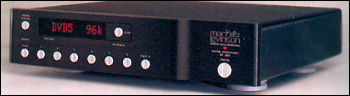
Unlike the imposing mbl and Burmester DACs that I review elsewhere in this issue, the Mark Levinson No.360 is New England conservative in appearance. Its operation was simple to master despite the sophistication and flexibility on tap. Flanked by Fasolt and Fafner, the Levinson No.360 seemed as amiable as Freia. 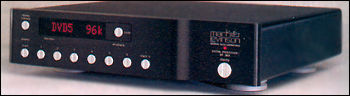 The No.360, the successor to the No.36 (which can be upgraded to 360S status), sits under the $6995 "special performance" No.360S in the hierarchy of Levinson DACs and features a Madrigal-designed input receiver circuit (DIR) rather than off-the-shelf chips. Levinson's receiver circuits are based on a wide-bandwidth gate array and are programmable to permit future compatibility with new audio data formats. The heart of the DAC, however, is a 32-bit SHARC digital signal processor, which performs as an oversampling filter and HDCD decoder and interfaces with the FIFO and DAC circuits. Additionally, this DSP might be reprogrammable to handle formats such as Dolby Digital, DTS, MPEG, and MLP, making the No.360 series almost obsolescence-proof. The single feature that, for me, most clearly separates Levinson DACs from others is the use of an "intelligent" FIFO to buffer and reclock the digital data. The No.360 uses an Analog Devices AD9850 Direct Digital Synthesis chip to generate a clock (with an accuracy of 4 parts per billion!) based on a continuous recalculation of the longterm input data rate. The buffer thus cannot be overrun or starved, and the words are clocked precisely into the DACs. In addition, the No.360 uses a low-voltage differential signal path throughout.
The No.360 differs from the more expensive No.360S in four ways. First, the No.360 has two 32-bit DSP chips to handle digital filtering and decoding; the No.360S has four. This means that the No.360S has twice the computational power and is capable of a wider range of future software options, but this probably means little for current performance. Second, while both have dual 24-bit DACs (Burr-Brown PCM1704) in each channel, the No.360's output level matching is accomplished with high-tolerance Vishay potentiometers, while hand-calibrated bulk metal-foil resistors are mated (to a tolerance of ±0.0002%!) to each of the No.360S's DACs. Third, the No.360S uses four-layer cyanate-ester printed circuit boards rather than the No.360's two-layer fiberglass/epoxy boards. Finally, the No.360S has separate discrete regulators for left and right channels, and local reservoirs for critical components based on relatively rare OSCON caps. An upgrade from the No.360 to No.360S is available from Madrigal. The R-2R DACs run at 8fs (352.8kHz or 384kHz) and the '360 can handle input data rates up to 96kHz. Externally, the No.360's brushed and anodized chassis bears 11 silver-colored buttons, each clearly marked so as to make its operation nearly intuitive. Six numbered buttons select the inputs. The mode button allows you to add a descriptive name (from a list of options) to each input number on the display. This button also turns on/off the digital outputs and disables the 6dB attenuation of non-HDCD signals. The Display Intensity button, on the upper left, steps the main display through four levels of brightness. The central LED panel displays the name and number of the active input and, usually, the sampling frequency. Under appropriate conditions, indications of HDCD, Mute, Lock, or Off replace the sampling frequency.
The No.360, the successor to the No.36 (which can be upgraded to 360S status), sits under the $6995 "special performance" No.360S in the hierarchy of Levinson DACs and features a Madrigal-designed input receiver circuit (DIR) rather than off-the-shelf chips. Levinson's receiver circuits are based on a wide-bandwidth gate array and are programmable to permit future compatibility with new audio data formats. The heart of the DAC, however, is a 32-bit SHARC digital signal processor, which performs as an oversampling filter and HDCD decoder and interfaces with the FIFO and DAC circuits. Additionally, this DSP might be reprogrammable to handle formats such as Dolby Digital, DTS, MPEG, and MLP, making the No.360 series almost obsolescence-proof. The single feature that, for me, most clearly separates Levinson DACs from others is the use of an "intelligent" FIFO to buffer and reclock the digital data. The No.360 uses an Analog Devices AD9850 Direct Digital Synthesis chip to generate a clock (with an accuracy of 4 parts per billion!) based on a continuous recalculation of the longterm input data rate. The buffer thus cannot be overrun or starved, and the words are clocked precisely into the DACs. In addition, the No.360 uses a low-voltage differential signal path throughout.
The No.360 differs from the more expensive No.360S in four ways. First, the No.360 has two 32-bit DSP chips to handle digital filtering and decoding; the No.360S has four. This means that the No.360S has twice the computational power and is capable of a wider range of future software options, but this probably means little for current performance. Second, while both have dual 24-bit DACs (Burr-Brown PCM1704) in each channel, the No.360's output level matching is accomplished with high-tolerance Vishay potentiometers, while hand-calibrated bulk metal-foil resistors are mated (to a tolerance of ±0.0002%!) to each of the No.360S's DACs. Third, the No.360S uses four-layer cyanate-ester printed circuit boards rather than the No.360's two-layer fiberglass/epoxy boards. Finally, the No.360S has separate discrete regulators for left and right channels, and local reservoirs for critical components based on relatively rare OSCON caps. An upgrade from the No.360 to No.360S is available from Madrigal. The R-2R DACs run at 8fs (352.8kHz or 384kHz) and the '360 can handle input data rates up to 96kHz. Externally, the No.360's brushed and anodized chassis bears 11 silver-colored buttons, each clearly marked so as to make its operation nearly intuitive. Six numbered buttons select the inputs. The mode button allows you to add a descriptive name (from a list of options) to each input number on the display. This button also turns on/off the digital outputs and disables the 6dB attenuation of non-HDCD signals. The Display Intensity button, on the upper left, steps the main display through four levels of brightness. The central LED panel displays the name and number of the active input and, usually, the sampling frequency. Under appropriate conditions, indications of HDCD, Mute, Lock, or Off replace the sampling frequency.
The No.360, the successor to the No.36 (which can be upgraded to 360S status), sits under the $6995 "special performance" No.360S in the hierarchy of Levinson DACs and features a Madrigal-designed input receiver circuit (DIR) rather than off-the-shelf chips. Levinson's receiver circuits are based on a wide-bandwidth gate array and are programmable to permit future compatibility with new audio data formats. The heart of the DAC, however, is a 32-bit SHARC digital signal processor, which performs as an oversampling filter and HDCD decoder and interfaces with the FIFO and DAC circuits. Additionally, this DSP might be reprogrammable to handle formats such as Dolby Digital, DTS, MPEG, and MLP, making the No.360 series almost obsolescence-proof. The single feature that, for me, most clearly separates Levinson DACs from others is the use of an "intelligent" FIFO to buffer and reclock the digital data. The No.360 uses an Analog Devices AD9850 Direct Digital Synthesis chip to generate a clock (with an accuracy of 4 parts per billion!) based on a continuous recalculation of the longterm input data rate. The buffer thus cannot be overrun or starved, and the words are clocked precisely into the DACs. In addition, the No.360 uses a low-voltage differential signal path throughout.