"They're cuuuute!" Not a very professional reaction, but what can I say? When the Monster Cable folks pulled out their new Entech Number Crunchers during a recent visit to Santa Fe, I couldn't help myself. I was edging John Atkinson and Wes Phillips out of the way, using my long arms to reach over...gotta get one! There would be time later for the critical evaluation and cool, detached objectivity—first, I had to get one. The Entechs are the Beanie Babies of the audio world
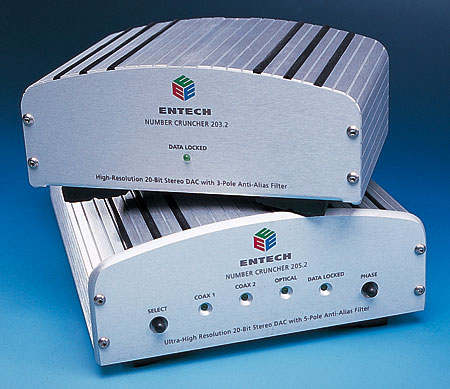
 Sure, I was interested in the Monster Cable/Entech story (see Sidebar), and impressed by the reasonable prices—$300 for the 203.2, $450 for the 205.2—but the real reason for the commotion was the Entech units' adorable packaging. Imagine a 1/100-scale model of a Quonset hut. I considered lobbying for product photos with a miniature village grouped around the Entech Quonset huts—a little drive-in, a movie theater with a teeny-tiny marquee...or how about an aerodrome from WWII England, with tiny tankers and RAF Spitfires parked out front of the Entechs and surrounded by verdant hills?
The Number Crunchers' chassis were created by industrial designer Alex Rasmussen, of Neal Feay Industries—a behind-the-scenes firm responsible for a lot of the metalwork you see on American high-end audio gear. Although they're adorable, the little chassis also make perfect sense. The extruded housings form both the top and sides of the chassis, so they minimize parts. They're also consistent, inexpensive, easily extended to encompass a wide range of internal layouts, and compliant with worldwide regulations. Finally, even though they're rounded, they're cleverly stackable, with sculpted feet that interlock with longitudinal rubber ridges on the roofs—er, tops. Eminently practical...and cuuuuute!
What's inside a mini-Quonset hut?
Sure, I was interested in the Monster Cable/Entech story (see Sidebar), and impressed by the reasonable prices—$300 for the 203.2, $450 for the 205.2—but the real reason for the commotion was the Entech units' adorable packaging. Imagine a 1/100-scale model of a Quonset hut. I considered lobbying for product photos with a miniature village grouped around the Entech Quonset huts—a little drive-in, a movie theater with a teeny-tiny marquee...or how about an aerodrome from WWII England, with tiny tankers and RAF Spitfires parked out front of the Entechs and surrounded by verdant hills?
The Number Crunchers' chassis were created by industrial designer Alex Rasmussen, of Neal Feay Industries—a behind-the-scenes firm responsible for a lot of the metalwork you see on American high-end audio gear. Although they're adorable, the little chassis also make perfect sense. The extruded housings form both the top and sides of the chassis, so they minimize parts. They're also consistent, inexpensive, easily extended to encompass a wide range of internal layouts, and compliant with worldwide regulations. Finally, even though they're rounded, they're cleverly stackable, with sculpted feet that interlock with longitudinal rubber ridges on the roofs—er, tops. Eminently practical...and cuuuuute!
What's inside a mini-Quonset hut?
The 203.2 and 205.2 share their basic technology, differing only in the 205.2's additional features, upgraded cosmetics, more extensive analog filter network, and additional power-supply regulation. Both units start with an input selector and buffer stage, followed by a Crystal Semiconductor CS8412 input receiver. Conversion is performed by a Crystal CS4329 20-bit delta-sigma DAC, and both use a Burr-Brown OPA2134 op-amp for the output stage and analog low-pass filter. Topnotch components—1% metal-film resistors and film caps—are used throughout the signal paths in both units. They also use identical in-line 115V/16V wall-wart transformers, feeding onboard power supplies with a batch of independent voltage regulators: six in the 205.2 vs five in the 203.2. Finally, the 203.2's output filter is a three-pole circuit, while the 205.2 uses a five-pole design. The bigger differences in the user-interface features reflect different target applications. On the 203.2, selection between the coax and optical inputs is handled by a rear-panel pushbutton, and the front panel contains only a single LED to indicate when the unit is locked on to a digital signal. The goal here, according to designer Peter Madnick, is to provide users and home installers an inexpensive upgrade to a wide range of digital devices. "It's a set-it-and-forget-it device, with the intention of being set behind a CD or laserdisc player. When you add another digital device anywhere in the home system, you just stick another 203.2 behind it to replace the onboard DAC." The 205.2 is intended to be a visible, accessible system hub, so it includes a microprocessor to handle the front-panel input selection switch and indicators, and a digital-domain phase inverter controlled via a second front-panel button. The aluminum chassis are identical in height, width, shape, and appearance, but the 205.2's is approximately twice as deep. It adds a softly sculpted front panel and recessed indicators for each of the three inputs to the 203.2's "Data Locked" LED, and the lights are flanked by the input selector and phase-inverter switches.
203.2 Number Cruncher
The couple of weeks I spent in my mountain cabin last fall provided a perfect opportunity to audition the 203.2 in its natural habitat—as an upgrade to an older, inexpensive CD player in a modest system. In this case, the CD player was a Philips CDC926 CD changer feeding a Rega Luna integrated amplifier and a pair of Castle Severn loudspeakers. A Technics tuner and cables by Kimber (PBJ and 4TC), Nordost (Blue Heaven), and Synergistic Research (Digital Corridor Reference) rounded out the gear. The little Number Cruncher turned out to be a super addition to our cabin system. The improvements it made were noticeable and significant, not only during serious listening sessions, but also when the system was used for background music. The system was nearly always on, and music—ranging from Ella Fitzgerald and Louis Armstrong to Tommy Castro to Melissa Etheridge to Mozart—provided a setting for reading, watching birds on the deck, or just hanging out. Admittedly, it would have been tough not to enjoy the time at the cabin, with the lovely setting and gorgeous fall weather, but the music—detailed, engaging, involving, dimensional—made it that much better. The 203.2's most noticeable contribution, apparent even in casual listening, was its even handling of dynamics and instruments' harmonic structures. The Philips changer was typical of a lot of inexpensive, early digital gear in that it had an excessive mid- and upper-midrange presence that seemed to funnel everything into that range. Instruments with fundamentals centered in the midrange were accentuated and magnified, and everything had a monochromatic harmonic sameness. With the 203.2, images were evenly and appropriately scaled. The frequency extremes were apparent and appropriately weighted, and instruments' harmonic structures were spread realistically across the frequency spectrum with their characteristic qualities and textures intact—clarinets sounded like clarinets, oboes like oboes, French horns like French horns. It was like going from a black-and-white television to living color.
The first selection from Festival (Stereophile STPH007-2), Aaron Copland's Appalachian Spring Suite, was a good example of how the 203.2 improved the system's performance. I noted how well the system captured the delicate presence of the woodwinds. "Wonderful flute, bassoon, and clarinet lines...lovely, delicate detail of the pitch modulations, all across their range," say my listening notes; "lovely string tone, complex and sweet—not only on the violins, but especially on the violas and cellos." I was struck as well by how "right" the piano sounded, consistent in weight, size, and dynamics across its entire range. The effect of the 203.2 was especially noticeable toward the bottom of the piano's range, where the balance of tone and harmonics, of string vibration and soundboard resonance, was right on the money.
Sure, I was interested in the Monster Cable/Entech story (see Sidebar), and impressed by the reasonable prices—$300 for the 203.2, $450 for the 205.2—but the real reason for the commotion was the Entech units' adorable packaging. Imagine a 1/100-scale model of a Quonset hut. I considered lobbying for product photos with a miniature village grouped around the Entech Quonset huts—a little drive-in, a movie theater with a teeny-tiny marquee...or how about an aerodrome from WWII England, with tiny tankers and RAF Spitfires parked out front of the Entechs and surrounded by verdant hills?
The Number Crunchers' chassis were created by industrial designer Alex Rasmussen, of Neal Feay Industries—a behind-the-scenes firm responsible for a lot of the metalwork you see on American high-end audio gear. Although they're adorable, the little chassis also make perfect sense. The extruded housings form both the top and sides of the chassis, so they minimize parts. They're also consistent, inexpensive, easily extended to encompass a wide range of internal layouts, and compliant with worldwide regulations. Finally, even though they're rounded, they're cleverly stackable, with sculpted feet that interlock with longitudinal rubber ridges on the roofs—er, tops. Eminently practical...and cuuuuute!
The 203.2 and 205.2 share their basic technology, differing only in the 205.2's additional features, upgraded cosmetics, more extensive analog filter network, and additional power-supply regulation. Both units start with an input selector and buffer stage, followed by a Crystal Semiconductor CS8412 input receiver. Conversion is performed by a Crystal CS4329 20-bit delta-sigma DAC, and both use a Burr-Brown OPA2134 op-amp for the output stage and analog low-pass filter. Topnotch components—1% metal-film resistors and film caps—are used throughout the signal paths in both units. They also use identical in-line 115V/16V wall-wart transformers, feeding onboard power supplies with a batch of independent voltage regulators: six in the 205.2 vs five in the 203.2. Finally, the 203.2's output filter is a three-pole circuit, while the 205.2 uses a five-pole design. The bigger differences in the user-interface features reflect different target applications. On the 203.2, selection between the coax and optical inputs is handled by a rear-panel pushbutton, and the front panel contains only a single LED to indicate when the unit is locked on to a digital signal. The goal here, according to designer Peter Madnick, is to provide users and home installers an inexpensive upgrade to a wide range of digital devices. "It's a set-it-and-forget-it device, with the intention of being set behind a CD or laserdisc player. When you add another digital device anywhere in the home system, you just stick another 203.2 behind it to replace the onboard DAC." The 205.2 is intended to be a visible, accessible system hub, so it includes a microprocessor to handle the front-panel input selection switch and indicators, and a digital-domain phase inverter controlled via a second front-panel button. The aluminum chassis are identical in height, width, shape, and appearance, but the 205.2's is approximately twice as deep. It adds a softly sculpted front panel and recessed indicators for each of the three inputs to the 203.2's "Data Locked" LED, and the lights are flanked by the input selector and phase-inverter switches.
The couple of weeks I spent in my mountain cabin last fall provided a perfect opportunity to audition the 203.2 in its natural habitat—as an upgrade to an older, inexpensive CD player in a modest system. In this case, the CD player was a Philips CDC926 CD changer feeding a Rega Luna integrated amplifier and a pair of Castle Severn loudspeakers. A Technics tuner and cables by Kimber (PBJ and 4TC), Nordost (Blue Heaven), and Synergistic Research (Digital Corridor Reference) rounded out the gear. The little Number Cruncher turned out to be a super addition to our cabin system. The improvements it made were noticeable and significant, not only during serious listening sessions, but also when the system was used for background music. The system was nearly always on, and music—ranging from Ella Fitzgerald and Louis Armstrong to Tommy Castro to Melissa Etheridge to Mozart—provided a setting for reading, watching birds on the deck, or just hanging out. Admittedly, it would have been tough not to enjoy the time at the cabin, with the lovely setting and gorgeous fall weather, but the music—detailed, engaging, involving, dimensional—made it that much better. The 203.2's most noticeable contribution, apparent even in casual listening, was its even handling of dynamics and instruments' harmonic structures. The Philips changer was typical of a lot of inexpensive, early digital gear in that it had an excessive mid- and upper-midrange presence that seemed to funnel everything into that range. Instruments with fundamentals centered in the midrange were accentuated and magnified, and everything had a monochromatic harmonic sameness. With the 203.2, images were evenly and appropriately scaled. The frequency extremes were apparent and appropriately weighted, and instruments' harmonic structures were spread realistically across the frequency spectrum with their characteristic qualities and textures intact—clarinets sounded like clarinets, oboes like oboes, French horns like French horns. It was like going from a black-and-white television to living color.