"You've got to hear it!"
I had e-mailed Cantus producer Erick Lichte last March to discuss the progress I was making assembling the performances for the choir's new CD Cantus, which is scheduled for release this fall. But instead of talking about nuances of performance and splices and mixes, Erick was raving about the new Bel Canto DAC3 he'd borrowed from a local dealer to audition at home.
 "I was floored! It was so involving. I was also so impressed with what they are going after with this product. . . . This kind of device, like my Benchmark DAC1, is not only the Swiss army knife of audio, but also one of the only future-proof source components you can buy these days. This piece made me excited about audio again."
Now, the sensible Erick lives in sensible Minnesota; I'm not used to such a lack of restraint from him, let alone a lack of restraint involving a product category—the standalone digital-to-analog processor—that has been out of fashion for some years.
Fads and fashions sweep the audiophile world at regular intervals, some of real value, others offering mixed benefits. With hindsight, it looks as if the introduction of separate digital processors in the first half of the 1990s was the latter rather than the former. Yes, moving the sensitive D/A circuits into a separate chassis, isolated from the widely varying power-supply demands of the disc-transport mechanism, would allow those circuits to perform at their optimum—but against that is the fact that, if not correctly implemented, the S/PDIF and AES/EBU datastreaming formats can introduce timing uncertainties that can degrade the noise floor of the decoded analog signal. (See "Bits Is Bits," by Malcolm Hawksford and Chris Dunn, in the March 1996 issue.) In the worst case, the cure was worse than the disease, but it may just have been that the unpredictability of the sonic result, coupled with the need for extra wires and system complexity, put paid to the product category. There were also the market death of DVD-Audio and the lack of an in-the-clear data output from SACD players, neither of which helped the situation. With the almost complete absence of high-resolution data sources, it should come as no surprise that we listed just a page and a half of D/A processors in our 2007 Buyer's Guide.
That's not to say that, when correctly engineered, a standalone digital processor can't give superb sound quality. My reference for digital playback since I bought the review sample in 1993 has been the Mark Levinson No.30. It held on to its position in my system through its No.30.5 and No.30.6 upgrades, and its measured performance and sound quality have come under serious challenge only in recent years. But—and it's a big but—that high-end performance came with an equally high-end price tag. Originally priced at $13,954 in 1992, the two-chassis No.30 had risen to $16,950 by the time I reviewed the No.30.6 revision in 1999, and $17,500 by the time it was discontinued, at the end of 2003.
The No.30 cost so much because Levinson's engineers had made heroic efforts to wrest the maximum performance from what was available in the parts bin at the time of its design and redesigns (that, and its expensive styling). But as the chip foundries have produced progressively better parts over the years, it should be possible, perhaps even probable, that a current-day digital processor designed with modern parts could approach or even surpass the performance of the mighty Levinson at a lower price.
Which brings me back to Bel Canto's e.One DAC3, which costs $2495.
The DAC3 . . .
"I was floored! It was so involving. I was also so impressed with what they are going after with this product. . . . This kind of device, like my Benchmark DAC1, is not only the Swiss army knife of audio, but also one of the only future-proof source components you can buy these days. This piece made me excited about audio again."
Now, the sensible Erick lives in sensible Minnesota; I'm not used to such a lack of restraint from him, let alone a lack of restraint involving a product category—the standalone digital-to-analog processor—that has been out of fashion for some years.
Fads and fashions sweep the audiophile world at regular intervals, some of real value, others offering mixed benefits. With hindsight, it looks as if the introduction of separate digital processors in the first half of the 1990s was the latter rather than the former. Yes, moving the sensitive D/A circuits into a separate chassis, isolated from the widely varying power-supply demands of the disc-transport mechanism, would allow those circuits to perform at their optimum—but against that is the fact that, if not correctly implemented, the S/PDIF and AES/EBU datastreaming formats can introduce timing uncertainties that can degrade the noise floor of the decoded analog signal. (See "Bits Is Bits," by Malcolm Hawksford and Chris Dunn, in the March 1996 issue.) In the worst case, the cure was worse than the disease, but it may just have been that the unpredictability of the sonic result, coupled with the need for extra wires and system complexity, put paid to the product category. There were also the market death of DVD-Audio and the lack of an in-the-clear data output from SACD players, neither of which helped the situation. With the almost complete absence of high-resolution data sources, it should come as no surprise that we listed just a page and a half of D/A processors in our 2007 Buyer's Guide.
That's not to say that, when correctly engineered, a standalone digital processor can't give superb sound quality. My reference for digital playback since I bought the review sample in 1993 has been the Mark Levinson No.30. It held on to its position in my system through its No.30.5 and No.30.6 upgrades, and its measured performance and sound quality have come under serious challenge only in recent years. But—and it's a big but—that high-end performance came with an equally high-end price tag. Originally priced at $13,954 in 1992, the two-chassis No.30 had risen to $16,950 by the time I reviewed the No.30.6 revision in 1999, and $17,500 by the time it was discontinued, at the end of 2003.
The No.30 cost so much because Levinson's engineers had made heroic efforts to wrest the maximum performance from what was available in the parts bin at the time of its design and redesigns (that, and its expensive styling). But as the chip foundries have produced progressively better parts over the years, it should be possible, perhaps even probable, that a current-day digital processor designed with modern parts could approach or even surpass the performance of the mighty Levinson at a lower price.
Which brings me back to Bel Canto's e.One DAC3, which costs $2495.
The DAC3 . . .
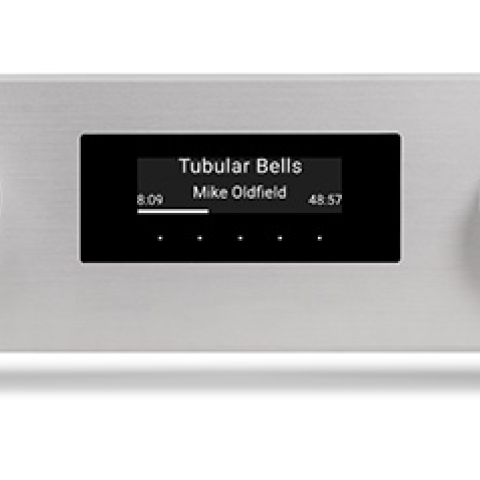
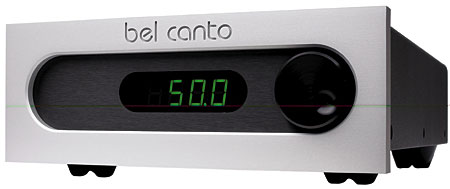
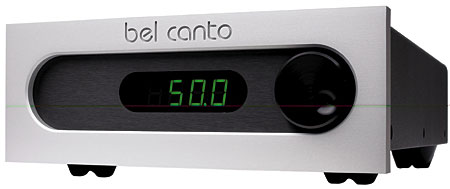
. . . is one of Bel Canto's e.One series of components, and is a relatively small device. Its half-width front panel features a central green display and, to its right, a black volume-control knob, both housed within a radiused recess. At the top of the rear panel are the IEC AC mains jack and five digital inputs: a transformer-coupled AES/EBU input on an XLR jack; two transformer-isolated electrical S/PDIF inputs, one on an RCA jack, the other on a BNC jack; a TosLink optical jack; and a standard USB port. (The last is said to be galvanically isolated so that electrical noise on a computer's ground doesn't affect the DAC's performance.) There are two pairs of analog outputs: a balanced pair on XLRs and an unbalanced pair on RCAs. A small pushbutton selects between fixed and variable output level. Inside the black-painted steel chassis, the audio circuitry is carried on a single lead-free printed-circuit board behind the rear panel. A second board carries the quite beefy power supply, this based on two toroidal transformers and four voltage regulators mounted on heatsinks. A small PCB mounted vertically behind the front panel contains the display and control circuits, while another small board behind the rear panel's digital input jacks carries the ground-isolating data transformers and the USB receiver. The last is based on a Burr-Brown PCM2903 chip, which includes both 16-bit A/D and D/A converters, though here it appears to be used to convert the USB datastream to S/PDIF, clocked by an adjacent crystal. The selected input datastream is sent to the ubiquitous Cirrus Logic CS8416 receiver chip. The heart of the DAC3 is a Burr-Brown PCM1792 two-channel DAC chip, a CMOS type with a specified 24-bit resolution using BB's Advanced Segment DAC architecture. (The six most significant bits are processed by a conventional D/A section; the 18 least significant bits are decoded by a five-level delta-sigma D/A section running at 64 times the clock speed.) The chip has onboard digital attenuation and a soft mute, both of which are used by Bel Canto, as well as slow- or fast-rolloff reconstruction filters. It will also process DSD data, though Bel Canto doesn't implement that option. Although the PCM1792 will handle data sampled over a wide range of frequencies (10–200kHz), Bel Canto runs it at a fixed sample rate of 192kHz, feeding the chip from the output of a high-quality asynchronous sample-rate converter chip, a Cirrus CS8421, which upsamples the coming data. This topology is increasingly popular—I've seen it used in processors from Benchmark and Musical Fidelity—because it provides an additional stage of jitter reduction. Bel Canto also describes the DAC3 as using a proprietary Ultra-Clock circuit, a master clock generator with very low levels of jitter.
"I was floored! It was so involving. I was also so impressed with what they are going after with this product. . . . This kind of device, like my Benchmark DAC1, is not only the Swiss army knife of audio, but also one of the only future-proof source components you can buy these days. This piece made me excited about audio again."
Now, the sensible Erick lives in sensible Minnesota; I'm not used to such a lack of restraint from him, let alone a lack of restraint involving a product category—the standalone digital-to-analog processor—that has been out of fashion for some years.
. . . is one of Bel Canto's e.One series of components, and is a relatively small device. Its half-width front panel features a central green display and, to its right, a black volume-control knob, both housed within a radiused recess. At the top of the rear panel are the IEC AC mains jack and five digital inputs: a transformer-coupled AES/EBU input on an XLR jack; two transformer-isolated electrical S/PDIF inputs, one on an RCA jack, the other on a BNC jack; a TosLink optical jack; and a standard USB port. (The last is said to be galvanically isolated so that electrical noise on a computer's ground doesn't affect the DAC's performance.) There are two pairs of analog outputs: a balanced pair on XLRs and an unbalanced pair on RCAs. A small pushbutton selects between fixed and variable output level. Inside the black-painted steel chassis, the audio circuitry is carried on a single lead-free printed-circuit board behind the rear panel. A second board carries the quite beefy power supply, this based on two toroidal transformers and four voltage regulators mounted on heatsinks. A small PCB mounted vertically behind the front panel contains the display and control circuits, while another small board behind the rear panel's digital input jacks carries the ground-isolating data transformers and the USB receiver. The last is based on a Burr-Brown PCM2903 chip, which includes both 16-bit A/D and D/A converters, though here it appears to be used to convert the USB datastream to S/PDIF, clocked by an adjacent crystal. The selected input datastream is sent to the ubiquitous Cirrus Logic CS8416 receiver chip. The heart of the DAC3 is a Burr-Brown PCM1792 two-channel DAC chip, a CMOS type with a specified 24-bit resolution using BB's Advanced Segment DAC architecture. (The six most significant bits are processed by a conventional D/A section; the 18 least significant bits are decoded by a five-level delta-sigma D/A section running at 64 times the clock speed.) The chip has onboard digital attenuation and a soft mute, both of which are used by Bel Canto, as well as slow- or fast-rolloff reconstruction filters. It will also process DSD data, though Bel Canto doesn't implement that option. Although the PCM1792 will handle data sampled over a wide range of frequencies (10–200kHz), Bel Canto runs it at a fixed sample rate of 192kHz, feeding the chip from the output of a high-quality asynchronous sample-rate converter chip, a Cirrus CS8421, which upsamples the coming data. This topology is increasingly popular—I've seen it used in processors from Benchmark and Musical Fidelity—because it provides an additional stage of jitter reduction. Bel Canto also describes the DAC3 as using a proprietary Ultra-Clock circuit, a master clock generator with very low levels of jitter.