In Robin D.G. Kelley's definitive, 450-page biography of Thelonious Monk, Monk and tenor saxophonist Charlie Rouse first meet on p.100, in 1944. Their next encounter comes 91 pages (11 years) later, when Rouse is working with Monk at the Music Barn concert series in the Berkshires. Then, from p.250 to p.409—that's 1958–1969, when the two parted ways—there aren't many pages that don't bear Rouse's name. The two are not only linked in music history; they are literally together in heaven—in the heavens rather: Astronomer Joe Montani named asteroids after them. Monk, of course, is one of the half-dozen or so most recognizable and influential figures in the history of jazz; Rouse not so much. Extended proximity to such fame sealed Rouse's main reputation—as Monk's sideman.
That reputation doesn't tell the whole story—when do they ever? Rouse, who was seven years younger than Monk, had been a professional jazz musician for more than a decade before he joined the pianist. He had worked with many other famous musicians: Fats Navarro, Tadd Dameron, Duke Ellington, Count Basie, Clifford Brown, Oscar Pettiford, Art Farmer, and Bennie Green, among others. He had co-led a date with Paul Quinichette (on Bethlehem in 1957) and founded, alongside French horn player Julius Watkins, one of the most interesting bands of the 1950s: Les Jazz Modes, which released five albums between 1956 and 1959. Even as he worked as a Monk sideman, he was active as a sideman for other musicians, including Art Taylor, Nat Adderley, Babs Gonzales, Dave Bailey, Benny Carter, Sonny Clark, and Duke Jordan. Rouse even recorded sessions as leader for Jazzland, Epic, and Blue Note.
What Rouse did after leaving Monk isn't all that well-documented. Thirty-seven years after Rouse's death, two new reissues of his later work as leader will help change that, fleshing out the years between 1969 and 1977, when Rouse further hitched his reputation to the great pianist's red wagon by co-founding Monk tribute band Sphere.
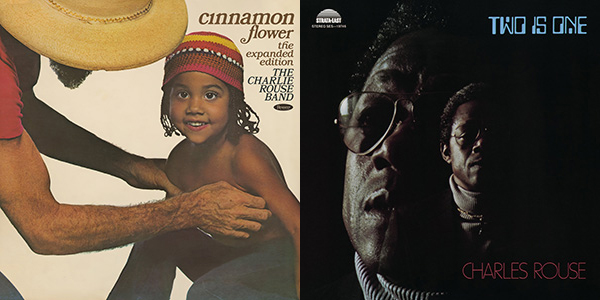
The earliest of the two reissues is Two Is One, Rouse's only record on the Strata-East label, which was first issued in 1974; Strata-East has recently been reinvigorated, issuing new and old music (footnote 1). The other is Cinnamon Flower, from 1976.
On Two Is One, some personnel were familiar, and others were new. Bassist Martin Rivera, who plays on two tracks, was a member of Les Jazz Modes. This is Rouse's only session with Stanley Clarke, who plays bass on the other three tracks. Cellist Calo Scott, guitarist Paul Metzke, drummer David Lee, and percussionists Airto Moreira and Azzedin Weston also make their only appearances in Rouse's discography. This album is unusual in that Rouse himself plays not just tenor sax but also bass clarinet.
This music fits squarely into both the Strata-East aesthetic and the spirit of jazz during the first half of the '70s. Guitars had appeared on some of Rouse's previous albums, though cello is a first. A second guitarist, George Davis, wrote and plays on "Bitchin'" and "In a Funky Way." Lee composed "In His Presence Searching," and Rouse wrote the title track, which is derived from a Monk expression about musical compatibility. The program is filled out by "Hopscotch," a Joe Chambers tune in its first recording; it would later be recorded by Stan Getz and Miles Davis, among others.
Davis's tunes are light-funk excursions, with Rouse floating on the groove. The Chambers and Rouse pieces are driving post-bop, driven by a gooey-sounding Clarke. Closing the album is Lee's outlier: Cello and bass clarinet circle around each other in an early section; later, tenor shuffles over slightly dirgy guitar and walking bass. This long piece closes with guitar and bass solos then a final section of what sounds like medieval court music. Moody and probing, with Rouse switching between horns, "Hopscotch" was named well: It sounds stitched together.
Two years later came the sessions for Cinnamon Flower. Reissued by Resonance Records with new photos, essays (including by original engineer George Klabin, who is a co-owner of the label), and an interview with Rouse's son, Charlie Jr., this album was originally released on Alan Douglas's Douglas Records. Douglas, the producer, added overdubs and effects for extra punch. Cinnamon Flower is available in digital form, on CD, and as a double LP.
Cinnamon Flower, too, is of its era, a period when Latin jazz—here of the Brazilian variety—was popular again. The band was large even before Douglas started overdubbing: Rouse, Clifford Adams (trombone), Claudio Roditi and Waymon Reid (trumpets), Lou Orenstein (flute), Dom Salvador and Albert Dailey (keyboards), Ted Dunbar and George Davis (electric guitar), Amaury Tristão (acoustic guitar), Jesse Levy and Ulysses Kirksey (two cellos!), Wilbur Bascomb and Ron Carter (bass), Portinho and Bernard Purdie (drums), Carlos Martinez and Steve Thornton (percussion), and Roger Powell (string synthesizer). Cinnamon Flower is all about ensemble sound, though Rouse makes the most of his spots, soloing with verve and economy.
Rouse wrote none of the music on Cinnamon Flower. Instead, it came mostly from the pens of Salvador and Amaury—the exception is "Cravo e Canela" by Milton Nascimento—but Rouse's burnished tone on tenor suits the music well whether he's galloping along twisting mountain paths or taking a stroll on a sun-kissed beach. In either mood, this is party music.
In this expanded edition, the original, pre-overdub album, as produced by Klabin in the studio, is heard alongside the original, overdubbed album. The unadulterated version is better of course, both because the overdubs don't improve things and because the tunes are longer, "Cravo e Canela" by almost three minutes. Another bonus track is Salvador's "Meeting House." Why didn't Douglas include it on the original release? The reason died with him in 2014.
Footnote 1: See Robert Baird's July 2025 article on the Strata-East revival here.
Footnote 1: See Robert Baird's July 2025 article on the Strata-East revival here.