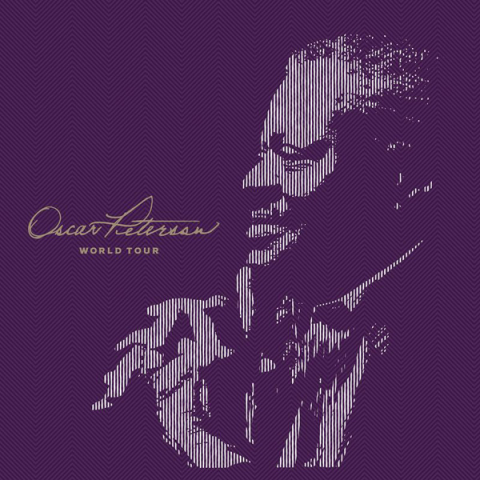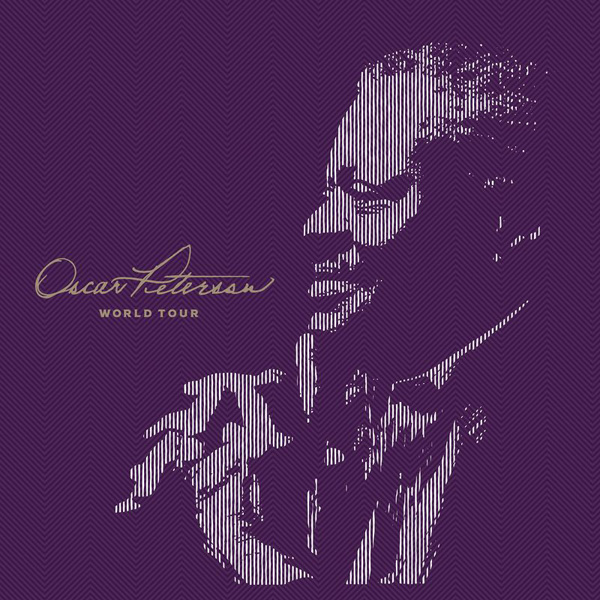
Oscar Peterson was born in 1925. In late 2026, a set titled World Tour was released on the Mack Avenue/Two Lions label. It is advertised as "part of the continued celebration of Peterson's centennial." Consider this article a modest attempt to join the celebration.
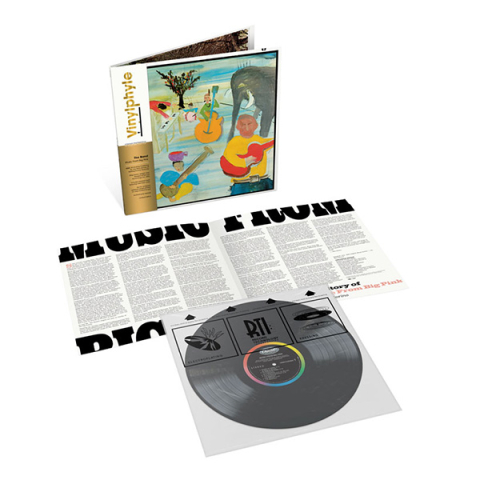
Mack Avenue/Two Lions is a small, specialized imprint that puts out previously unreleased recordings from the Oscar Peterson estate. The label's most ambitious project to date is World Tour, available in six-LP and four-CD sets containing over four hours of music. The title is metaphorical. The collection draws upon performances spanning more than 26 years, from 1969 to 1996. The cities on the "tour" are Basel Auckland, Detroit, Toronto, and São Paulo.
Oscar Peterson is one of the best-documented musicians in the history of jazz. His discography is enormous. Yet World Tour is its own treasure trove. Peterson's body of work is dominated by studio recordings of trios. World Tour offers some stunning solo piano tracks. It provides perspective on the arc of Peterson's late career as a touring artist, performing live for his worldwide fans. It includes appearances by some long-forgotten sidemen. It contains versions of ballads he rarely played, and two unique, extravagant Duke Ellington medleys.
To rave about Peterson's chops is beyond redundant. It feels like everything ever written about him starts with his mind-boggling technique. The earliest concert here is from Basel in 1969. Peterson has so much juice on this November night in Switzerland that almost every song gets lit on fire. His chops spoil you. After a few tracks, you start to lose your awareness of how crazy it is that someone can play the piano that fast. But it is not only about velocity. It is about precise articulation. It is about the ability to fly off, at warp speed, into intricate digressions made of vast runs, chromatic ornamentations, and resounding tremolos, and then fly back again to the main path of improvisation. Even ballads like "My Romance" and "I Concentrate on You" become quick, dense, and hard.
Kelly Peterson, Oscar's widow, is in charge of his estate. She was the curator of this collection. In her touching liner note/memoir, she says, "What Oscar most embodied [was] joy." A lasting benefit of his keyboard mastery was that it enabled him to communicate life-affirming jubilation. Examples are everywhere on World Tour. There are many pieces, like "(Back Home Again in) Indiana," which are introduced by huge, far-flung prologues, outpourings of exuberant brilliance. It is as if Peterson is not ready to be limited by starting the song. There is an epic blazing duet with guitarist Joe Pass in which "Stella by Starlight" loses all claim to being a ballad.
Because Peterson's first instinct was joy, his gift was not to break your heart with ballads, as Bill Evans did. But the slower performances here could be the subject of their own essay. Even when he did not speed up a ballad, his chops sometimes got in the way. Gordon Jenkins's "Goodbye" is one of the starkest, saddest ballads in the American Songbook. Peterson over-decorates it and loses its essence. Still, his ballads usually win you over with the sheer elegance of his phrasing and touch and timing. They feel, in their own way, definitive.
In Basel in 1969, he made the rare decision to play a Jimmy Webb song that was a hit for Glen Campbell. Peterson's rendition of "By the Time I Get to Phoenix" may be the finest ever performed. In New Zealand in 1972, he played, solo, a version of "A Child Is Born" that segued into "Here's That Rainy Day" and became a single interwoven ballad entity that existed by itself, without explanation, outside of time.
In the liner notes for this set, pianist Benny Green says, "To focus ... on [Peterson's] technical virtuosity perpetuates a shallow filter." What is more important, he says, is "Oscar's heart, tremendous soul and mighty everlasting spirit." The two tracks recorded in Brazil in 1996 are testaments to that spirit. Peterson suffered a stroke in 1993, at age 68. He lived 14 more years, and for most of them, he continued to perform and record, even though his left arm and hand were severely impaired. His left hand had been famous for its powerful walking bass lines and its complex chordal variations. After the stroke, it was limited to basic, minimal accompaniment. Bob Rae, a Peterson fan and the Canadian Ambassador to the United Nations, once said, in only a slight exaggeration, "A one-handed Oscar was better than just about anyone else with two hands."
The vinyl edition of World Tour offers a major benefit over the four-CD set. Only the six-LP vinyl edition comes with a lavish 43-page hardcover book. (The CD set has an abridged version in a booklet.) The hardcover book is a fascinating compendium of what Kelly Peterson calls "remnants of a life": Newspaper clippings. Family photos. Concert advertisements. Telegrams. Testimonials and nostalgic reflections from friends and musical associates. Poems by Peterson. Photos by Peterson. (He was a shutterbug who brought a miniature darkroom with him on the road.)
In addition to Kelly's liner note piece, there is a poignant reminiscence from Peterson's daughter Céline. The sharing of personal memories by Kelly and Céline humanizes the great artist that this collection, in its entirety, presents. By gathering in one place the music and all the memorabilia—the "remnants of a life"—Kelly and Céline have assembled their own love letter, to someone who is gone but is not lost, to them or us.