The outputs of the microphones were amplified with solid-state Millennia Media HV-3B preamplifiers, which also supplied the mikes with the necessary 130V. The output of the omnis' preamplifier fed a Manley/ UltraAnalog 20-bit analog/digital converter running at 44.1kHz, and the cardioids' preamplifier fed a dCS 900D 24-bit A/D converter—both via 1m lengths of AudioTruth Lapis x3 balanced interconnect with passive splitters to send a second feed to the 96kHz recording setup. To get the maximal transparency, the mike preamplifiers and A/D converters were placed on stage as close as possible to the microphones; two 50' lengths of Apogee Wyde-Eye AES/EBU cable took the digital data to a Nagra-D four-channel tape recorder in the remote vestry. Because the microphone signals were to be mixed together in post-production, it was important that the A/D converters be sample-synchronized. The Manley ADC therefore served as the master clock for all four channels of data, its second AES/EBU output feeding the dCS converter's word-clock input. Because even a short length of AES/EBU cable can introduce jitter, something that is most deleterious at the analog/digital conversion stage, this clock signal was cleaned up with a Sonic Frontiers UltraJitterbug. Figs.3 and 4 show spectral analyses of the dCS 900D's digital noise floor encoding a high-level 20kHz tone, with the encoder clocked by the Manley via two 1m lengths of AES/EBU cable without and with the UltraJitterbug. I chose a high-level tone at the upper edge of the audio band for this test, as this will be most revealing of jitter-produced errors. Note that the noise floor with the dCS clocked by the Manley via the Sonic Frontiers is lower and cleaner, with less LSB toggling, than when it was clocked by the Manley. Note also the dCS converter's extremely low noise floor, implying resolution better than 20 bits. 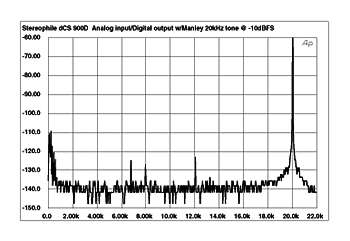 Fig.3 dCS 900D, clocked by Manley ADC, spectrum of 20kHz tone at -10dBFS, DC-22kHz (10dB/vertical div., -60 to -150dBFS, linear frequency scale).
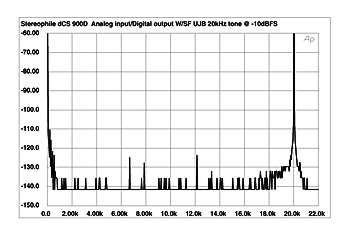 Fig.4 dCS 900D, clocked by Manley ADC via Sonic Frontiers UltraJitterbug, spectrum of 20kHz tone at -10dBFS, DC-22kHz (10dB/vertical div., -60 to -150dBFS, linear frequency scale).
Fig.3 dCS 900D, clocked by Manley ADC, spectrum of 20kHz tone at -10dBFS, DC-22kHz (10dB/vertical div., -60 to -150dBFS, linear frequency scale). Fig.4 dCS 900D, clocked by Manley ADC via Sonic Frontiers UltraJitterbug, spectrum of 20kHz tone at -10dBFS, DC-22kHz (10dB/vertical div., -60 to -150dBFS, linear frequency scale).