"But it's only a PC soundcard," I hear you groan. "What's the big deal?"
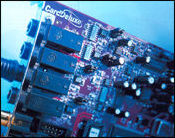 The big deal is that while soundcards—since the very first SoundBlaster—have aimed low with respect to sound quality, and have often failed to reach even that standard, the CardDeluxe (and some other new cards I intend to write about at a later date) represents a no-compromise attitude to computer sound that is worthy of an established high-end audio company. I was impressed with what I saw and heard of a prototype CardDeluxe at an AES Convention a couple of years back, so when Digital Audio Labs contacted me in fall 1999 about a review, I jumped at it.
A DeLuxe Card
The CardDeluxe is a small printed circuit board that plugs into one of a PC's PCI-bus slots. Unlike regular soundcards, it does not offer a MIDI port or FM synthesis. What it does offer are two channels of balanced I/O using TRS (tip-ring-sleeve) ¼" phone jacks, and two channels of S/PDIF digital I/O using RCA jacks. It also offers 24-bit word depth, a sample rate of 96kHz, an optional AES/EBU digital interface adapter ($50), and an extension port to word-sync it with other CardDeluxes so that an inexpensive PC can be used as a high-resolution multi-track digital recorder. Its specifications offer virtually state-of-the-art A/D and D/A conversion, using delta-sigma converter chips from AKM. The fact that the CardDeluxe retails for less than $600 can be explained by the fact that its manufacturer doesn't have to sell you the two most expensive parts of an audio component: the power supply and the chassis.
Installation
The first PC in which I installed the CardDeluxe, a 350MHz Pentium Pro, already had an integral soundcard on its Intel motherboard. The Windows 95 plug-and-play feature made installation straightforward. All I had to do was, when prompted, insert the diskette with the driver software, and select—from the Windows Control Panel's "Multimedia" submenu—the CardDeluxe as the default device for record and replay. But even though the Windows Device Manager reported no interrupt or address conflicts, I occasionally experienced the No Sound Syndrome.
I therefore reinstalled the CardDeluxe in a less-well-specified PC: a Pentium MMX running at 166MHz, which is the minimum computer recommended by Digital Audio Labs (DAL). I upped the RAM to 64MB and added a second, 27GB IDE hard drive that I picked up cheap at Office Max, then a third 10GB SCSI drive. (That you can never have too much hard-drive space has been my experience from the Sonic Solutions audio workstation that I use to edit, mix, and master the Stereophile CDs.) The CardDeluxe proved perfectly reliable in this PC.
The card saves sound files as standard two-channel PCM WAV files. It deals with 24-bit data in the same manner as the Sonic by saving each word as two 16-bit bytes, which is inherently wasteful. (See what I meant by hard-drive space?) And, at the highest sample rate of 96kHz, you're writing data to or reading it from the hard drive at more than 6 megabits/second. This might be too much for older drives.
After using the CardDeluxe for three months, I downloaded from DAL's website upgrades both for the driver software and for the onboard firmware. This was mainly so that I could choose from among four flavors of dither when recording from the analog inputs at word lengths of less than 24 bits. These upgrades went without a hitch.