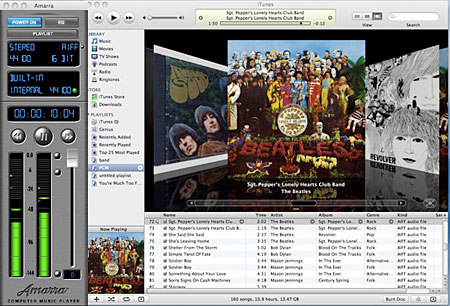
While Amarra does sound very good, it is important to note that Itunes is bit perfect for all resolutions without Amarra. Some might infer from this post that Itunes is not bit perfect, and that is simply not the case.
Sonic Studio Amarra

The company's Jonathan Reichbach was at CES to talk about the most recent release of the program along with its mini version. Both versions bypass Apple's Core Audio for "bit perfect" data straight to your DAC. The full-fledged version of the program runs $995 and enables playback of all resolutions of PCM up to 192kHz while the mini version is available as a single-computer license for $295 or available with an iLok dongle (can be moved around multiple computers one at a time) for $395 and supports up to 96kHz audio.

- Login or register to post comments

In the interests of consumer choice, Amarra is not the only show in town. Channel D's Pure Vinyl features a stand alone high res player using iTunes for file management and play/pause/etc controls.It's a considerably more compact program, plays all resolutions up to 192 kHz, has memory play and optional upsampling (64 bit processing) and sells for $229.

The problem with iTiunes that the Amarra program addresses is that iTunes does not take exclusive control of CoreAuduio. Thus, while it is bit-perfect when playing files that match the format set for the output device in AudioMidi Set-Up, it uses the (not-very-good) real-time Qucktime SRC for files with other sample rates and is thus not bit-perfect. Amarra automatically switches CoreAudio's sample rate to match that of the file selected. In iTunes, you have to exit iTunes, open AudioM idi Setup, reset the playback device parameters, exit AudioMidi Setup, then reopen iTunes. A pain in the proverbial...

John,If I understand you well, Amarra is only useful when playing files with different sample rates to automatically adjust CoreAudio's accordingly. What's the gain if I only have standard res. files (Aiff 44,100/16 bits) ? According to my ongoing initial trial, Amarra also provides some audible improvements on these files. What we wonder is how ?

I can't tell you why, but Amarra sounds considerably better than iTunes or XBMC or Songbird, for that matter, even when the SRC problem is avoided.I've heard talk about better math when converting from fixed point to floating point operation but this is well beyond my area of expertise.

I can't tell you why, but Amarra sounds considerably better than iTunes or XBMC or Songbird, for that matter, even when the SRC problem is avoided.I've heard talk about better math when converting from fixed point to floating point operation but this is well beyond my area of expertise.

Amarra has a new version called Amarra Junior that only handles recordings up to 44.1 res, which I presume should be just fine if all my recording are AIFFs. I tried the demo with a wide variety of music and in every single case it sounded worse than iTunes (!). The sound with Amarra Junior was constricted and flat compared to iTunes.

I downloaded Amarra mini and I keep going back and forth on what I like better. I-tunes or Amarra? Amarra applies some very nice EQ settings, I like the Amarra R&B EQ, but also seems to add high quality filters. I-tunes is more raw and open on my high end system. (Ayer QB9 DAV, McIntosh Tube Pre- and 400w solid state amp.) I like having both, because it depends on the recording. For 24/96 high res files, Itunes works perfectly, and you don’t need Amarra, though I did need Amarra to convert the flac downloads to AIFF 24/96. Took 45 seconds, and the AIFF files turned out perfect, and they will play on my Mac Mini that I use for a music server.

This is an update to my September 9th post. As time has passed, I no longer use I-Tunes at all. Amarra is smoother and nicer sounding than I-Tunes. The “openness” that I heard originally with I-Tunes became irritating over time. (It lead to listening fatigue.) The smoother, more “Tube Like” or “Analog Like” sound of Amarra grew on me, to the point were I no longer liked the sound of I-Tunes. In addition, the R&B Eq setting in Amarra is a perfect match for my system. That said, just to drive myself crazy, I also bought Pure Vinyls Channel D software. As far as I can tell, so far, Amarra sounds MUCH better than Channel D on the MacIntosh 402’s 8 Ohm taps, but Channel D sounds better on the Mac’s 4 Ohm Tap. I also like the fact that Channel D up-samples to 88.2. Currently, I am using Channel D, on the 4 Ohm taps. I really think you need to buy the program that matches your system. If you have an all tube system, Amarra my be too closed in for you. If you have a solid sate system, Amarra may be a perfect match.
- All Headphones Ship Free!
Shop a Huge Selection of Top Quality
Headphones at Great Prices!
www.Headphones.com
| Loudspeakers Amplification Digital Sources | Analog Sources Accessories Featured | Music Columns Features | Show Reports | Show Reports |
Recommended Components Blogs Latest News Community |
Shop Resources Subscriptions |