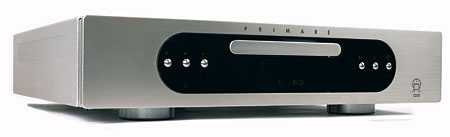
At $2295, the CD31 is the most expensive integrated CD player from Swedish manufacturer Primare, and an evolution of their D30.2, which I reviewed in the June 2004 Stereophile. I knew that the CD31 wasn't a clean-sheet design, but my first look suggested that it wasn't even much of an evolution—a comparison of its and the D30.2's spec sheets matched almost line for line. When I asked Terry Medalen of Sumiko, Primare's US distributor, about the similarity, and if the CD31 was just a mild tweaking of the D30.2, he said, "Well, yes and no. You really need to listen to it."
 So what's the big deal?
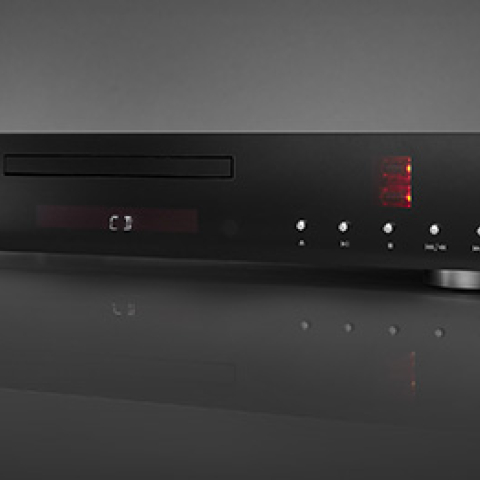
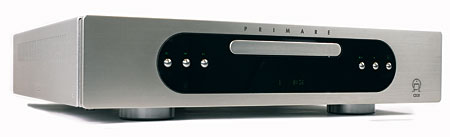
The most obvious change from the Primare D30.2 to the CD31 is visual. The difference isn't dramatic, but enough to make the CD31 look fresh and modern by comparison, with an overall effect that's stereotypically Scandinavian: spare, clean lines, with a rounded glass inset that nicely echoes the rounded knobs and buttons used in all Primare products. The second major difference is under the skin: the CD31 uses a DVS DSL-710A "ultra-silent" transport mechanism instead of the D30.2's stock OEM Sony device. The CD31 also has optical and AES/EBU digital outputs in addition to the Toslink S/PDIF, and replaces the D30.2's Fixed Power switch—which kept that player's analog circuitry warmed up—with a Power switch in the AC cord receptacle. While the CD31 keeps more of its circuitry warmed up than did the D30.2, its front-panel On/Off button, like the earlier player's, toggles between Standby and Operate. The CD31's basic circuitry is much like the D30.2's. The S/PDIF signal moves from the transport to a DIR1703 digital receiver and two Burr-Brown PCM1704-K D/A converters per channel, resulting in a true balanced analog signal. Each component of the signal goes through a Burr-Brown OPA2134 op-amp for voltage-to-current conversion, then finally to the output stage, which uses an active current source to drive matched discrete MOSFETs. According to Medalen, the differences are in the details and optimization, and he suggested I take a close look under the CD31's cover. "We put a lot of effort into the power supply," he said, "adding storage throughout the circuits, and keeping the paths between storage and delivery as short as possible."
Sure enough, the CD31's main circuit board looked like Nebraska farmland, with silo-like clusters of capacitors liberally scattered across the plain—something like 140 caps, according to my casual count. This is in addition to Primare's basic CD-player architecture, in which each circuit block has its own thirteenfold filtered power supply, actively regulated in the case of the analog output stage. Medalen summed it up: "The new transport is much quieter and more stable, so it gives us more information to work with. The circuit and power-supply modifications allow you to use this, and to translate the information into better resolution of subtle nuances."
System—but does it really matter?
Since my review in 2004 of the D30.2, every aspect of my system has changed. I've built a dedicated listening room, brought in gear from Halcro, VTL, and Wilson, and upgraded my analog setup. Along the way, I'd also heard a few truly stellar digital front-ends, SACD as well as CD. On one hand, the CD31 had a great environment in which to shine. On the other, my frame of reference, and hence my standards, has been significantly upgraded in the past three years, and I've become especially attuned to how subtle performance nuances distinguish sublime components from the merely excellent. Listening
I began my serious listening sessions with the Nylons' One Size Fits All (Open Air OD-0301). The CD31 was well balanced and true to the music, and had no distracting quirks or "listen-to-me" audiophile traits. As I'd found with the D30.2, the CD31's tonal balance was slightly warm, though not enough to draw attention to the upper bass and lower midrange. The Nylons, and male vocalists in general, simply had slightly richer timbres, and images— ie, my sense of a chest behind each voice—were more solid and obvious.
Ambience cues, whether real or mixed in, were wonderfully portrayed—another strength that the CD31 shared with its predecessor. In the case of the Nylons disc, the church-like echo surrounding the vocals was rich and thick. On a different disc, Together at the Bluebird Café, with Steve Earle, Townes Van Zandt, and Guy Clark (Snapper Classics SDPCD161), I noticed how well the CD31 made my listening room melt away, leaving the performers and original venue. I've found that the very best digital systems—in particular, SACD setups—do this, but the Primare re-created the recording space in a way and to an extent that usually occurs only with vinyl.
The CD31's natural, vinyl-like feel also showed up in its reproduction of inner detail. The tonal and temporal characteristics that distinguish an individual instrument or voice were clearly identifiable, but not in the audiophile sense of being individually polished and separately displayed. The Primare integrated these nuances into a coherent whole in which the detail wasn't about the audibility of chairs squeaking and people coughing backstage, but about the subtle nuances of a particular musician's style.
So what's the big deal?
The most obvious change from the Primare D30.2 to the CD31 is visual. The difference isn't dramatic, but enough to make the CD31 look fresh and modern by comparison, with an overall effect that's stereotypically Scandinavian: spare, clean lines, with a rounded glass inset that nicely echoes the rounded knobs and buttons used in all Primare products. The second major difference is under the skin: the CD31 uses a DVS DSL-710A "ultra-silent" transport mechanism instead of the D30.2's stock OEM Sony device. The CD31 also has optical and AES/EBU digital outputs in addition to the Toslink S/PDIF, and replaces the D30.2's Fixed Power switch—which kept that player's analog circuitry warmed up—with a Power switch in the AC cord receptacle. While the CD31 keeps more of its circuitry warmed up than did the D30.2, its front-panel On/Off button, like the earlier player's, toggles between Standby and Operate. The CD31's basic circuitry is much like the D30.2's. The S/PDIF signal moves from the transport to a DIR1703 digital receiver and two Burr-Brown PCM1704-K D/A converters per channel, resulting in a true balanced analog signal. Each component of the signal goes through a Burr-Brown OPA2134 op-amp for voltage-to-current conversion, then finally to the output stage, which uses an active current source to drive matched discrete MOSFETs. According to Medalen, the differences are in the details and optimization, and he suggested I take a close look under the CD31's cover. "We put a lot of effort into the power supply," he said, "adding storage throughout the circuits, and keeping the paths between storage and delivery as short as possible."
Since my review in 2004 of the D30.2, every aspect of my system has changed. I've built a dedicated listening room, brought in gear from Halcro, VTL, and Wilson, and upgraded my analog setup. Along the way, I'd also heard a few truly stellar digital front-ends, SACD as well as CD. On one hand, the CD31 had a great environment in which to shine. On the other, my frame of reference, and hence my standards, has been significantly upgraded in the past three years, and I've become especially attuned to how subtle performance nuances distinguish sublime components from the merely excellent. Listening
I began my serious listening sessions with the Nylons' One Size Fits All (Open Air OD-0301). The CD31 was well balanced and true to the music, and had no distracting quirks or "listen-to-me" audiophile traits. As I'd found with the D30.2, the CD31's tonal balance was slightly warm, though not enough to draw attention to the upper bass and lower midrange. The Nylons, and male vocalists in general, simply had slightly richer timbres, and images— ie, my sense of a chest behind each voice—were more solid and obvious.