You've heard it said that the early bird catches the worm, which is all well and good if you like worms. If you're more interested in music, you might want to follow the lead of Roy Gandy instead: He's the managing director of Rega Research, a 331/3-year-old audio company that was the very last of its kind to enter the CD market. Rega's first CD player, the Planet of 1996, was a success in virtually every way.
 The world has moved on since then, for better and for worse: better in the sense that digital sound has continued to improve, worse in the sense that the major corporations with the technology for making integrated digital control systems—the basic servo and data-control chipsets—have shifted their focus toward DVD and away from the humble music-only compact disc. That state of affairs has prompted Gandy and company to tap a different technology source, and to launch an entirely new player: the $995 Rega Apollo.
As Gandy puts it, "If we go back three years, that's when 'the big five' stopped supplying kit to specialist manufacturers. And all of them rely on chipsets or transports or whatever from Sony, Philips, and the rest. Around the same time, CD-player sales were decreasing. So Rega got together with two other specialist manufacturers in the UK, and we eventually found a company near Cambridge that had foreseen this hole in the market, with all the Japanese companies pulling out. They predicted, correctly, that a number of people would continue to want to make boomboxes in China, so they developed their own chipsets, and not just the software."
Gandy can't name the UK company in question—his relationship with them involves a confidentiality agreement—but he says that both they and Rega stand to benefit. "We agreed to work with them at the debugging stage, to help work out various problems—which their Chinese clients are in less [of] a position to do—and in exchange Rega gets to buy chipsets in small quantities."
Small in amount—but hardly small in power. Gandy says that the Apollo incorporates more than 20MB of memory, along with true 32-bit processing capabilities. That's several times the power of early digital control systems, and Gandy suggests that this newer level of technology was needed all along to attain the performance goals set for "Red Book" digital playback in the first place. "This isn't at all like working with the old CD chipsets," he says. "For the first time, we've got a CD operating mechanism that is so good, all we've had to do is avoid messing it up. Now, for example, we can design a better power supply and it makes the player better instead of worse: We don't have to worry that we're taking out something that was masking a flaw."
From puck to chuck
The world has moved on since then, for better and for worse: better in the sense that digital sound has continued to improve, worse in the sense that the major corporations with the technology for making integrated digital control systems—the basic servo and data-control chipsets—have shifted their focus toward DVD and away from the humble music-only compact disc. That state of affairs has prompted Gandy and company to tap a different technology source, and to launch an entirely new player: the $995 Rega Apollo.
As Gandy puts it, "If we go back three years, that's when 'the big five' stopped supplying kit to specialist manufacturers. And all of them rely on chipsets or transports or whatever from Sony, Philips, and the rest. Around the same time, CD-player sales were decreasing. So Rega got together with two other specialist manufacturers in the UK, and we eventually found a company near Cambridge that had foreseen this hole in the market, with all the Japanese companies pulling out. They predicted, correctly, that a number of people would continue to want to make boomboxes in China, so they developed their own chipsets, and not just the software."
Gandy can't name the UK company in question—his relationship with them involves a confidentiality agreement—but he says that both they and Rega stand to benefit. "We agreed to work with them at the debugging stage, to help work out various problems—which their Chinese clients are in less [of] a position to do—and in exchange Rega gets to buy chipsets in small quantities."
Small in amount—but hardly small in power. Gandy says that the Apollo incorporates more than 20MB of memory, along with true 32-bit processing capabilities. That's several times the power of early digital control systems, and Gandy suggests that this newer level of technology was needed all along to attain the performance goals set for "Red Book" digital playback in the first place. "This isn't at all like working with the old CD chipsets," he says. "For the first time, we've got a CD operating mechanism that is so good, all we've had to do is avoid messing it up. Now, for example, we can design a better power supply and it makes the player better instead of worse: We don't have to worry that we're taking out something that was masking a flaw."
From puck to chuck
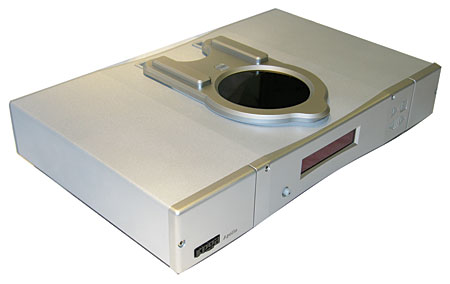
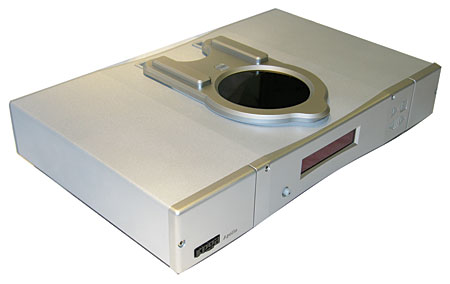
The Apollo is built into the same casework as the Rega Planet, with one key difference: The new player's transport holds the disc with a three-point ball chuck instead of a magnetic puck. That means the motor has less mass to spin, so the disc can accelerate and decelerate with greater ease. It also means that Rega's already elegant transport lid is now a single, undisturbed expanse of smoked Plexiglas—which looks very nice indeed.
The Apollo's transport, manufactured by Sanyo, is compliantly suspended from the upper portion of Rega's standard chassis of cast aluminum alloy. The D/A converter is Wolfson's top-of-the-line WM8740, a dual-differential chip that operates in sigma-delta mode and supports word lengths of up to 24 bits. The output section, which is said to apply class-A amplification to a digital source component in an entirely new way, is Rega's own design.
Apart from all that, the Apollo is a straightforward thing, with a front-mounted board for the logic bits and a single main circuit board for all the rest, fastened to the bottom of the chassis alongside the smallish toroidal mains transformer. RCA and optical digital output jacks are on the rear panel for those who wish to use an outboard DAC, as well as the usual pair of phono jacks for line-level analog output. In addition to the mains switch, the front panel has only the most basic start, stop, and track-advance buttons, while those and a full brace of other user controls appear on the nicely styled remote handset—including a button that can be used to kill the display lights. To jump ahead just a bit: As with the same feature on recent CD players from Naim Audio, that last one really did make an audible difference for the better; all of my comments on sound quality below refer to the Apollo's performance with its display dark.
The world has moved on since then, for better and for worse: better in the sense that digital sound has continued to improve, worse in the sense that the major corporations with the technology for making integrated digital control systems—the basic servo and data-control chipsets—have shifted their focus toward DVD and away from the humble music-only compact disc. That state of affairs has prompted Gandy and company to tap a different technology source, and to launch an entirely new player: the $995 Rega Apollo.
As Gandy puts it, "If we go back three years, that's when 'the big five' stopped supplying kit to specialist manufacturers. And all of them rely on chipsets or transports or whatever from Sony, Philips, and the rest. Around the same time, CD-player sales were decreasing. So Rega got together with two other specialist manufacturers in the UK, and we eventually found a company near Cambridge that had foreseen this hole in the market, with all the Japanese companies pulling out. They predicted, correctly, that a number of people would continue to want to make boomboxes in China, so they developed their own chipsets, and not just the software."
The Apollo is built into the same casework as the Rega Planet, with one key difference: The new player's transport holds the disc with a three-point ball chuck instead of a magnetic puck. That means the motor has less mass to spin, so the disc can accelerate and decelerate with greater ease. It also means that Rega's already elegant transport lid is now a single, undisturbed expanse of smoked Plexiglas—which looks very nice indeed.