It was inevitable that I'd encounter the California Audio Labs CL-15 in my search for a CD player priced less than stratospherically. CAL was one of the first companies to hit the market with a high-end CD player, and they've been building great-sounding digital gear ever since. What's more, the CL-15's predecessor was the Icon PowerBoss Mk.II HDCD, a longtime personal favorite. I was particularly curious to see how the CAL would stack up against today's competition. I've been impressed with CAL products over the years—the original Sigma, the Delta, the DX-1 and 2, and, of course, the Icon. On the other hand, the competition—players like the Rega Planet, Arcam's Alpha 8 and Alpha 9, and Ultech's UCD 100—has improved dramatically since I last heard the Icon.
 What's special?
The CL-15 is the second product to use CAL's current chassis, cosmetics, and configuration, following the CL-10 Multi-Disc Server, reviewed by Robert Harley in the November 1996 Stereophile. The CL-10 and CL-15 are very similar in their overall topology and digital technology, so I'll hit only the high points here and refer the reader to Bob's piece for a detailed description of the '15's inner workings. The CL-10 and CL-15 are both based on the PowerBoss system—the combination of a Pacific Microsonics PMD-100 HDCD decoder/filter, dual colinear 20-bit Burr-Brown PCM1702P DACs, and a series of regulated power supplies. Matsushita supplies both transports, but instead of the CL-10's five-disc carousel, the CL-15 has a thick, single-disc drawer with silky-smooth action. Both players use discrete circuitry in their analog output stages, but the CL-15 adds a number of enhanced performance features. The first is a multilayer glass-epoxy circuit board that results in improved separation of the various circuits and a 4–5dB reduction in the noise floor. Other improvements include the CL-15's much more extensive power supply and regulation, and its true dual-mono construction, which starts with separate power transformers.
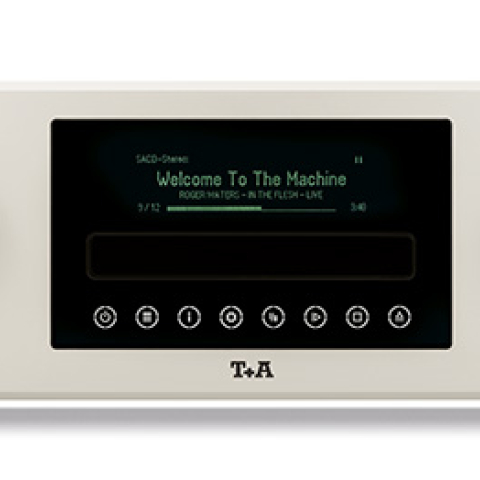
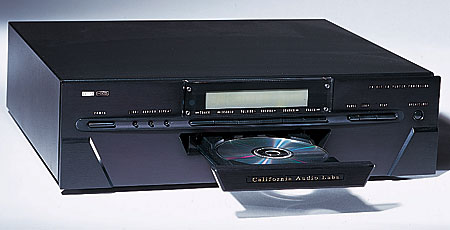
The CL-15's elegant cosmetics also resemble the CL-10's. It's basic black, with a thick, anodized faceplate and BMW-ish black-on-orange backlit LCD display. The faceplate treatment is a little unusual, though, and quite striking. It's softly sculpted with an upside-down trapezoidal motif, which is machined into the faceplate and mirrored in the disc drawer's shape. The faceplate is also slightly larger than the chassis itself, and its inside edge, where it meets the player, has a 1/8" deep by 1/4" wide groove machined into the top and sides, so the panel stands a bit proud from the chassis. Photos don't do it justice; the overall treatment is gorgeous.
The front panel features a thin horizontal row of buttons just below the display that control all of the standard functions—Power, Open/Close, Play, Pause, Stop, Random (shuffle), Track Selection, Search, (Display) Light On/Off, and Repeat—which can be controlled from the remote as well. The unit's rear panel includes the basics: gold-plated RCA jacks for analog out, XLR jacks for the balanced output option, and an IEC receptacle for the removable power cord. The back panel also includes an RS232 interface jack (about which more in a minute) and a coaxial digital port that isn't a digital out, but a 75 ohm S/PDIF input.
CAL refers to the CL-15 as a "CD Player/Processor," referring to its ability to function as a digital processor/preamplifier as well as a standard CD player. The remote's Aux In button toggles between the onboard transport and external digital source, and the volume can be controlled with either the remote or the front-panel buttons. Volume control is implemented in the digital domain, so it doesn't change the analog gain but rather the digital-to-analog scaling. According to CAL, reducing the volume won't result in a loss of resolution as long as the CL-15 is operated in the top two-thirds of its output range, with less than 18dB of attenuation. The CL-15's maximum voltage output can be adjusted from 0V to 3V (2–6V in balanced mode), and it has an output impedance of 50 ohms. Whenever the unit is turned off for more than 15 seconds, the maximum output level reverts to the factory default of 1V (2V balanced).
The CL-15 is priced at $1695 in standard trim. Fully balanced analog stages—actually, a second set of analog stages rather than just a synthesized balanced output—are a $500 option. The CL-15 DMP software adds another $99, bringing the total for a fully loaded CL-15 (like the review unit) to $2294.
Bill Gates is watching
Does your CD player come with software? The CL-15 does: the three-disc CL-15 DMP software package allows a Windows-based PC to operate the unit remotely or change several of its configuration parameters. Again, I refer the reader to Robert Harley's CL-10 review for a full description. Here are the basics: The user can select one of eight dither levels, with the default being "Level 4" (a moderate amount). You can choose 0, 2x, 4x, or 8x oversampling, 8x being the default. The channels can be reversed and the balance between them adjusted—the only way to change balance, by the way. Finally, the default maximum output voltage—the level that the unit reverts to if turned off or unplugged—can be changed from the presets of 1V single-ended and 2V balanced. In all cases, the changes are loaded into an EEPROM, which in turn changes the configuration of the Pacific Microsonics digital filter.
I spoke briefly with CAL's VP of Sales, Bob Altenbern, about the computer interface. When asked "Why?," he responded that, first of all, the interface was intended to facilitate remote operation in an integrated, whole-house automation/entertainment system. "It's a two-way communication system that not only sends configuration information to the player, but sends an on-screen graphical representation of the CL-15 back to the computer." There's actually a nifty on-screen "virtual remote" that can be used to control the CL-15's operation from the computer.
As for the capability to change configuration parameters, Altenbern said that "High-end audio is still a tweak hobby, where the end-user frequently likes to experiment with different combinations and parameters to get the best performance out of a system. These parameters [dither, oversampling] are things we experiment with during product development, and often we don't come to a consensus on the best combination. The interface [for the remote operation] was already there, so we decided to make the parameters available to the customer."
What's special?
The CL-15 is the second product to use CAL's current chassis, cosmetics, and configuration, following the CL-10 Multi-Disc Server, reviewed by Robert Harley in the November 1996 Stereophile. The CL-10 and CL-15 are very similar in their overall topology and digital technology, so I'll hit only the high points here and refer the reader to Bob's piece for a detailed description of the '15's inner workings. The CL-10 and CL-15 are both based on the PowerBoss system—the combination of a Pacific Microsonics PMD-100 HDCD decoder/filter, dual colinear 20-bit Burr-Brown PCM1702P DACs, and a series of regulated power supplies. Matsushita supplies both transports, but instead of the CL-10's five-disc carousel, the CL-15 has a thick, single-disc drawer with silky-smooth action. Both players use discrete circuitry in their analog output stages, but the CL-15 adds a number of enhanced performance features. The first is a multilayer glass-epoxy circuit board that results in improved separation of the various circuits and a 4–5dB reduction in the noise floor. Other improvements include the CL-15's much more extensive power supply and regulation, and its true dual-mono construction, which starts with separate power transformers.
Does your CD player come with software? The CL-15 does: the three-disc CL-15 DMP software package allows a Windows-based PC to operate the unit remotely or change several of its configuration parameters. Again, I refer the reader to Robert Harley's CL-10 review for a full description. Here are the basics: The user can select one of eight dither levels, with the default being "Level 4" (a moderate amount). You can choose 0, 2x, 4x, or 8x oversampling, 8x being the default. The channels can be reversed and the balance between them adjusted—the only way to change balance, by the way. Finally, the default maximum output voltage—the level that the unit reverts to if turned off or unplugged—can be changed from the presets of 1V single-ended and 2V balanced. In all cases, the changes are loaded into an EEPROM, which in turn changes the configuration of the Pacific Microsonics digital filter.