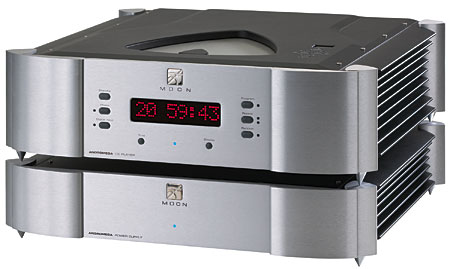
It's easy to be impressed by Simaudio's Moon Evolution Andromeda Reference CD player. Everything about it oozes quality and luxury, from its imposing two-chassis configuration to the multi-component disc clamp of machined aluminum. Even surrounded by my double-decker VTL amps, VPI HR-X turntable, and Ferrari Fly-yellow Wilson Audio Sophia 2 speakers, the Andromeda was usually the first thing guests asked about: "How much does that cost?" The answer is $12,500. The Andromeda should look impressive.
 Skin-deep or through and through?
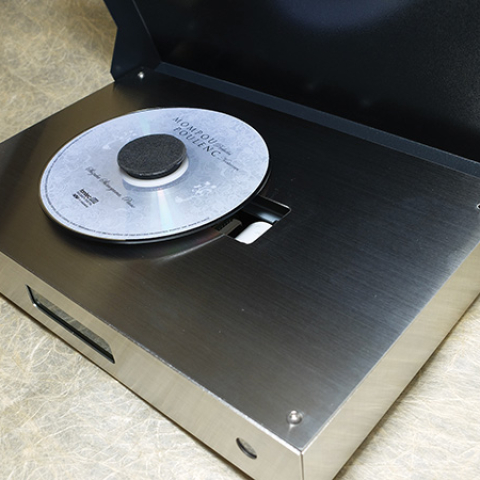
The Andromeda Reference, part of the Moon Evolution series, is Simaudio's flagship CD player. As such, it's a showcase for the company's latest and best technology, and they've gone all out in its execution. The double chassis is a perfect example. Sim began by separating the power supplies for the digital and analog sections, then designed each around an optimized, purpose-built toroidal transformer to minimize thermal, electrical, and magnetic leakage, and loaded them up with copious amounts of capacitor storage. Next, they shielded the transformers from the circuitry, and mechanically isolated the transformers and the circuit boards from each other and within the power-supply chassis. Then, to ensure that any residual power-supply noise was truly isolated from the audio signals, Sim put both supplies in their own chassis. The analog and digital power supplies each has its own umbilical to the CD-player chassis. Even a cursory examination of the Andromeda confirms that this level of design and execution has been maintained throughout. It's a top-loader because such a configuration provides more stability and precision than a drawer-type transport. The mechanical stability is further improved by mounting the Philips CD-Pro 2 M transport assembly in a heavy, isolated subchassis of its own, and still further by floating the subchassis with Sim's proprietary gel-based Delta suspension.
Once the signal is extracted from the CD, it's processed to 24-bit/705.6kHz by a 16x-oversampling Burr-Brown DF-1704 digital filter, then converted by four Burr-Brown 24-bit PCM1704U-K converters to generate a truly balanced signal. These aren't just any Burr-Brown DACs; each chip has been extensively measured and characterized to be part of a matched set of four. To keep jitter as low as possible, the Andromeda uses Sim's Alpha Clocking Circuit, an externally generated, PLL-synchronized clock signal.
The dual-mono, fully balanced signal paths are carried through the analog stages. The circuitry is laid out in symmetrical multiboard sets in which each balanced leg is mirrored by the circuit for the opposite leg, and the left and right channels are kept separate to minimize the possibility of crosstalk. The circuit boards themselves are military-grade, four-layer units with the signal paths on the top and third layers, the ground plane on the second layer, to better isolate the two signal paths, and the power traces on the bottom. The Andromeda's manual claims that its Independent Inductive DC Filtering (I2DCf) power-supply regulation provides "1 inductor for each and every chip (ie, op-amp, DAC, digital filter, etc.) in the audio circuit's signal path—56 stages of regulation in all."
The thorough, thoughtful engineering that has gone into the Andromeda is also evident in its user interfaces. The rear-panel connectors are solid and widely spaced, permitting the use of insanely thick, heavy cables. The front-panel red-LED display, which scrolls through several functions, is large and bright enough to be read from across the room, but can be dimmed to match ambient conditions. I used the player à la carte, but its SimLink inputs allow it to be incorporated into a complete Simaudio system, and its RS-232 connector supports complete two-way communication with an independent system controller. Viewed intimately or from afar, the Moon Evolution Andromeda Reference is one impressive piece of gear.
And when I turned it on . . .
Simaudio was gracious and patient—I was able to use the Andromeda with a wide range of associated equipment, including some of the finest gear available. These components—the VTL TL-7.5 preamplifier and S-400 power amplifier, for example—took my system to a completely new level of transparency and neutrality, and both Stereovox's interconnects and speaker cables and Audience's Adept Response power conditioner removed even more vestigial colorations. When my system was at its best, even the smallest change in setup was plainly audible. I mention this because it was only against this new level of neutrality that I was able to evaluate the Andromeda. Even then, I found it very difficult to consistently hear its contribution to the system's sound. It was harder still to say with any certainty whether I was hearing anomalies in the Andromeda's performance, or residual characteristics elsewhere in my system or room—or even bumping up against the inherent limitations of the "Red Book" CD format. First, the bad news. The Andromeda, even with the best-sounding CDs I own, still didn't have the effortless, natural flow and purity that a good vinyl system produces. Michael Fremer's comment about the Sutherland PhD phono stage having "a freedom from electronic detritus" is an apt if unduly pejorative way of distinguishing high-end vinyl playback from the Andromeda's presentation. Not that there was any obvious detritus, electronic or other, in the Andromeda's sound—it just didn't have the uncanny purity of tone that I find so compelling when listening to my VPI-Lyra-Sutherland LP-playing setup. Nor did the Andromeda sound as coherent or as, well, analog-like as some of the megabuck SACD players I've heard playing good SACDs. More bad news, at least for people in my tax bracket, is the price. $12,500 isn't out of line in a world of $100,000 speaker systems and $40,000 amplifiers, and the Andromeda is appropriately lavish in build quality and attention to detail. In my world, however, such a sum is more likely to be earmarked for the kids' tuition or a horse trailer for Trish than for a CD player—we can't do it all. Everyone's checkbook balances differently, but it can't be ignored that dynamite-sounding, reasonably priced players such as the Primare CD31 ($2295), which I reviewed in the July issue, set the bar pretty high for a model that costs more than five times as much.
Everything else about the Andromeda and its tenure in my system was good news. Actually, it was all great news. The Andromeda was excellent, superb, fantastic, exquisite, and incredible—pick your superlative, and I'm sure I can find it sprinkled liberally throughout my listening notes. How was the Sim's bass performance? It was powerful, articulate, and deep. The top end was delicate, shimmering, and airy—or crisp, clean and crystalline, depending on the situation. It was whatever it needed to be, no more and no less. And as for the Andromeda's ambience retrieval, detail resolution, and temporal precision, they were all superb—or, if you prefer, they were excellent, fantastic, incredible. You get the idea.
Skin-deep or through and through?
The Andromeda Reference, part of the Moon Evolution series, is Simaudio's flagship CD player. As such, it's a showcase for the company's latest and best technology, and they've gone all out in its execution. The double chassis is a perfect example. Sim began by separating the power supplies for the digital and analog sections, then designed each around an optimized, purpose-built toroidal transformer to minimize thermal, electrical, and magnetic leakage, and loaded them up with copious amounts of capacitor storage. Next, they shielded the transformers from the circuitry, and mechanically isolated the transformers and the circuit boards from each other and within the power-supply chassis. Then, to ensure that any residual power-supply noise was truly isolated from the audio signals, Sim put both supplies in their own chassis. The analog and digital power supplies each has its own umbilical to the CD-player chassis. Even a cursory examination of the Andromeda confirms that this level of design and execution has been maintained throughout. It's a top-loader because such a configuration provides more stability and precision than a drawer-type transport. The mechanical stability is further improved by mounting the Philips CD-Pro 2 M transport assembly in a heavy, isolated subchassis of its own, and still further by floating the subchassis with Sim's proprietary gel-based Delta suspension.
Simaudio was gracious and patient—I was able to use the Andromeda with a wide range of associated equipment, including some of the finest gear available. These components—the VTL TL-7.5 preamplifier and S-400 power amplifier, for example—took my system to a completely new level of transparency and neutrality, and both Stereovox's interconnects and speaker cables and Audience's Adept Response power conditioner removed even more vestigial colorations. When my system was at its best, even the smallest change in setup was plainly audible. I mention this because it was only against this new level of neutrality that I was able to evaluate the Andromeda. Even then, I found it very difficult to consistently hear its contribution to the system's sound. It was harder still to say with any certainty whether I was hearing anomalies in the Andromeda's performance, or residual characteristics elsewhere in my system or room—or even bumping up against the inherent limitations of the "Red Book" CD format. First, the bad news. The Andromeda, even with the best-sounding CDs I own, still didn't have the effortless, natural flow and purity that a good vinyl system produces. Michael Fremer's comment about the Sutherland PhD phono stage having "a freedom from electronic detritus" is an apt if unduly pejorative way of distinguishing high-end vinyl playback from the Andromeda's presentation. Not that there was any obvious detritus, electronic or other, in the Andromeda's sound—it just didn't have the uncanny purity of tone that I find so compelling when listening to my VPI-Lyra-Sutherland LP-playing setup. Nor did the Andromeda sound as coherent or as, well, analog-like as some of the megabuck SACD players I've heard playing good SACDs. More bad news, at least for people in my tax bracket, is the price. $12,500 isn't out of line in a world of $100,000 speaker systems and $40,000 amplifiers, and the Andromeda is appropriately lavish in build quality and attention to detail. In my world, however, such a sum is more likely to be earmarked for the kids' tuition or a horse trailer for Trish than for a CD player—we can't do it all. Everyone's checkbook balances differently, but it can't be ignored that dynamite-sounding, reasonably priced players such as the Primare CD31 ($2295), which I reviewed in the July issue, set the bar pretty high for a model that costs more than five times as much.