After two decades of motorcycling, I recently achieved a long-held goal by buying a bike built by Bimota, a tiny Italian manufacturer. Although Bimota engages in a wide range of activities, from two-stroke engine design to racing, they're best known for their exotic, hand-built street bikes. They always include the very best components and feature cutting-edge engineering and performance, but what they're truly revered for is their style. Bimotas unfailingly combine shapes, textures, and finishes into motorcycles that are most often referred to as "works of art."
A Question of Style
If there's a manufacturer in high-end audio whose products might be thought of in this way, it's the Canadian company Oracle. Anyone who was around in 1981 when Oracle's LP turntable was introduced no doubt recalls the stir caused by its audacious beauty. In a world of sedate, veneered boxes, it was a lightning bolt—a turntable stripped to its essence and industrially futuristic in its obvious functionality, yet executed with an eye toward detail, finish, proportion, and...well, style. The resulted was a device of staggering beauty. No one who saw an Oracle turntable was left untouched.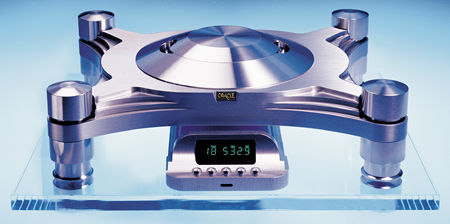 The two decades since then have brought dizzying progress and technological advance, and the High End has seen a plethora of bold, aggressive designs ranging from the sublime to the silly. None, however, has been as out-of-the-box gorgeous as the original Oracle turntable, nor as exquisite. None, that is, until Oracle's CD transport and visually identical CD player.
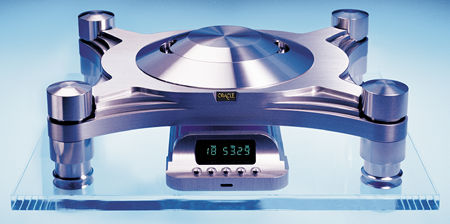
When Oracle's transport debuted at the 1998 WCES, it was 1981 all over again: Jaws dropped, crowds gathered, and breathless word of its beauty spread like wildfire. It was probably the most photographed piece at that show, but photos don't do it justice, and a verbal description doesn't come close. Imagine something that's equal thirds Buck Rogers, James Bond, and MoMA, with an attention to detail and fit'n'finish that scream exquisite hand-craftsmanship.
But is Beauty Only Skin-Deep?
The two decades since then have brought dizzying progress and technological advance, and the High End has seen a plethora of bold, aggressive designs ranging from the sublime to the silly. None, however, has been as out-of-the-box gorgeous as the original Oracle turntable, nor as exquisite. None, that is, until Oracle's CD transport and visually identical CD player.
When Oracle's transport debuted at the 1998 WCES, it was 1981 all over again: Jaws dropped, crowds gathered, and breathless word of its beauty spread like wildfire. It was probably the most photographed piece at that show, but photos don't do it justice, and a verbal description doesn't come close. Imagine something that's equal thirds Buck Rogers, James Bond, and MoMA, with an attention to detail and fit'n'finish that scream exquisite hand-craftsmanship.
But is Beauty Only Skin-Deep?
Under the lid, inside the pod—wherever you look, the quality of the Oracle's components match the lavish style of its exterior. The outboard power supply, for example, is an unusually hefty unit, designed so that "each major element will have its own dedicated primary and secondary electrical supply," according to Oracle's literature. What this means is that AC is heavily filtered and run through a single, large EI-cored transformer, off of which are split separate supplies for the transport/control system, the D/A conversion board, and the analog output stage. Each supply contains additional filtering—quite extensive in the case of the D/A and analog sections—and is fed from its own transformer secondary. The transformer is potted and suspended to damp vibrations, and shielded to prevent cross-contamination from electromagnetic fields. The power supply's case is designed to provide further EM shielding, and to protect the entire supply from external fields. It connects to the main unit via a 15-pin computer-type connector and cable, and to the wall via a standard, removable AC cord. In the main unit, disc spinning and reading are performed by a Philips CD-PRO mechanism, modified by Oracle and internally damped and suspended. In fact, Oracle is emphatic that the player's configuration and appearance are as much about controlling vibrations as they are about style. Oracle uses a combination of a magnetic clamp and elastomer damping compound to hold the CD firmly in place and damp any vibrations generated by the transport mechanism itself.
Visually stunning as it is, the main chassis is actually designed to maximize mass and rigidity while minimizing surface area, and hence reduce the player's susceptibility to airborne vibrations. But even if such vibrations manage to pierce the Oracle's surface, they still have to run a gauntlet of mechanical filters—carefully constructed combinations of milled aluminum and nylon, Delrin, and urethane—between there and the drive assembly.
In our house at least, vibrations are less likely to be airborne than structural—the result of four dogs racing to greet guests or to chase a neighborhood cat. Oracle's got this covered as well. The main chassis is suspended atop its Plexiglas plinth by four pillars similar to those used in Oracle's turntables, which combine multiple springs, dampers, and elastomers to form seven mechanical filtering steps, these tuned to block vibrations in overlapping frequency regimes from 5Hz up.
Componentry on the electrical side is likewise first-rate. Internal connections use an I2S bus and the D/A circuitry is built around Crystal Logic's CS4390 24-bit delta-sigma chipset. Oracle were apparently involved in a three-year effort to finalize the design and fine-tune the parameters. Speed and signal purity were high priorities; Oracle claims a 0.1µs risetime for the analog circuitry and the ability to handle a 430kHz squarewave.
Analog filtering is used to eliminate any remaining quantization "residues," and balanced analog circuitry adds common-mode rejection to further clean things up. The analog stage is simple in design and uses no global feedback. It is executed with top-quality bits, all the way out to the Cardas rhodium-plated RCA jacks.
Setup
Like everything else about the Oracle, setup and use are a bit unusual. Rather than a simple unboxing, plunking down, and plugging in, the process is more reminiscent of setting up an analog turntable, and involves assembly and adjustment of the four spring-suspension towers. It's not difficult or complicated, just different. The player comes elaborately and thoughtfully packaged, and the manual is wonderfully concise and descriptive, with photos and detailed explanations exactly where they're needed. The Oracle's user interface is similarly unusual, yet once you've been through it, it makes sense; it's simple, intuitive, and even kind of elegant. The CD player is a top-loader, but rather than a sliding or hinged lid, there's a cover that's simply lifted off to expose the transport well. The cover is a heavy piece of machined aluminum damped on its underside, lusciously crafted and finished, and machined to exactly match the contours of the surrounding chassis.
Once the cover is removed, the CD is set on the spindle and held in place by a magnetic clamp—also of beautifully machined aluminum. The clamp's underside is faced with a soft, sticky, elastomeric compound that further holds and damps the disc. Insert the disc, clamp it down, replace the cover, and...now what? That's where the five unlabeled buttons on the pod's front panel, just under the readout, come into play. Push the one on the left and the Oracle wakes up and initializes the disc. The next four are obvious: track forward, track backward, play, and stop.
Oracle also includes an all-too-ordinary, full-function remote—the sort of cheesy, zillion-buttoned plastic unit you'd get with a $100 discount-store player. It's astounding that a unit as special and as costly as the Oracle, on which so much effort, quality, and style have been expended, completely ignores the most important user interface. This CD player deserves something with more élan—perhaps something like Sonic Frontiers' nifty disc, or at least a heavy, elegantly machined unit like the ones supplied by SimAudio and Mark Levinson. The Oracle's remote works just fine, but stylistically it's a letdown.
Readers of fine print will probably have noticed that I've listed two serial numbers. Shortly after the initial unit was shipped, Oracle discovered that a slight modification to the analog circuitry—essentially the bypass of a few coupling capacitors—while slightly degrading measured performance, resulted in a more open, three-dimensional sound. I agreed, and used the modified unit for the remainder of the review.
If there's a manufacturer in high-end audio whose products might be thought of in this way, it's the Canadian company Oracle. Anyone who was around in 1981 when Oracle's LP turntable was introduced no doubt recalls the stir caused by its audacious beauty. In a world of sedate, veneered boxes, it was a lightning bolt—a turntable stripped to its essence and industrially futuristic in its obvious functionality, yet executed with an eye toward detail, finish, proportion, and...well, style. The resulted was a device of staggering beauty. No one who saw an Oracle turntable was left untouched.
The two decades since then have brought dizzying progress and technological advance, and the High End has seen a plethora of bold, aggressive designs ranging from the sublime to the silly. None, however, has been as out-of-the-box gorgeous as the original Oracle turntable, nor as exquisite. None, that is, until Oracle's CD transport and visually identical CD player.
Under the lid, inside the pod—wherever you look, the quality of the Oracle's components match the lavish style of its exterior. The outboard power supply, for example, is an unusually hefty unit, designed so that "each major element will have its own dedicated primary and secondary electrical supply," according to Oracle's literature. What this means is that AC is heavily filtered and run through a single, large EI-cored transformer, off of which are split separate supplies for the transport/control system, the D/A conversion board, and the analog output stage. Each supply contains additional filtering—quite extensive in the case of the D/A and analog sections—and is fed from its own transformer secondary. The transformer is potted and suspended to damp vibrations, and shielded to prevent cross-contamination from electromagnetic fields. The power supply's case is designed to provide further EM shielding, and to protect the entire supply from external fields. It connects to the main unit via a 15-pin computer-type connector and cable, and to the wall via a standard, removable AC cord. In the main unit, disc spinning and reading are performed by a Philips CD-PRO mechanism, modified by Oracle and internally damped and suspended. In fact, Oracle is emphatic that the player's configuration and appearance are as much about controlling vibrations as they are about style. Oracle uses a combination of a magnetic clamp and elastomer damping compound to hold the CD firmly in place and damp any vibrations generated by the transport mechanism itself.
Like everything else about the Oracle, setup and use are a bit unusual. Rather than a simple unboxing, plunking down, and plugging in, the process is more reminiscent of setting up an analog turntable, and involves assembly and adjustment of the four spring-suspension towers. It's not difficult or complicated, just different. The player comes elaborately and thoughtfully packaged, and the manual is wonderfully concise and descriptive, with photos and detailed explanations exactly where they're needed. The Oracle's user interface is similarly unusual, yet once you've been through it, it makes sense; it's simple, intuitive, and even kind of elegant. The CD player is a top-loader, but rather than a sliding or hinged lid, there's a cover that's simply lifted off to expose the transport well. The cover is a heavy piece of machined aluminum damped on its underside, lusciously crafted and finished, and machined to exactly match the contours of the surrounding chassis.