Taken together, these unusual interconnect, loudspeaker, and AC cables brought a new measure of spaciousness, scale, smoothness, heretofore unimagined detail, and overall musical ease and naturalness to my music system. And they did it while sounding neither dull nor bright—just right.
 I start with that observation not in an effort to be cute, but as a good-natured warning to ill-natured skeptics: Unless you're open to the idea that such a thing is possible, the 2300 words that follow will be little more than nonsense, howsoever differently I intend them.
There's more: From the moment JPS Labs offered to loan me these review samples, right up through the bulk of my listening and note-taking, I didn't know how much they cost. Of course I assumed they weren't cheap, given that designer Joe Skubinski described the Aluminatas, in genuinely excited tones, as his best ever. But it never dawned on me that a 1m interconnect pair, for example, would retail for $2999. And when I did look at the Aluminata portion of JPS Labs' price list, I shifted uncomfortably in my seat.
Description
I start with that observation not in an effort to be cute, but as a good-natured warning to ill-natured skeptics: Unless you're open to the idea that such a thing is possible, the 2300 words that follow will be little more than nonsense, howsoever differently I intend them.
There's more: From the moment JPS Labs offered to loan me these review samples, right up through the bulk of my listening and note-taking, I didn't know how much they cost. Of course I assumed they weren't cheap, given that designer Joe Skubinski described the Aluminatas, in genuinely excited tones, as his best ever. But it never dawned on me that a 1m interconnect pair, for example, would retail for $2999. And when I did look at the Aluminata portion of JPS Labs' price list, I shifted uncomfortably in my seat.
Description
Just as Audio Note has its silver wire and Cardas its golden ratio, JPS has a calling card of its own: a proprietary conductor material called Alumiloy. Nominal appearances aside, pure aluminum is not the main ingredient of Alumiloy—although it plays a role, and may well give the finished product some of its signature strengths. Aluminum is low in density, nonmagnetic, and highly malleable. It also conducts electricity well, being surpassed in that regard only by the usual suspects: copper, gold, and silver. But the greatest distinction of JPS's Aluminata line lies beyond its choice of conductors, in a realm where aluminum does play a decisive role. As Joe Skubinski sees it, the main challenge faced by a connecting cable of low reactance and resistance, where conductor mass and configuration are already appropriate to the current being passed, is that of outside interference. So he developed a cable shield to end all cable shields: Skubinski surrounded his insulated conductor cores with a thick blanket of granulated aluminum, densely packed and held in place with a polymer jacket. The result, called a Particle Aluminum Shield or PAS, is more flexible than a solid tube, yet many times thicker than a braided shield, with the potential for vastly better RFI and EMI shielding than any other practical solution—and a few that aren't. That wasn't quite enough: Surrounding an electrical conductor with a metal tube and separating the two with a dielectric creates a crude sort of capacitor, with high-frequency AC finding a fairly easy route from the former to the latter. For the tube to function as a shield within an electrical system, it must be grounded at one end: common practice, in any event. Unfortunately, as Skubinski says, RFI sees that connection to ground as an impedance: Noise picked up by the antenna-like shield is dispersed through the system, and little of that energy actually makes its way to the electrical ground.
Skubinski wanted to make a cable that could itself absorb and dispense with any RFI and EMI energy, so he came up with an interesting variation on grounding the shield: He added a length of absorptive material—the precise substance remains undisclosed—between that thick layer of aluminum particles and the ground reference point of each Aluminata cable, which follows a conductive path to the ground. For the Aluminata interconnects, the ground point is at the source end; for the speaker cables, it's at the amplifier end; and for the AC cords, the ground path is at the same end as the wall receptacle.
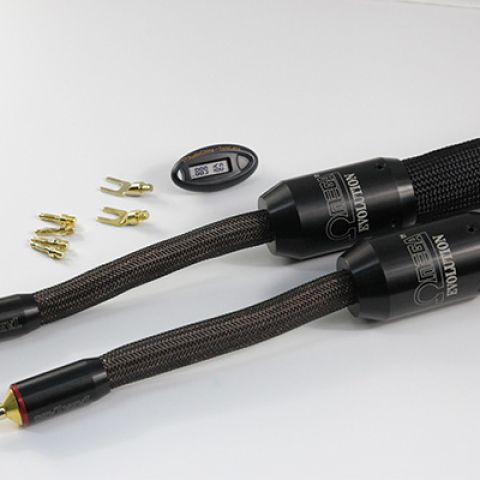
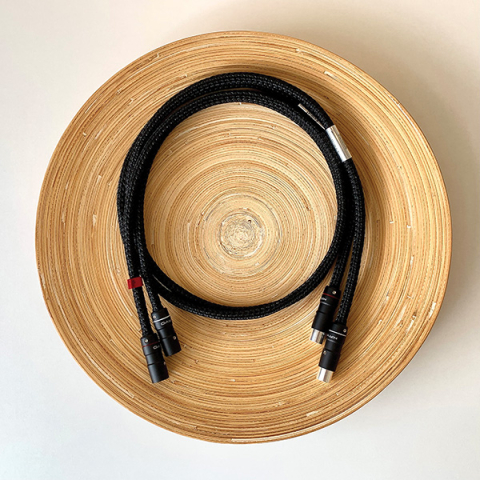
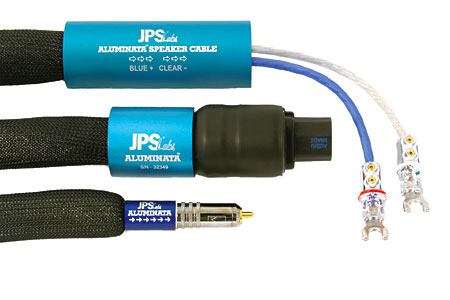
Apart from their common approach to shielding, the three types of Aluminata cable I tried are built with different conductor sizes and configurations—not to mention their obviously different terminations. Aluminata interconnect begins life as a quartet of 15-gauge solid-core Alumiloy conductors, insulated with the flexible polyimide Kapton and terminated with WBT locking phono plugs. Aluminata AC has three 8-gauge alloy conductors, also insulated with Kapton, and uses a Wattgate plug and IEC connector, both with gold-plated contacts. JPS's largest Alumiloy conductors are reserved for the Aluminata speaker cable: a twisted pair of 5-gauge solid-core, insulated by hand—using cotton gloves, so skin oils won't be left behind on the otherwise clean alloy surfaces. The 6" leads at the ends of the Aluminata speaker cables are 8-gauge stranded alloy wires insulated with Teflon. Those leads are crimped and soldered to the 5-gauge Alumiloy conductors inside the cable structure itself, and are terminated with the buyer's choice of WBT spade lugs or locking banana plugs. Crimped connections on all JPS Aluminata cables are made and remade several times before the cable is finished—a prudent move, given the tendency of certain alloys to expand and contract with greater ease than others. Only lead-free solders are used.
Installation and setup
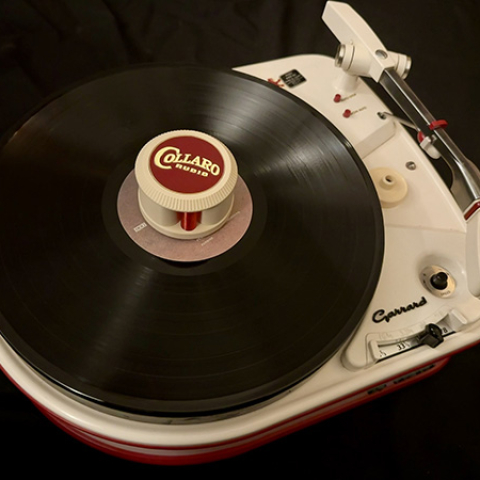
I tried the Aluminata cables, both individually and as a more or less complete connection rig (minus the tonearm lead and various remaining AC cords), in my main system: Linn LP12 record player and Sony SCD-777 SACD player, Artemis and Lamm preamplifiers, Quad and Lamm amplifiers, and Quad ESL loudspeakers.
All of the Aluminata cables were at least somewhat unwieldy: Bending them to a radius much smaller than 6" took more coaxing than usual, although they were far from the stiffest I've used. The more severe challenge was posed by the cables' substantial weight: The granulated aluminum shielding alone adds over a pound to every meter of stereo interconnect, and even more to the speaker cables and AC cords. Taken as a whole, the 1m Aluminata interconnect pair weighed approximately 2.5 lbs, and a single Aluminata AC weighed over 5 lbs. By comparison, a Quad monoblock amplifier weighs about 16 lbs.
I start with that observation not in an effort to be cute, but as a good-natured warning to ill-natured skeptics: Unless you're open to the idea that such a thing is possible, the 2300 words that follow will be little more than nonsense, howsoever differently I intend them.
There's more: From the moment JPS Labs offered to loan me these review samples, right up through the bulk of my listening and note-taking, I didn't know how much they cost. Of course I assumed they weren't cheap, given that designer Joe Skubinski described the Aluminatas, in genuinely excited tones, as his best ever. But it never dawned on me that a 1m interconnect pair, for example, would retail for $2999. And when I did look at the Aluminata portion of JPS Labs' price list, I shifted uncomfortably in my seat.
Just as Audio Note has its silver wire and Cardas its golden ratio, JPS has a calling card of its own: a proprietary conductor material called Alumiloy. Nominal appearances aside, pure aluminum is not the main ingredient of Alumiloy—although it plays a role, and may well give the finished product some of its signature strengths. Aluminum is low in density, nonmagnetic, and highly malleable. It also conducts electricity well, being surpassed in that regard only by the usual suspects: copper, gold, and silver. But the greatest distinction of JPS's Aluminata line lies beyond its choice of conductors, in a realm where aluminum does play a decisive role. As Joe Skubinski sees it, the main challenge faced by a connecting cable of low reactance and resistance, where conductor mass and configuration are already appropriate to the current being passed, is that of outside interference. So he developed a cable shield to end all cable shields: Skubinski surrounded his insulated conductor cores with a thick blanket of granulated aluminum, densely packed and held in place with a polymer jacket. The result, called a Particle Aluminum Shield or PAS, is more flexible than a solid tube, yet many times thicker than a braided shield, with the potential for vastly better RFI and EMI shielding than any other practical solution—and a few that aren't. That wasn't quite enough: Surrounding an electrical conductor with a metal tube and separating the two with a dielectric creates a crude sort of capacitor, with high-frequency AC finding a fairly easy route from the former to the latter. For the tube to function as a shield within an electrical system, it must be grounded at one end: common practice, in any event. Unfortunately, as Skubinski says, RFI sees that connection to ground as an impedance: Noise picked up by the antenna-like shield is dispersed through the system, and little of that energy actually makes its way to the electrical ground.
I tried the Aluminata cables, both individually and as a more or less complete connection rig (minus the tonearm lead and various remaining AC cords), in my main system: Linn LP12 record player and Sony SCD-777 SACD player, Artemis and Lamm preamplifiers, Quad and Lamm amplifiers, and Quad ESL loudspeakers.