It's not unusual for a high-end audio company to originate in another segment of the high-tech electronics world, but it is a bit unusual when the spin-off is a cable company. That's the case with Empirical Audio, whose founder, Steve Nugent, spent 25 years as a digital hardware designer for Unisys and Intel. The key is that, in addition to standard design work, he chased "the more esoteric sides of design, namely grounding, shielding, ESD (electrostatic discharge), EMI (electromagnetic interference), transmission-line effects, and power delivery." Voilà—cable design.
 Empirical Audio is a small Mom & Pop operation with a very small number of extremely loyal dealers; mainly, they operate primarily via their website. Their products are painstakingly hand-made, one at a time. On the plus side, this gives you overall excellence, as well as attention to such details as including a data sheet that lists measurements made of your specific cables. On the minus side, the products' fit, finish, and packaging, while more than adequate, are not as impressive as, say, Monster Cable's.
Discussing cable theory with Nugent made my head spin, but here are the basics. Minimizing capacitance was a major goal for the interconnects, so Empirical uses Bare Wire Technology, which eliminates any sort of coating on the solid-silver conductors and minimizes the extent to which they contact a dielectric. The leads are widely spaced as well, and wound in a proprietary geometry designed to minimize parallelism between the conductors.
In contrast to the interconnects, Empirical designed their speaker cables for minimum inductance (footnote 1) via "a geometry that achieves inductive coupling . . . which allows the inductance to be very low without the conductors being very large." The Clarity-7 has seven pairs of silver-plated OFC conductors, for a total cross-section equivalent to 11 gauge, as well as Empirical's Bare Wire Technology. Other aspects of the Clarity-7's construction that Empirical touts include both physical and electromagnetic damping, and an unusual 5"-long twisted pigtail—an "anti-resonance damping termination"—on each end.
Empirical Audio is a small Mom & Pop operation with a very small number of extremely loyal dealers; mainly, they operate primarily via their website. Their products are painstakingly hand-made, one at a time. On the plus side, this gives you overall excellence, as well as attention to such details as including a data sheet that lists measurements made of your specific cables. On the minus side, the products' fit, finish, and packaging, while more than adequate, are not as impressive as, say, Monster Cable's.
Discussing cable theory with Nugent made my head spin, but here are the basics. Minimizing capacitance was a major goal for the interconnects, so Empirical uses Bare Wire Technology, which eliminates any sort of coating on the solid-silver conductors and minimizes the extent to which they contact a dielectric. The leads are widely spaced as well, and wound in a proprietary geometry designed to minimize parallelism between the conductors.
In contrast to the interconnects, Empirical designed their speaker cables for minimum inductance (footnote 1) via "a geometry that achieves inductive coupling . . . which allows the inductance to be very low without the conductors being very large." The Clarity-7 has seven pairs of silver-plated OFC conductors, for a total cross-section equivalent to 11 gauge, as well as Empirical's Bare Wire Technology. Other aspects of the Clarity-7's construction that Empirical touts include both physical and electromagnetic damping, and an unusual 5"-long twisted pigtail—an "anti-resonance damping termination"—on each end.
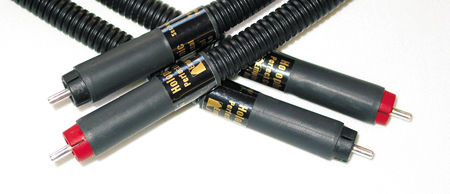 Each Empirical cable's data sheet compares that specific cable's measured parameters with specifications. For example, a 1m length of Holophonic-PC has capacitance and inductance specs of 15pF and 1.2µH, respectively; my units measured 13.5pF and 1.1µH for SN 87, and 13.3pF and 1.1µH for SN 86. For reference, Nordost reports values of around 70pF and 0.17µH for 1m of their superb Valhalla interconnect. Although the Clarity-7 speaker cables shift the emphasis from low capacitance to low inductance, their specifications, and the measured parameters of the review cables, were also very low.
Measurements, schmeasurements—how do they sound?
Each Empirical cable's data sheet compares that specific cable's measured parameters with specifications. For example, a 1m length of Holophonic-PC has capacitance and inductance specs of 15pF and 1.2µH, respectively; my units measured 13.5pF and 1.1µH for SN 87, and 13.3pF and 1.1µH for SN 86. For reference, Nordost reports values of around 70pF and 0.17µH for 1m of their superb Valhalla interconnect. Although the Clarity-7 speaker cables shift the emphasis from low capacitance to low inductance, their specifications, and the measured parameters of the review cables, were also very low.
Measurements, schmeasurements—how do they sound?
Empirical's product literature cautioned that my initial reaction to their cables might be "that the body is missing from the music" because other cables "have a lot of phase distortion . . . that fills in the empty spaces between the instruments and vocalists." The instructions went on to explain that I needed to give myself time—several months—to get used to the cables, to fully appreciate and understand their more accurate portrayal.
This sounded like pretty standard PR rhetoric, but after spending almost a year with the Empiricals, I had to admit that there was some truth to it. I was underwhelmed with the Empiricals at first; indeed, there seemed to be some life and pizzazz missing from the music. After using the Holophonic and Clarity wires exclusively for about three months, however, a strange thing happened when I swapped my original wires back in. Rather than boosting the system's performance, adding life and strengthening the musical connection, just the opposite occurred. What had once seemed like excitement and electricity in the performance and a lifelike energy in the ambience now felt artificial, like a superimposed grittiness.
Instrumental tones seemed purer and more direct with the Empiricals. The warm woodiness of Franz Helmerson's cello on Bach's Solo Suite 2 (LP, BIS LP-65) was a great example, as was the exquisite detailing within the pulsating overtones coming off of Diego Blanco's guitar after he raps it with his knuckles during his performance of Ponce's Folias de Espaa: 20 Variations & Fugue (LP, BIS LP-33).
 Similarly, I initially thought that the Empiricals' detail resolution didn't match that of the other cables I have reviewed in recent issues. The Empirical cables were less obvious, less "you are there" spectacular, but I ended up concluding that their understated revelation of low-level subtleties was the more accurate.
The Empiricals' soundstage wasn't noticeably different from that of other cables, but they did a good job of opening up the area between the images. They didn't have the sharply defined image edges that typically wow me because of the definition and solidity they gave the players, but because of the clarity between the players, as well as of the space surrounding the orchestra—the overall sonic picture seemed more realistic.
As I did my reviewer duty, dissecting the Empiricals' sound, I found myself checking item after item. Tight, clean bass—check. Huge dynamic swings, articulate microdynamic shadings, nicely tangible images—check, check, check. Extended airy highs—check (though maybe not quite as airy as some I've heard). They did it all.
I did most of my listening to the Empirical cables as a system: the 1m Holophonic-PCs between turntable and preamp, the 5m XPCs running from preamp to amp, the Clarity-7s feeding my Thiel CS6 speakers. I mixed 'n' matched to try to sort out any differences, but they were very slight. The Clarity-7s seemed to have slightly less effect than the Holophonics.
Summary
Similarly, I initially thought that the Empiricals' detail resolution didn't match that of the other cables I have reviewed in recent issues. The Empirical cables were less obvious, less "you are there" spectacular, but I ended up concluding that their understated revelation of low-level subtleties was the more accurate.
The Empiricals' soundstage wasn't noticeably different from that of other cables, but they did a good job of opening up the area between the images. They didn't have the sharply defined image edges that typically wow me because of the definition and solidity they gave the players, but because of the clarity between the players, as well as of the space surrounding the orchestra—the overall sonic picture seemed more realistic.
As I did my reviewer duty, dissecting the Empiricals' sound, I found myself checking item after item. Tight, clean bass—check. Huge dynamic swings, articulate microdynamic shadings, nicely tangible images—check, check, check. Extended airy highs—check (though maybe not quite as airy as some I've heard). They did it all.
I did most of my listening to the Empirical cables as a system: the 1m Holophonic-PCs between turntable and preamp, the 5m XPCs running from preamp to amp, the Clarity-7s feeding my Thiel CS6 speakers. I mixed 'n' matched to try to sort out any differences, but they were very slight. The Clarity-7s seemed to have slightly less effect than the Holophonics.
Summary
I heartily recommend giving the Empirical Audio Holophonic interconnects and Clarity speaker cables a try. Empirical offers an unconditional 30-day, money-back guarantee, and while these cables do take some time to appreciate, a month should long enough to decide if they're for you. At $1512/pair for 8' speaker cables and $570–$630/pair for 1m interconnects, they're neither particularly inexpensive nor insanely expensive. What they are is very, very good—and well worth a listen.
Footnote 1: It is a fact of life that minimum capacitance and minimum inductance are mutally exclusive goals for a cable designer. —John Atkinson
Empirical Audio is a small Mom & Pop operation with a very small number of extremely loyal dealers; mainly, they operate primarily via their website. Their products are painstakingly hand-made, one at a time. On the plus side, this gives you overall excellence, as well as attention to such details as including a data sheet that lists measurements made of your specific cables. On the minus side, the products' fit, finish, and packaging, while more than adequate, are not as impressive as, say, Monster Cable's.
Discussing cable theory with Nugent made my head spin, but here are the basics. Minimizing capacitance was a major goal for the interconnects, so Empirical uses Bare Wire Technology, which eliminates any sort of coating on the solid-silver conductors and minimizes the extent to which they contact a dielectric. The leads are widely spaced as well, and wound in a proprietary geometry designed to minimize parallelism between the conductors.
Each Empirical cable's data sheet compares that specific cable's measured parameters with specifications. For example, a 1m length of Holophonic-PC has capacitance and inductance specs of 15pF and 1.2µH, respectively; my units measured 13.5pF and 1.1µH for SN 87, and 13.3pF and 1.1µH for SN 86. For reference, Nordost reports values of around 70pF and 0.17µH for 1m of their superb Valhalla interconnect. Although the Clarity-7 speaker cables shift the emphasis from low capacitance to low inductance, their specifications, and the measured parameters of the review cables, were also very low.
Measurements, schmeasurements—how do they sound?
Empirical's product literature cautioned that my initial reaction to their cables might be "that the body is missing from the music" because other cables "have a lot of phase distortion . . . that fills in the empty spaces between the instruments and vocalists." The instructions went on to explain that I needed to give myself time—several months—to get used to the cables, to fully appreciate and understand their more accurate portrayal.
Similarly, I initially thought that the Empiricals' detail resolution didn't match that of the other cables I have reviewed in recent issues. The Empirical cables were less obvious, less "you are there" spectacular, but I ended up concluding that their understated revelation of low-level subtleties was the more accurate.
I heartily recommend giving the Empirical Audio Holophonic interconnects and Clarity speaker cables a try. Empirical offers an unconditional 30-day, money-back guarantee, and while these cables do take some time to appreciate, a month should long enough to decide if they're for you. At $1512/pair for 8' speaker cables and $570–$630/pair for 1m interconnects, they're neither particularly inexpensive nor insanely expensive. What they are is very, very good—and well worth a listen.
Footnote 1: It is a fact of life that minimum capacitance and minimum inductance are mutally exclusive goals for a cable designer. —John Atkinson