NAD has been out there on the leading edge of entry-level high-end sound long enough that some audiophiles reckon they invented the category. Sure, we should give serious props to the likes of Creek, Rotel, Musical Fidelity, Arcam, Denon, and Parasound, all of which have made significant contributions to the musical aspirations of budget-conscious pilgrims. But I continue to harbor warm feelings about my last extended visit with an NAD component: the inexpensive yet supremely musical L40 CD Receiver, which I reviewed in the June 2000 Stereophile. 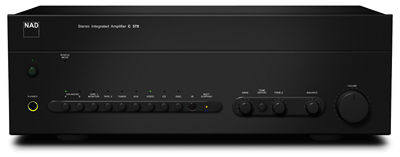 The new C370 was designed to function as the cost-effective centerpiece of a quality component system. This full-featured, remote-controlled integrated amplifier offers a multiplicity of performance features, and the flexibility to evolve as your system grows. Compared with the earlier 317, NAD has therefore upped the 8-ohm power from 80Wpc to the C370's 120Wpc, increased the number of line inputs to seven (plus two tape in/outs with dubbing capabilities), and lowered the price from $749 to $699. From the far left on the black front panel are a headphone jack and a number of tiny buttons with green illumination to indicate source modes and functions; on the right are a non-intrusive set of treble and bass controls (±6dB at 100Hz and 10kHz, with a tone defeat switch), a balance control, and an illuminated, motorized volume pot.
On the rear panel are a large bank of RCA inputs, two sets of speaker outs, an NAD link (for remote control of associated NAD gear), a 12V trigger out (for remote activation of ancillary equipment also equipped with a 12V trigger), a hardwired power cord, and a single switched AC outlet. The most interesting features on the C370's rear are the pre-out/main-in sockets (normally linked with jumpers), which allow one to employ an external preamp or power amp. An additional pre-out section with its own volume control offers attenuation of the output level from 0 to 12dB, for gain matching with another power amp. Finally, Soft Clipping and bridge-mode switches correspond to illuminated indicators on the front panel. Soft Clipping, a trademarked NAD circuit, allows users to maximize gain and dynamics when driving the C370 extra-hard, the tradeoff being enhanced headroom Bridging the C370 in mono lets you drive a single loudspeaker with roughly 300W into 8 ohms, while pre-out 2 allows the addition of a second power amp (such as the precisely gain-matched NAD C270, which duplicates the C370's power section) in bridged mode or as part of a horizontal biamp configuration. As with the VTL combo of IT-85 integrated and ST-85 power amp I reviewed last February, the flexibility of adding a second amp (the C270 costs $599) means that the C370 won't suddenly become obsolete if you decide to upgrade speakers or move to a bigger room. A nice touch. Among the C370's more intriguing new design features are its Impedance Sensing Circuit, or ISC (patent pending), for its power-amp section. "This automatically adjusts the power supply of the C370 for maximum voltage or maximum current, depending on the speaker load seen by the output stage," explained Greg Stidsen, NAD's director of product planning. "Most moderately priced electronics run out of current early when presented with less than 8 ohms speaker impedance. They look good on the spec sheet, but they've got no balls. The C370 offers 120W continuous power into 8 or 4 ohms. But music demands short bursts of power, not a continuous drone. This is where the ISC gets interesting: IHF dynamic power (10ms toneburst) is 210W into 8 ohms, 340W into 4 ohms, and 450W into 2 ohms.
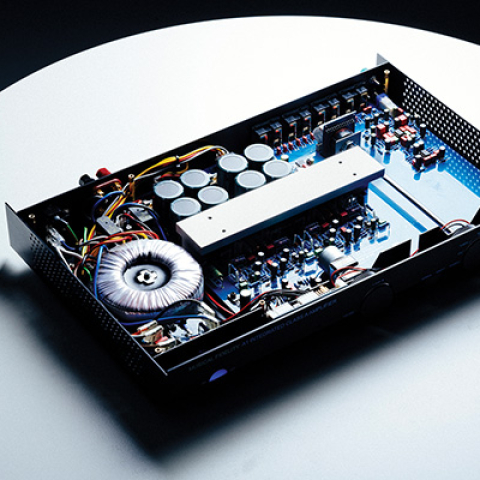
"The power supply of the C370 features a nice, big toroidal transformer, and the signal path employs very short signal routing, aided by switching inputs via relays (rather than sound-coloring CMOS transistors) and star grounding for lowest possible noise. Speaker switching is also via relay, which has the nice convenience benefit of activation via IR remote. We use lots of premium-quality parts—like 1% metal-film resistors and 2% film capacitors—where they make a difference in sound. The preamp and power-amp driver stages use NAD's own discrete class-A amplifier modules—high-current, low-impedance gain devices that contribute significantly to the excellent sound quality."
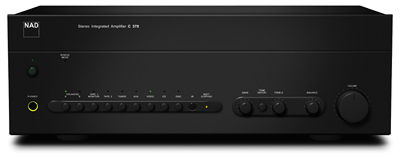
The new C370 was designed to function as the cost-effective centerpiece of a quality component system. This full-featured, remote-controlled integrated amplifier offers a multiplicity of performance features, and the flexibility to evolve as your system grows. Compared with the earlier 317, NAD has therefore upped the 8-ohm power from 80Wpc to the C370's 120Wpc, increased the number of line inputs to seven (plus two tape in/outs with dubbing capabilities), and lowered the price from $749 to $699. From the far left on the black front panel are a headphone jack and a number of tiny buttons with green illumination to indicate source modes and functions; on the right are a non-intrusive set of treble and bass controls (±6dB at 100Hz and 10kHz, with a tone defeat switch), a balance control, and an illuminated, motorized volume pot.
On the rear panel are a large bank of RCA inputs, two sets of speaker outs, an NAD link (for remote control of associated NAD gear), a 12V trigger out (for remote activation of ancillary equipment also equipped with a 12V trigger), a hardwired power cord, and a single switched AC outlet. The most interesting features on the C370's rear are the pre-out/main-in sockets (normally linked with jumpers), which allow one to employ an external preamp or power amp. An additional pre-out section with its own volume control offers attenuation of the output level from 0 to 12dB, for gain matching with another power amp. Finally, Soft Clipping and bridge-mode switches correspond to illuminated indicators on the front panel. Soft Clipping, a trademarked NAD circuit, allows users to maximize gain and dynamics when driving the C370 extra-hard, the tradeoff being enhanced headroom Bridging the C370 in mono lets you drive a single loudspeaker with roughly 300W into 8 ohms, while pre-out 2 allows the addition of a second power amp (such as the precisely gain-matched NAD C270, which duplicates the C370's power section) in bridged mode or as part of a horizontal biamp configuration. As with the VTL combo of IT-85 integrated and ST-85 power amp I reviewed last February, the flexibility of adding a second amp (the C270 costs $599) means that the C370 won't suddenly become obsolete if you decide to upgrade speakers or move to a bigger room. A nice touch. Among the C370's more intriguing new design features are its Impedance Sensing Circuit, or ISC (patent pending), for its power-amp section. "This automatically adjusts the power supply of the C370 for maximum voltage or maximum current, depending on the speaker load seen by the output stage," explained Greg Stidsen, NAD's director of product planning. "Most moderately priced electronics run out of current early when presented with less than 8 ohms speaker impedance. They look good on the spec sheet, but they've got no balls. The C370 offers 120W continuous power into 8 or 4 ohms. But music demands short bursts of power, not a continuous drone. This is where the ISC gets interesting: IHF dynamic power (10ms toneburst) is 210W into 8 ohms, 340W into 4 ohms, and 450W into 2 ohms.
"The power supply of the C370 features a nice, big toroidal transformer, and the signal path employs very short signal routing, aided by switching inputs via relays (rather than sound-coloring CMOS transistors) and star grounding for lowest possible noise. Speaker switching is also via relay, which has the nice convenience benefit of activation via IR remote. We use lots of premium-quality parts—like 1% metal-film resistors and 2% film capacitors—where they make a difference in sound. The preamp and power-amp driver stages use NAD's own discrete class-A amplifier modules—high-current, low-impedance gain devices that contribute significantly to the excellent sound quality."
The new C370 was designed to function as the cost-effective centerpiece of a quality component system. This full-featured, remote-controlled integrated amplifier offers a multiplicity of performance features, and the flexibility to evolve as your system grows. Compared with the earlier 317, NAD has therefore upped the 8-ohm power from 80Wpc to the C370's 120Wpc, increased the number of line inputs to seven (plus two tape in/outs with dubbing capabilities), and lowered the price from $749 to $699. From the far left on the black front panel are a headphone jack and a number of tiny buttons with green illumination to indicate source modes and functions; on the right are a non-intrusive set of treble and bass controls (±6dB at 100Hz and 10kHz, with a tone defeat switch), a balance control, and an illuminated, motorized volume pot.