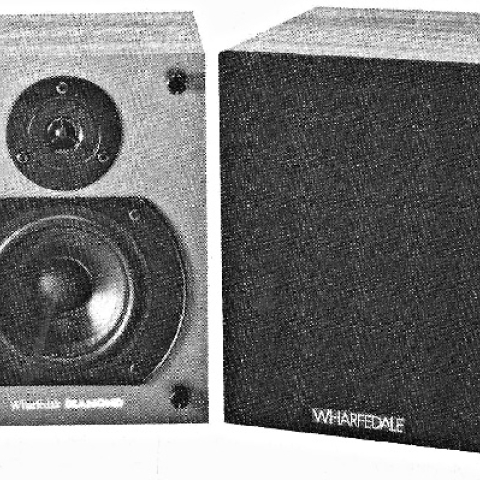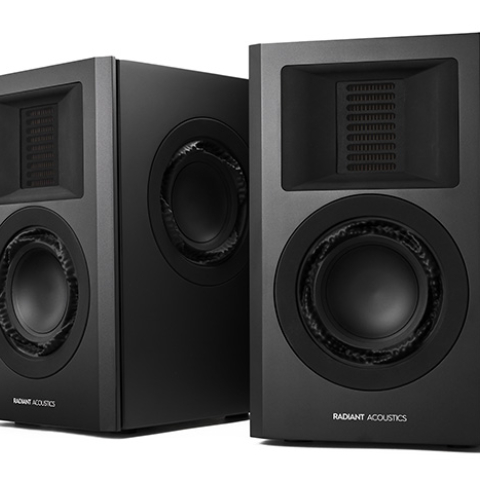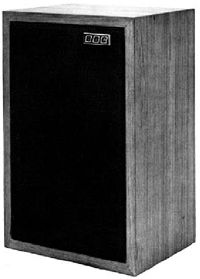
These diminutive little sleepers have been available in the US for quite some time but have attracted little attention because (1) they have never really been promoted and (2) they are just too small to look as if they could be worth $430 a pair.  Originally designed by the BBC for monitoring of on-location broadcast and recording pickups (footnote 1), they hide most of their cost—a complex equalizer and phase-corrected crossover network—inside a cabinet only slightly larger than a shoe box. They were intended for "close-in" listening in a small control room rather than to fill a large room, and they will definitely not put the kind of levels beloved of rock nuts without woofer-bottoming or ultimately permanent damage. Despite what must be a rather large amount of built-in bass boost (to compensate for the small size of the woofer), they are fairly efficient: We would estimate around 1¾%, which is comparable to an average acoustic-suspension system (footnote 2). Maximum safe output level is around 95dB SPL (sound pressure level) at a listening distance of up to 15', which is about as loud as a symphonic crescendo from 10' behind the conductor. This is with full-range program material; the limiting factor on power input is the "woofer" (because of its bass boost), so when the speakers are used with a subwoofer (crossing at 60 to 80Hz), they are capable of a clean 100 to 105dB, which is enough to give any masochist a most gratifying case of permanent ear damage. Judging by their size, one's first thought is likely to be that these will work just dandy up on the wall, right below the ceiling and toward the room corners, where standing-wave resonances in the room will help augment the speakers' thin bass. But their size is very deceptive. These are not thin-sounding. In fact, they produce an overall balance similar to that of a pair of large systems when they (the Rogers) are located on 30"-high stands, right out near the center of the floor. (This bass-balance design is consistent with the BBC's recent research findings which showed that the smoothest bass response is obtained when a speaker is as far as possible from room boundaries.)
It is because these speakers are so well-balanced when they are out in the room that they may well produce too much bass when placed against a wall, particularly when located near the junction between three room surfaces. In corners, they are (in most rooms) intolerably boomy because they are designed for out-of-corner placement, and because that location excites the maximum number and amplitude of standing-wave resonances (footnote 3) in the room. The close proximity of room surfaces (or, worse yet, of a box or shelf under the speakers) also causes diffraction interference—the chopping of deep holes in the frequency response due to selective cancellation of certain frequencies. The smaller the speaker enclosure, the less audible are these diffraction effects and the smoother the system sounds. But nearby corners and surfaces can spoil the advantage of the small enclosure. Another advantage of a small sound source is that it tends to radiate sound waves as expanding spheres rather than as a planar wave (as from large screens). Human ears react in a seemingly paradoxical manner to a spherical sound field: The reproduced sound seems, much bigger than its source, yet the angular localization of sounds across the "stage" between the speakers (ie, the imaging) is dramatically improved. In fact, the apparent audible size of these tiny speakers is almost laughable; we had the feeling that it just could not possibly be.
Adding to the illusion of a large speaker system, is the remarkable low-end performance, which is not really all that deep (subjectively flat to a bit below 57Hz in our rooms) but sounds deeper than it is because the response is actually pretty flat down to there (rather than drooping), and the bass detail is astonishing from 5" woofers. The speakers gave such a startling account of themselves at the low end that we were not acutely aware of the lack of deep bottom until deeper notes (as from bass drum or the bottom range of the string bass) that we knew were on the recording failed to come through. High-end performance is quite remark able. The speakers have a very slightly rising response above about 5kHz (fig.1), but because there is no audible peak at the top, the rise does not cause any sizzling or spitting, but tends rather to exaggerate slightly the extreme high-end energy in the program, adding a bit more sibilance to voices, a bit more shimmer to cymbals, and a bit more overall airiness to the sound than is actually in the program material.
Originally designed by the BBC for monitoring of on-location broadcast and recording pickups (footnote 1), they hide most of their cost—a complex equalizer and phase-corrected crossover network—inside a cabinet only slightly larger than a shoe box. They were intended for "close-in" listening in a small control room rather than to fill a large room, and they will definitely not put the kind of levels beloved of rock nuts without woofer-bottoming or ultimately permanent damage. Despite what must be a rather large amount of built-in bass boost (to compensate for the small size of the woofer), they are fairly efficient: We would estimate around 1¾%, which is comparable to an average acoustic-suspension system (footnote 2). Maximum safe output level is around 95dB SPL (sound pressure level) at a listening distance of up to 15', which is about as loud as a symphonic crescendo from 10' behind the conductor. This is with full-range program material; the limiting factor on power input is the "woofer" (because of its bass boost), so when the speakers are used with a subwoofer (crossing at 60 to 80Hz), they are capable of a clean 100 to 105dB, which is enough to give any masochist a most gratifying case of permanent ear damage. Judging by their size, one's first thought is likely to be that these will work just dandy up on the wall, right below the ceiling and toward the room corners, where standing-wave resonances in the room will help augment the speakers' thin bass. But their size is very deceptive. These are not thin-sounding. In fact, they produce an overall balance similar to that of a pair of large systems when they (the Rogers) are located on 30"-high stands, right out near the center of the floor. (This bass-balance design is consistent with the BBC's recent research findings which showed that the smoothest bass response is obtained when a speaker is as far as possible from room boundaries.)
It is because these speakers are so well-balanced when they are out in the room that they may well produce too much bass when placed against a wall, particularly when located near the junction between three room surfaces. In corners, they are (in most rooms) intolerably boomy because they are designed for out-of-corner placement, and because that location excites the maximum number and amplitude of standing-wave resonances (footnote 3) in the room. The close proximity of room surfaces (or, worse yet, of a box or shelf under the speakers) also causes diffraction interference—the chopping of deep holes in the frequency response due to selective cancellation of certain frequencies. The smaller the speaker enclosure, the less audible are these diffraction effects and the smoother the system sounds. But nearby corners and surfaces can spoil the advantage of the small enclosure. Another advantage of a small sound source is that it tends to radiate sound waves as expanding spheres rather than as a planar wave (as from large screens). Human ears react in a seemingly paradoxical manner to a spherical sound field: The reproduced sound seems, much bigger than its source, yet the angular localization of sounds across the "stage" between the speakers (ie, the imaging) is dramatically improved. In fact, the apparent audible size of these tiny speakers is almost laughable; we had the feeling that it just could not possibly be.
Adding to the illusion of a large speaker system, is the remarkable low-end performance, which is not really all that deep (subjectively flat to a bit below 57Hz in our rooms) but sounds deeper than it is because the response is actually pretty flat down to there (rather than drooping), and the bass detail is astonishing from 5" woofers. The speakers gave such a startling account of themselves at the low end that we were not acutely aware of the lack of deep bottom until deeper notes (as from bass drum or the bottom range of the string bass) that we knew were on the recording failed to come through. High-end performance is quite remark able. The speakers have a very slightly rising response above about 5kHz (fig.1), but because there is no audible peak at the top, the rise does not cause any sizzling or spitting, but tends rather to exaggerate slightly the extreme high-end energy in the program, adding a bit more sibilance to voices, a bit more shimmer to cymbals, and a bit more overall airiness to the sound than is actually in the program material.
Footnote 1: American visitors to England consistently report that the BBC transmits superb-quality sound and that unlike the US (where practically everything aired is canned), Britons are privileged to hear frequent live broadcasts of orchestra concerts. It is thus reasonable to assume that the BBC engineers know good sound when they hear it.
Footnote 2: This efficiency means that a power input of 1W produces an acoustic output power of 17.5mW. However, as measuring acoustic power is very difficult, whereas sound pressure level in dB (the acoustic equivalent of voltage) at one point in space is straightforward. I believe 82.5dB/2.83V/m was the BBC's original specification for the LS3/5a.—John Atkinson Footnote 3: A standing wave occurs when a sound wave travels to one room surface and back again in exact synchronism with the reproduced frequency, causing an energy buildup (a response peak) between the surfaces.
Originally designed by the BBC for monitoring of on-location broadcast and recording pickups (footnote 1), they hide most of their cost—a complex equalizer and phase-corrected crossover network—inside a cabinet only slightly larger than a shoe box. They were intended for "close-in" listening in a small control room rather than to fill a large room, and they will definitely not put the kind of levels beloved of rock nuts without woofer-bottoming or ultimately permanent damage. Despite what must be a rather large amount of built-in bass boost (to compensate for the small size of the woofer), they are fairly efficient: We would estimate around 1¾%, which is comparable to an average acoustic-suspension system (footnote 2). Maximum safe output level is around 95dB SPL (sound pressure level) at a listening distance of up to 15', which is about as loud as a symphonic crescendo from 10' behind the conductor. This is with full-range program material; the limiting factor on power input is the "woofer" (because of its bass boost), so when the speakers are used with a subwoofer (crossing at 60 to 80Hz), they are capable of a clean 100 to 105dB, which is enough to give any masochist a most gratifying case of permanent ear damage. Judging by their size, one's first thought is likely to be that these will work just dandy up on the wall, right below the ceiling and toward the room corners, where standing-wave resonances in the room will help augment the speakers' thin bass. But their size is very deceptive. These are not thin-sounding. In fact, they produce an overall balance similar to that of a pair of large systems when they (the Rogers) are located on 30"-high stands, right out near the center of the floor. (This bass-balance design is consistent with the BBC's recent research findings which showed that the smoothest bass response is obtained when a speaker is as far as possible from room boundaries.) Footnote 1: American visitors to England consistently report that the BBC transmits superb-quality sound and that unlike the US (where practically everything aired is canned), Britons are privileged to hear frequent live broadcasts of orchestra concerts. It is thus reasonable to assume that the BBC engineers know good sound when they hear it.