In nearly 25 years, it's been rare that I've reviewed an exciting breakthrough product. The Audioengine 2 is such a product—not because it performs at an extraordinary level (though it does), and not because it's such an incredible value for money (though it is), but because it creates a new market, a new application for high-end audio, and a chance for audiophiles to enjoy music in ways they may have never considered before.
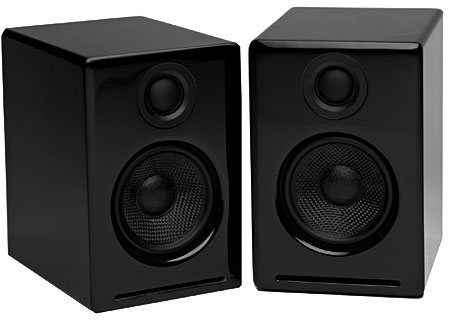
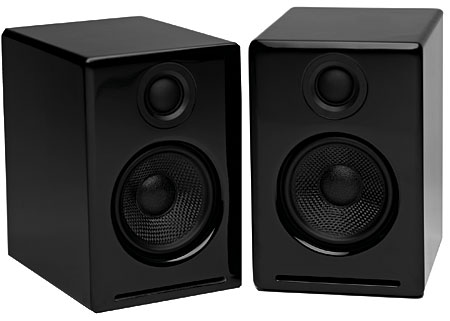 The Audioengine 2 is a powered bookshelf speaker—not a new type of product per se for the California-based company, which for years has sold the Audioengine 5 ($350/pair), a powered bookshelf speaker designed for larger rooms. Audioengine founders Brady Bargenquast and Don Evans came up with the idea for the 2 after becoming frustrated with the low quality of many computer speakers in the market. What he's done to create the 2—which is designed for use on desktops and in offices and bedrooms—is put the 5's silk-dome tweeter and a smaller woofer in a much smaller cabinet, for $199/pair.
Design
The Audioengine 2 is a powered bookshelf speaker—not a new type of product per se for the California-based company, which for years has sold the Audioengine 5 ($350/pair), a powered bookshelf speaker designed for larger rooms. Audioengine founders Brady Bargenquast and Don Evans came up with the idea for the 2 after becoming frustrated with the low quality of many computer speakers in the market. What he's done to create the 2—which is designed for use on desktops and in offices and bedrooms—is put the 5's silk-dome tweeter and a smaller woofer in a much smaller cabinet, for $199/pair.
Design
I look at the Audioengine 2's technical specifications and scratch my head. How can the company sell this speaker for $199/pair? All drivers, transformers, magnets, and wiring harnesses are custom-made to Audioengine's specs—they're not off-the-shelf parts. The 2 has a 20mm silk-dome tweeter with a neodymium magnet and a 2.75" woofer of Kevlar woven-glass aramid composite with a rubber surround. The 2 has a front port under the woofer and is shielded for video applications, and is rugged enough that Audioengine decided to dispense with a grille altogether.
The amplifier is a 15Wpc dual class-AB monolithic analog type, mounted vertically in the left speaker for maximum protection from mechanical shock. Audioengine claims that the amplifier's gapless-core toroidal transformer has a smaller radiated magnetic field, with the result being lower noise. The left speaker has dual RCA and miniplug inputs; each speaker has a pair of five-way binding posts for a single cable to connect the right speaker to the amp in the left.
The Audioengine 2 comes with accessories—two pairs of interconnects (miniplug) in lengths of 6.5' and 8", a 2m run of speaker cable, and an external power supply—all packaged in attractive cloth drawstring bags. The shipping box serves as a carrying case. The speaker is sold factory-direct, but also via a regular dealer network; it comes with a 30-day money-back guarantee if purchased on-line. The speakers are available in glossy black or white. I found the colors equally sexy; the black reminded me of an attractive Wilson Audio or NHT design, and the white was a perfect match for my Apple iPod.
I reviewed the Audioengine 2 as I do all bookshelf speakers, using my Celestion Si stands loaded with sand and lead shot, and comparing it with several entry-level bookshelf speakers. Rather than the included wires, I used a pair of Monster Interlink Reference A interconnects and a single run of MIT's MITerminator 5 speaker cable. In addition to my CD and analog front-ends, I used an 80GB iPod loaded with Apple Lossless versions of CDs from my collection. But I had even more fun experimenting with the many different ways I used the Audioengine 2 to create a high-end audio experience in places I hadn't thought it possible before.
Sound
What can you expect from a speaker costing $199/pair, including amplifier, that you can hold in the palm of your hand? I tried to forget the Audioengine 2's size and price and just listen to the music. First, in my affordable reference system, with every tune I played, I heard no noticeable coloration throughout the speaker's entire range; it was as neutral-sounding as any under-$1000 speaker I've heard. The highs were extended and detailed, and the Audioengine 2 was able to recreate room ambience and low-level dynamic articulation at levels of quality I'm used to hearing from far more expensive speakers. What shocked me most about the Audioengines was how LARGE they sounded. All vocal recordings were completely devoid of coloration, and vocal images were holographically projected at lifelike size with all low-level phrase articulations intact. Mighty Sam McClain's delicate, guttural growl on Give It Up to Love (CD, JVC JVCXR-0012-2) was reproduced with the requisite chestiness, richness, and vibrancy. On the female end of the vocal spectrum, Sequentia's disc of Hildegard von Bingen's Canticles of Ecstasy (CD, Deutsche Harmonia Mundi 05472 77320 2) caused me to note: "glorious, shimmering vocals, holographic in space, wide and deep hall sound of the Kln Cathedral."
The Audioengine's rich midrange capabilities induced me to mine my jazz-piano recordings. Tord Gustavsen's introspective, space-filled piano phrasings in The Ground (CD, ECM 1892) were as woody, rich, articulate, and involving as I've heard from any budget speaker. The 2s' retrieval of midrange ambience was amazing. I set my iPod to Shuffle Play and heard some crowd sounds in a familiar space. Without cheating, I accurately guessed that it was the beginning of "I'm So Glad," from Cream's Royal Albert Hall: London May 2-3-5-6 2005 (CD, Reprise 49416-2)—the very concert I'd attended in London.
How deep could the bass from such a small speaker possibly go? With the Audioengines on the Celestion Si stands—ie, not cheating by getting a little subjective midbass bump from placing the speakers on a desk or coffee table—I spent a good bit of time listening to solo acoustic jazz bass. There was not a thing missing, even in the instrument's middle-lower registers. I was riveted by bassist Peter Warren's infectious opening riff in my favorite Jack DeJohnette tune, "Zoot Suite," from Special Edition (CD, ECM 1892); the lower notes of that riff had slam, dynamics, and didn't lose a bit of power. Ditto for Ray Brown's solo in "I'm an Old Cowhand," from Sonny Rollins' Way Out West (CD, JVC VICJ-60088).
I wouldn't expect high-level blasts of bombastic bass from the Audioengines, however. My normal subjective criterion for a speaker that's not bass-shy is that it produce a convincing 55Hz with normal program material. I'll wager John Atkinson's measurements will reveal that the Audioengines miss that mark, but I never felt I needed a subwoofer to enjoy music through the 2s. Transient articulations shone: I analyzed in detail the interplay of bassist Chris Jones and drummer Mark Flynn on my jazz quartet Attention Screen's Live at Merkin Hall (CD, Stereophile STPH018-2). Flynn's bass drum and snare technique was very easy to follow, and Jones' mid-bass rumbles thundered when required.
The Audioengine 2 is a powered bookshelf speaker—not a new type of product per se for the California-based company, which for years has sold the Audioengine 5 ($350/pair), a powered bookshelf speaker designed for larger rooms. Audioengine founders Brady Bargenquast and Don Evans came up with the idea for the 2 after becoming frustrated with the low quality of many computer speakers in the market. What he's done to create the 2—which is designed for use on desktops and in offices and bedrooms—is put the 5's silk-dome tweeter and a smaller woofer in a much smaller cabinet, for $199/pair.
Design
I look at the Audioengine 2's technical specifications and scratch my head. How can the company sell this speaker for $199/pair? All drivers, transformers, magnets, and wiring harnesses are custom-made to Audioengine's specs—they're not off-the-shelf parts. The 2 has a 20mm silk-dome tweeter with a neodymium magnet and a 2.75" woofer of Kevlar woven-glass aramid composite with a rubber surround. The 2 has a front port under the woofer and is shielded for video applications, and is rugged enough that Audioengine decided to dispense with a grille altogether.
What can you expect from a speaker costing $199/pair, including amplifier, that you can hold in the palm of your hand? I tried to forget the Audioengine 2's size and price and just listen to the music. First, in my affordable reference system, with every tune I played, I heard no noticeable coloration throughout the speaker's entire range; it was as neutral-sounding as any under-$1000 speaker I've heard. The highs were extended and detailed, and the Audioengine 2 was able to recreate room ambience and low-level dynamic articulation at levels of quality I'm used to hearing from far more expensive speakers. What shocked me most about the Audioengines was how LARGE they sounded. All vocal recordings were completely devoid of coloration, and vocal images were holographically projected at lifelike size with all low-level phrase articulations intact. Mighty Sam McClain's delicate, guttural growl on Give It Up to Love (CD, JVC JVCXR-0012-2) was reproduced with the requisite chestiness, richness, and vibrancy. On the female end of the vocal spectrum, Sequentia's disc of Hildegard von Bingen's Canticles of Ecstasy (CD, Deutsche Harmonia Mundi 05472 77320 2) caused me to note: "glorious, shimmering vocals, holographic in space, wide and deep hall sound of the Kln Cathedral."