The first time I attended the Las Vegas Consumer Electronics Show, in January 1986, I didn't get there until the second day of the Show. Still, by the beginning of the fourth and final day I'd managed to visit every high-end audio exhibit, and still had time to go back for seconds to the rooms that had sounded the best. Twenty years later, CES has grown so much that it's impossible for a single writer to visit even a quarter of the exhibits in which he might be interested. And even with the sort of team reporting Stereophile now practices, covering the Show has become an exercise in applied logistics for the busy journalist: "Should I wait for the free shuttle bus? Should I get a taxi—though I might get caught in Las Vegas's increasing traffic jams, or even just get stuck at the city's interminable traffic lights? Or should I take the new monorail—though that goes nowhere near the hotel in which [insert name of hot company] is demming its products?"
 During the four days of the 2006 CES, I estimated I spent eight hours in taxis, buses, and their respective queues. But I did make the effort to visit the Signal Path International suite at the Mirage Hotel, because the Musical Fidelity distributor was introducing its own new brand of speakers, Era Acoustics, designed by Jim Spainhour and David Solomon, engineered by Aerial Acoustics' Michael Kelly, and manufactured in China.
I was particularly struck by the Era Design 4, selling for just $600/pair. Driven, naturally, by Musical Fidelity amplification, a pair of these tiny two-way speakers produced a much bigger sound in the hotel suite than they had any right to. Yes, they were benefiting from some boundary reinforcement, but this was definitely a loudspeaker that punched above its weight. I asked for a pair for review, along with a pair of Era's SUB10 powered subwoofers. Bob Reina shouldn't get to review all the affordable speakers, right?
The Design 4
During the four days of the 2006 CES, I estimated I spent eight hours in taxis, buses, and their respective queues. But I did make the effort to visit the Signal Path International suite at the Mirage Hotel, because the Musical Fidelity distributor was introducing its own new brand of speakers, Era Acoustics, designed by Jim Spainhour and David Solomon, engineered by Aerial Acoustics' Michael Kelly, and manufactured in China.
I was particularly struck by the Era Design 4, selling for just $600/pair. Driven, naturally, by Musical Fidelity amplification, a pair of these tiny two-way speakers produced a much bigger sound in the hotel suite than they had any right to. Yes, they were benefiting from some boundary reinforcement, but this was definitely a loudspeaker that punched above its weight. I asked for a pair for review, along with a pair of Era's SUB10 powered subwoofers. Bob Reina shouldn't get to review all the affordable speakers, right?
The Design 4
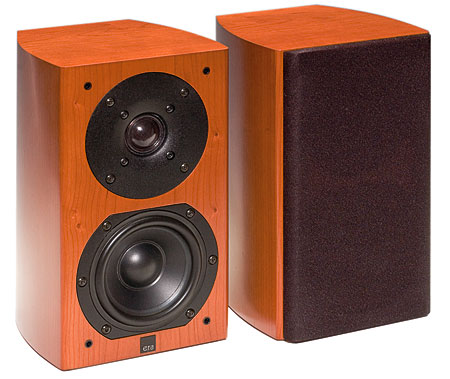
This little speaker stands just short of 10" tall, its front baffle almost completely occupied by its two drive-units. These are both rabbeted into the baffle and securely mounted with Allen-head wood screws. The tweeter appears to be a conventional design: its 1" silk-dome tweeter is set back within a shallow flare in the front plate, and its woofer, constructed on a diecast 4" frame, uses a 3"-diameter Kevlar/fiber-composite cone and a substantially sized magnet. The woofer is reflex-loaded with a small, deep port on the rear of the wood-veneered cabinet. This is flared on both ends to minimize wind noise, and below the port are two rubber-grommet–covered keyholes to allow the speaker to be mounted on a wall. Electrical connection is via a single pair of good-quality, plastic-shrouded terminals mounted on a panel inset below the port. These will take both spade lugs and banana plugs. The crossover is carried on a small printed circuit board behind the terminals. The cabinet is braced and filled with fiber of two different densities; its sidewalls are gently curved, and the overall visual impression is of a speaker considerably more expensive than $600/pair. Sound
My room and its furnishings are not conducive to placing speakers close to the wall behind them. I ended up with the Design 4s about 48" out into the room but just 12" from the sidewalls, which would give some boundary reinforcement at low frequencies. The speakers were mounted on 24" Celestion stands whose central pillars were mass-loaded with a mixture of dry sand and lead shot.
My first impression, other than noting that the Eras' low frequencies did not sound lean, was of the enormous yet stable soundstage they threw. I had no sense of sound emanating from the actual physical positions of the Design 4s. Instead, they allowed a window to be opened onto the stereo stage of each recording I played. This was particularly noticeable with my own recordings: Whether it was the spacious acoustic of Sioux Falls' Washington Pavilion on Cantus' There Lies the Home (CD, Cantus CTS-1206); the more anonymous modern hall at Utah's Weber State University on Variations (CD, Stereophile STPH017-2); the reverberant ambience of Santa Fe's Loretto Chapel on Duet (CD, Stereophile STPH012-2); the small-church acoustic of Chad Kassem's Blue Heaven Studios in Salina, Kansas, on Mosaic (CD, Stereophile STPH015-2); or the small Santa Monica recital hall I used to record all 32 of Beethoven's piano sonatas (CD, OrpheumMasters RSP830), there was virtually no sense that the speakers were imposing their own interpretation on the original venues' sizes and shapes.
Moreover, those acoustics seemed wider and deeper, more tangible, than I'd been used to with the last two speakers I'd used, the Revel Ultima Studio and the Snell LCR7XL. The members of the backing choir on Stanford's "Outward Bound" (from There Lies the Home) stood unambiguously behind and around the baritone soloist, and the piano back a bit farther still, just as they had at the original sessions. Some speakers achieve a wide soundstage but leave the center of the stage a little unstable, images tending to pull to the sides. That was not the case with the Era Design 4s; the image of the dual-mono pink-noise track on Editor's Choice (Stereophile STPH016-2) remained well defined at the center of the image.
During the four days of the 2006 CES, I estimated I spent eight hours in taxis, buses, and their respective queues. But I did make the effort to visit the Signal Path International suite at the Mirage Hotel, because the Musical Fidelity distributor was introducing its own new brand of speakers, Era Acoustics, designed by Jim Spainhour and David Solomon, engineered by Aerial Acoustics' Michael Kelly, and manufactured in China.
I was particularly struck by the Era Design 4, selling for just $600/pair. Driven, naturally, by Musical Fidelity amplification, a pair of these tiny two-way speakers produced a much bigger sound in the hotel suite than they had any right to. Yes, they were benefiting from some boundary reinforcement, but this was definitely a loudspeaker that punched above its weight. I asked for a pair for review, along with a pair of Era's SUB10 powered subwoofers. Bob Reina shouldn't get to review all the affordable speakers, right?
This little speaker stands just short of 10" tall, its front baffle almost completely occupied by its two drive-units. These are both rabbeted into the baffle and securely mounted with Allen-head wood screws. The tweeter appears to be a conventional design: its 1" silk-dome tweeter is set back within a shallow flare in the front plate, and its woofer, constructed on a diecast 4" frame, uses a 3"-diameter Kevlar/fiber-composite cone and a substantially sized magnet. The woofer is reflex-loaded with a small, deep port on the rear of the wood-veneered cabinet. This is flared on both ends to minimize wind noise, and below the port are two rubber-grommet–covered keyholes to allow the speaker to be mounted on a wall. Electrical connection is via a single pair of good-quality, plastic-shrouded terminals mounted on a panel inset below the port. These will take both spade lugs and banana plugs. The crossover is carried on a small printed circuit board behind the terminals. The cabinet is braced and filled with fiber of two different densities; its sidewalls are gently curved, and the overall visual impression is of a speaker considerably more expensive than $600/pair. Sound
My room and its furnishings are not conducive to placing speakers close to the wall behind them. I ended up with the Design 4s about 48" out into the room but just 12" from the sidewalls, which would give some boundary reinforcement at low frequencies. The speakers were mounted on 24" Celestion stands whose central pillars were mass-loaded with a mixture of dry sand and lead shot.