"It's rather warm in here."
—violinist Mischa Elman, at Jascha Heifetz's Carnegie Hall debut By the time you read this, the tomato cages will be back in our shed, the electric fans will be back in our basement, and the snow tires may even be back on my Subaru. But today in Cherry Valley the outside temperature is over 90°, with 68% humidity and the kind of low-lying haze that passes for atmosphere in such diverse films as Mad Max, Mad Max 2, and Mad Max 3. And I'm stuck inside, listening to a couple of amplifiers that run so hot they could make Jesus drink gin out of the cat's dish.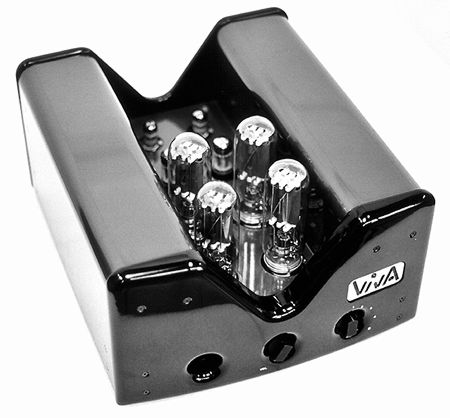 Maybe stuck is the wrong word: These are single-ended amplifiers, a breed with more virtues than flaws—the latter comprising only a surfeit of power and an excess of heat. I might add to that list excessively high prices, except that's no less true of their push-pull cousins.
Because each of a single-ended amplifier's output devices passes a full music waveform, swing to swing, it must run in pure class-A, which is the least efficient way of doing things—less efficient, even, than attempting to stimulate energy conservation by giving tax breaks to oil companies and to people who buy Hummers. So a single-ended amp simply can't help giving off a great deal of heat, and is certainly less in control of its circumstances than the audio writer who gets things wrong year after year, requesting hot amps in March that are delivered in June. Ours, in case you were wondering, is a very cold house in the winter, being a former seasonal cottage that I haven't yet fully converted to year-round use. Not only do I keep forgetting not to borrow hot-running amps for the summer, I keep forgetting to borrow them for the winter, when I can use the extra heat. That, and not some ephemeral sonic gimcrack, is the real meaning of inverted phase. I blame Clark Johnsen.
But I mentioned virtues, so here are a few things that single-ended amplifiers seem to do better than their push-pull counterparts:
• A single-ended amplifier allows voices and instruments to retain their natural presence to an uncanny degree—or, as Harvey Rosenberg once quoted Gertrude Stein as saying, "There is lots of there there." A very good single-ended amp goes further, pulling solo voices and instruments away from whatever else is taking place in the recording, musically and sonically. Either way, the effect isn't like the fussy, fey, overetched imaging that some audiophiles and reviewers hanker for: It's not as if an SE amp wants you to think there's a trumpet or a tambourine between your speakers, but rather that there is real music, made by real people playing the trumpet or tambourine, between your speakers—solid, of course, but still alive and breathing.
The difference between typical high-end audio imaging and the musical presence of a single-ended amp is the difference between listening to somebody type a manuscript and listening to them read what they've written.
• Single-ended amps allow music to retain its sense of flow and momentum. Failing to do so is the most egregious shortcoming I hear whenever circumstances force me to listen to some overwrought system built around an overpriced and overpowered push-pull amplifier: Despite being able to produce attractive or even "realistic" sound, the thing doesn't damn make music. The sounds don't move forward in time, but rather hang there and clang there, dead, dull, and uninteresting.
I recall reading some fatuous and windy audio review years ago, in which the writer suggested that certain audio components reproduce sounds in bas-relief, while the sounds of the best ones were "like unto" whole statues. Single-ended amplification, like music itself, is the antidote to even thinking about that sort of nonsense—although for some people I imagine it may be too late.
• On a related note, single-ended amps do timing and tunefulness almost as well as the best in that regard—solid-state amps from Naim, Linn, Exposure, Rega, and the like. I say almost because single-ended amplifiers, especially single-ended triode amplifiers, or SETs (which most SE amps are), and single-ended amplifiers lacking in negative feedback (which most SEs also are), usually don't have the tightest bottom in the candy shop, the result being that bass instruments sound more or less puffy, as if getting a note to sound from an electric bass were a matter of moving a balloon very precisely from one place to another, as opposed to simultaneously fretting and plucking a string. But, unlike their friends on the shelves marked "Push-Pull Amps Only," single-ended amps with slow bass are only that: single-ended amps with slow bass. For whatever reason, they resist the temptation to muck up the timing and pitch relationships everywhere else.
• My friend Herb Reichert made some good observations in his days of writing about audio, one of my all-time favorites being the axiom that things tend to sound like whatever it is they're made out of. But his greatest contribution to the craft of reviewing was applying the phrase flesh and blood to the notion of re-creating a realistic sense of color and texture in musical sounds. SETs do flesh and blood like nothing else. Nothing else.
• Another old friend, the aforementioned Harvey Rosenberg, loved to tell the story of his first modern SET experience, which occurred during a trip to Japan. He was listening to a very-low-powered tube amplifier playing traditional Japanese music through a very large, efficient horn speaker when, all of a sudden, WHAM!—a large bell was struck with great force, and the reproduced sound startled him in a way that a hi-fi had never been able to startle him before. Then and there he realized that the single greatest asset of the single-ended amp was its ability to retain music's drama—noting, of course, that it's a great deal easier for a single-ended amp to "accelerate" from 1W to 2W than it is for a comparatively baroque push-pull design to do the same trick, but from 50W to 100W. (Of course, the right loudspeaker must also be a part of the deal...)
• Finally, and with a more sincere nod to Clark Johnsen, a single-ended amp makes it easier to hear when the absolute polarity of the audio signal is inverted. That's no small matter, because inverted polarity can rob music of its momentum, mostly by distorting the attack components of notes. Example: When a playback system has the polarity wrong, the first two measures of Elgar's Serenade, Op.20, just blend into the wallpaper instead of being the quiet but taut, scene-setting phrase they're supposed to be.
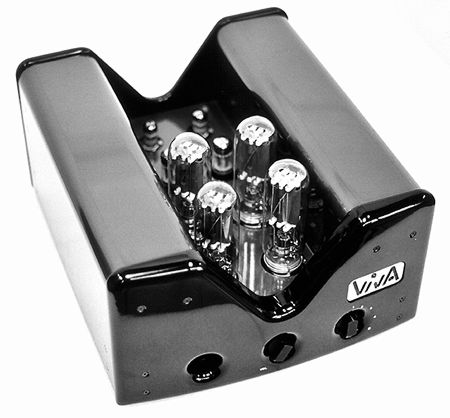
Viva Solista single-ended integrated amplifier
Maybe stuck is the wrong word: These are single-ended amplifiers, a breed with more virtues than flaws—the latter comprising only a surfeit of power and an excess of heat. I might add to that list excessively high prices, except that's no less true of their push-pull cousins.
Because each of a single-ended amplifier's output devices passes a full music waveform, swing to swing, it must run in pure class-A, which is the least efficient way of doing things—less efficient, even, than attempting to stimulate energy conservation by giving tax breaks to oil companies and to people who buy Hummers. So a single-ended amp simply can't help giving off a great deal of heat, and is certainly less in control of its circumstances than the audio writer who gets things wrong year after year, requesting hot amps in March that are delivered in June. Ours, in case you were wondering, is a very cold house in the winter, being a former seasonal cottage that I haven't yet fully converted to year-round use. Not only do I keep forgetting not to borrow hot-running amps for the summer, I keep forgetting to borrow them for the winter, when I can use the extra heat. That, and not some ephemeral sonic gimcrack, is the real meaning of inverted phase. I blame Clark Johnsen.
But I mentioned virtues, so here are a few things that single-ended amplifiers seem to do better than their push-pull counterparts:
• A single-ended amplifier allows voices and instruments to retain their natural presence to an uncanny degree—or, as Harvey Rosenberg once quoted Gertrude Stein as saying, "There is lots of there there." A very good single-ended amp goes further, pulling solo voices and instruments away from whatever else is taking place in the recording, musically and sonically. Either way, the effect isn't like the fussy, fey, overetched imaging that some audiophiles and reviewers hanker for: It's not as if an SE amp wants you to think there's a trumpet or a tambourine between your speakers, but rather that there is real music, made by real people playing the trumpet or tambourine, between your speakers—solid, of course, but still alive and breathing.
The difference between typical high-end audio imaging and the musical presence of a single-ended amp is the difference between listening to somebody type a manuscript and listening to them read what they've written.
• Single-ended amps allow music to retain its sense of flow and momentum. Failing to do so is the most egregious shortcoming I hear whenever circumstances force me to listen to some overwrought system built around an overpriced and overpowered push-pull amplifier: Despite being able to produce attractive or even "realistic" sound, the thing doesn't damn make music. The sounds don't move forward in time, but rather hang there and clang there, dead, dull, and uninteresting.
I recall reading some fatuous and windy audio review years ago, in which the writer suggested that certain audio components reproduce sounds in bas-relief, while the sounds of the best ones were "like unto" whole statues. Single-ended amplification, like music itself, is the antidote to even thinking about that sort of nonsense—although for some people I imagine it may be too late.
• On a related note, single-ended amps do timing and tunefulness almost as well as the best in that regard—solid-state amps from Naim, Linn, Exposure, Rega, and the like. I say almost because single-ended amplifiers, especially single-ended triode amplifiers, or SETs (which most SE amps are), and single-ended amplifiers lacking in negative feedback (which most SEs also are), usually don't have the tightest bottom in the candy shop, the result being that bass instruments sound more or less puffy, as if getting a note to sound from an electric bass were a matter of moving a balloon very precisely from one place to another, as opposed to simultaneously fretting and plucking a string. But, unlike their friends on the shelves marked "Push-Pull Amps Only," single-ended amps with slow bass are only that: single-ended amps with slow bass. For whatever reason, they resist the temptation to muck up the timing and pitch relationships everywhere else.
• My friend Herb Reichert made some good observations in his days of writing about audio, one of my all-time favorites being the axiom that things tend to sound like whatever it is they're made out of. But his greatest contribution to the craft of reviewing was applying the phrase flesh and blood to the notion of re-creating a realistic sense of color and texture in musical sounds. SETs do flesh and blood like nothing else. Nothing else.
• Another old friend, the aforementioned Harvey Rosenberg, loved to tell the story of his first modern SET experience, which occurred during a trip to Japan. He was listening to a very-low-powered tube amplifier playing traditional Japanese music through a very large, efficient horn speaker when, all of a sudden, WHAM!—a large bell was struck with great force, and the reproduced sound startled him in a way that a hi-fi had never been able to startle him before. Then and there he realized that the single greatest asset of the single-ended amp was its ability to retain music's drama—noting, of course, that it's a great deal easier for a single-ended amp to "accelerate" from 1W to 2W than it is for a comparatively baroque push-pull design to do the same trick, but from 50W to 100W. (Of course, the right loudspeaker must also be a part of the deal...)
• Finally, and with a more sincere nod to Clark Johnsen, a single-ended amp makes it easier to hear when the absolute polarity of the audio signal is inverted. That's no small matter, because inverted polarity can rob music of its momentum, mostly by distorting the attack components of notes. Example: When a playback system has the polarity wrong, the first two measures of Elgar's Serenade, Op.20, just blend into the wallpaper instead of being the quiet but taut, scene-setting phrase they're supposed to be.
Viva Solista single-ended integrated amplifier
I've owned four or five different single-ended amplifiers over the years, and I've been lucky enough to live with many others—the latest being the beautiful Solista integrated amp ($9900) from Viva Audio Devices of Vicenza, Italy (footnote 1). Viva was founded in 1996 by designer Amedeo Schembri, and the company's first product was the Aurora power amplifier, a hand-wired monoblock that used an 845 triode tube in a single-ended, zero-feedback circuit, for an output of about 30W. The Aurora's sound impressed reviewers on both sides of the Atlantic, as did the amp's distinctive appearance: a mildly convex and generously rounded front panel that seemed to grow organically from a substantial M-shaped chassis, the whole thing done up in a thick, glossy, automotive lacquer.
Footnote 1: Distributed in the US by Profundo, 3020 El Cerrito Plaza, Ste. 320, El Cerrito, CA 94530. Tel: (510) 375-8651. Fax: (510) 525-8942. Web: www.profundo.us.
—violinist Mischa Elman, at Jascha Heifetz's Carnegie Hall debut By the time you read this, the tomato cages will be back in our shed, the electric fans will be back in our basement, and the snow tires may even be back on my Subaru. But today in Cherry Valley the outside temperature is over 90°, with 68% humidity and the kind of low-lying haze that passes for atmosphere in such diverse films as Mad Max, Mad Max 2, and Mad Max 3. And I'm stuck inside, listening to a couple of amplifiers that run so hot they could make Jesus drink gin out of the cat's dish.
Maybe stuck is the wrong word: These are single-ended amplifiers, a breed with more virtues than flaws—the latter comprising only a surfeit of power and an excess of heat. I might add to that list excessively high prices, except that's no less true of their push-pull cousins.
Because each of a single-ended amplifier's output devices passes a full music waveform, swing to swing, it must run in pure class-A, which is the least efficient way of doing things—less efficient, even, than attempting to stimulate energy conservation by giving tax breaks to oil companies and to people who buy Hummers. So a single-ended amp simply can't help giving off a great deal of heat, and is certainly less in control of its circumstances than the audio writer who gets things wrong year after year, requesting hot amps in March that are delivered in June. Ours, in case you were wondering, is a very cold house in the winter, being a former seasonal cottage that I haven't yet fully converted to year-round use. Not only do I keep forgetting not to borrow hot-running amps for the summer, I keep forgetting to borrow them for the winter, when I can use the extra heat. That, and not some ephemeral sonic gimcrack, is the real meaning of inverted phase. I blame Clark Johnsen.
I've owned four or five different single-ended amplifiers over the years, and I've been lucky enough to live with many others—the latest being the beautiful Solista integrated amp ($9900) from Viva Audio Devices of Vicenza, Italy (footnote 1). Viva was founded in 1996 by designer Amedeo Schembri, and the company's first product was the Aurora power amplifier, a hand-wired monoblock that used an 845 triode tube in a single-ended, zero-feedback circuit, for an output of about 30W. The Aurora's sound impressed reviewers on both sides of the Atlantic, as did the amp's distinctive appearance: a mildly convex and generously rounded front panel that seemed to grow organically from a substantial M-shaped chassis, the whole thing done up in a thick, glossy, automotive lacquer.
Footnote 1: Distributed in the US by Profundo, 3020 El Cerrito Plaza, Ste. 320, El Cerrito, CA 94530. Tel: (510) 375-8651. Fax: (510) 525-8942. Web: www.profundo.us.