These are great times for analog, and I'm happy to have played a small part in the revival, but recently the demand for some products has outstripped supply; getting review samples has been next to impossible. I've requested an Audio Research PH7 phono preamplifier for literally years now, but ARC can't build them fast enough, so they don't need a review. The more they sell, the greater the buzz, and the greater the buzz, the more e-mails I get from readers asking for a review. It's not nice to not be needed.
You know what's the first thing they teach you in dental school? Don't ever say "Oops!" Even if you stick one of those hooked teeth scrapers through the patient's cheek, you don't say "Oops!" "Don't move!"? Yes. "Oops!"? No. That's the big day-one lesson—and given the cost of medical malpractice insurance today, a damn good one.
The ceiling remains, but the floor has changed: Benz-Micro continues to offer a selection of rather expensive phono cartridges, including their well-established LP Ebony ($4700) and Ruby 3 ($3000) models. But in recent years, my attention has been drawn by the succession of budget Benzes: first, the Gliders ($795), then the ACEs ($550), and now the MC20E2-L ($199).
There are a thousand different ways to make a loudspeaker. A hundred to make an amplifier. And at least a million to make a piece of wire. But here's the deal with a moving-coil phono cartridge: stylus, cantilever, rubber grommet, tensioning wire, coils, magnet, output pins, and maybe a body. Done.
The Brinkmann Pi cartridge's Benz-Micro heritage was obvious from the get-go. The motor is built to Brinkmann's specifications by Benz-Micro and includes a Micro-Ridge stylus. The cantilever material is not specified. The Pi's output is approximately 0.25mV, and its compliance is moderate at 15µm/mN. Recommended are a tracking force of 1.82gm, a VTA of 23°, and a resistive load of 600 ohms.
Helmut Brinkmann says he tweaked the Pi's design for a year and a half before he achieved the results he desired, including making the tiny set screws out of various materials. The Pi, with a body of machined aluminum designed to control the dissipation of resonant energy, weighs a hefty 14gm. Brinkmann supplies aluminum screws and titanium washers, which, he claims, in combination with special damping between the cartridge body and headshell, have been "sonically tuned to create a unique musical instrument."
There is no better time than now to invest in audiophile-quality vinyl playback gear. I'll bet even Mikey Fremer would be surprised at the amount of new vinyl releases and reissues and used vinyl available to music-lovers today. And the choices available to audiophiles seeking turntables, tonearms, phono cartridges, and phono preamps is greater than it's been in a decade.
The plumber's here, and he says we need a new hot-water heater because the one we have now isn't maintaining the correct water temperature, and because it's been in use for nine years. "And the thing is, this is a five-year heater." I responded by repeating his last six words, only louder, and with decorations. And I couldn't help thinking: I've had phono cartridges that lasted longer than that. And none of them have attacked me in the shower when my wife flushed the toilet, either.
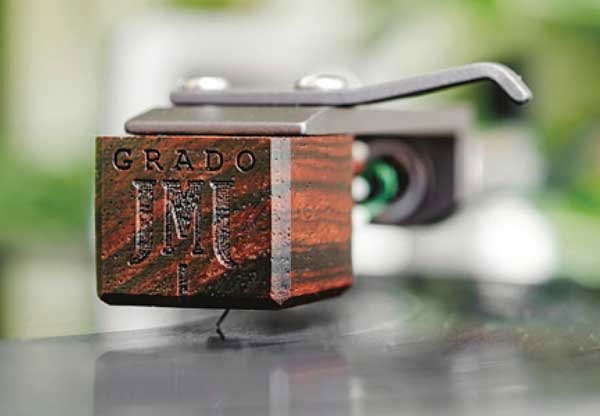
In the early to mid-1980s, I read every high-end hi-fi magazine I could get my hands on. Among the consequences was my discovery that the Grado Signature Seven phono cartridgewhich was better and cheaper than the Signatures One through Sixwas the cartridge that God wanted me to have. So I cut back on all manner of luxuries, saved every dollar I could save, and a few months later brought a walletful of cash to Harvey Sound in midtown Manhattan, where an unpleasant man with a bad comb-over handed me a little pill bottle of a plastic tube.
Every two or three years my family and I travel to Disney World in Orlando, Florida—one of those places I used to think I'd hate, but which I always enjoy in spite of myself. No such trip would be complete without visiting the Mitsukoshi department store at Epcot Center, which represents the pinnacle of Japanese consumer culture. At the Epcot Mitsukoshi store—the 430-year-old company's only US location—one can buy the finest of everything, including the rarest and most expensive writing papers and inks, the most exquisitely crafted pottery, and the loveliest freshwater pearls on Earth. Young shoppers are accommodated with the latest toys, trends, and technology—but there's nothing frantic or cheap about the manner in which they're offered. The watchword at Mitsukoshi is quality, and the presentation borders on being artistic.
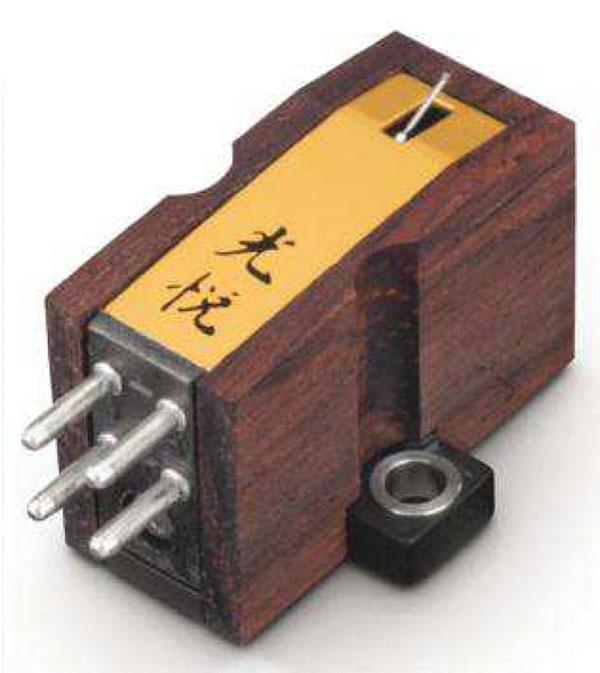
Among the more intriguing audio-related announcements this year was that Koetsu phono cartridges were once again available in the States. In fact, they're being handmade in limited quantities by the sons of founder Yoshiaki Sugano.
What makes a phono cartridge worth $3500 or $4000? Pride of ownership? Snob appeal? Sound? Tracking ability? Exotic materials? Styling? Labor cost for skilled artisans? Special ether? Cool wooden box? All of the above?
The observation has been made, often and well, that audio writers are out of touch when it comes to judging value for money. For one thing, we get to live with exotic gear for months at a time, without spending a penny. For another, when we do decide on a more permanent upgrade, we usually get the opportunity to buy at wholesale—at a so-called "industry accommodation price," extended to us because, after all, we are a part of the industry.
Ten years ago, I'd probably have got pretty good odds from industry insiders on a bet that Stereophile would still be reviewing phono cartridges into the new millennium. Linn's Arkiv B may not be a brand-new design—I heard my first sample in mid-1997—but phono-cartridge technology is about as stable as anything in hi-fi today. This Stereophile review is long overdue.
If you asked me to name a single specific high-end audio component that could make or break a system, I'd name the Linn LP12 turntable. Of all the thousands of hi-fi products I've heard over the years, not a one of 'emnot a speaker, amplifier, or digital processorhas been able to draw me into the music, no matter what the associated componentry, like the LP12. I've heard the most highly regarded speakers/amps/processors fall flat in certain situations due to a lack of synergy with their surrounding systems, but I've never heard an LP12-based system that didn't put a smile on my face and make me green with envy.
Some six or so years ago, the Linn Asak cartridge set new standards for imaging and soundstage reproduction. I can remember the first time I heard an Asak in a system using Quad ESL-63s—I had never experienced such depth of soundstage and solidity of imaging from any system, and that with Quad amplification! The Asak was relatively quickly overshadowed in this area, however, and in any case, soundstaging precision by itself didn't seem to be a high priority for the Linn design team, who were apparently more concerned with dynamics and a musical integration of the sound across the frequency range.