| Columns Retired Columns & Blogs |

Focal Chorus 826W 30th Anniversary Edition loudspeaker Page 2
Audio Plus's Ian McArthur came by to help set up the Focals, and to make sure they were working properly. He said that in most listening environments the optimal toe-in is where you can just see the inner wall of each speaker, and this turned out to be true for these speakers in my room. The rest of the system was exactly the same as was used with the Monitor Audio PL200, Simaudio graciously allowing me to hold on to their Moon Evolution P-7 preamplifier and Evolution W-7 power amp, so that I didn't have to deal with a change in associated components. I don't use bi- or triwiring unless the manufacturer absolutely insists that single-wiring would handicap the performance of their speakers. In the case of the Chorus 826W, this was not an issue: the speaker accommodates nothing but single-wiring.
I was told that the review samples had been through some break-in; nevertheless, before doing any serious listening, I played Monitor Audio's System De-Tox break-in disc (good for cleaning out the cobwebs), as well as an assortment of music CDs. And, as mentioned earlier, after an initial trial of comparing the sound with the speaker grilles on and off, all my subsequent listening was with the grilles off—but with the apparently fixed tweeter grilles in place.
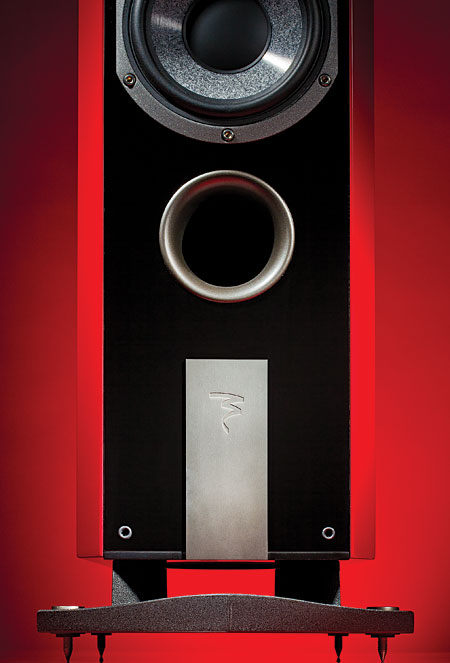
And here the plot thickens. My review of the Chorus 826W was nearly completed—or so I thought—when I attended the Salon Son & Image show in Montreal. One of the rooms I visited there was that of Montreal Focal dealer Multi Electronique. There, to my great surprise, I saw a pair of Chorus 826Ws—and the tweeters had no grilles. I talked to Multi Electronique salesman Phillippe Renaud, who said, "Oh, you must remove the tweeter grille. The speaker sounds much better that way." He said the tweeter grille could be removed by gently prying it loose with a straightened paper clip—or with the tip of a ballpoint pen, as he then demonstrated. When you put it back, it's held by magnetic attraction.
My next stop was the Audio Plus room, where I basically asked their main man, Daniel Jacques, What gives? "Sorry, we should have told you to remove the tweeter grilles. The speaker sounds better that way. But better late than never, eh?"
When I got home, I listened to the speakers, then removed the tweeter grilles, then listened again. (The main grilles were already off.) I repeated that cycle several times. No doubt about it: The speakers sounded better with the tweeter grilles off. The highs had greater clarity, and there was a most welcome improvement in the specificity of images within the soundstage. These were areas of performance that I'd been critical of in the initial draft of the review. Now I had to go back to, if not square one of my listening, then at least square two. Oh, the reviewer's lot . . . Except as noted, my description of the Chorus 826Ws' sound refers to the speakers with the tweeter and main grilles removed.
Although the review samples had had a break-in period at Audio Plus, I suspect that additional break-in was taking place in my listening room—the speakers sounded more "relaxed" by the end of the review period. (I'd been using the Simaudio electronics in my system for several months without ever turning them off; I'm pretty sure they were long past any break-in period.)
Sound
A big, spacious sound, tonally neutral, with impressive dynamics, and powerful bass for the size of the speaker—that's my capsule description of the sound of the Chorus 826W. These characteristics were fully evident when I played All Star Percussion Ensemble (CD, Golden Strings GS CD 005). This early digital recording—which I discussed in the review of the Monitor Audio PL200—provides a formidable challenge to loudspeakers, as well as to other system components. There's a great variety of percussion instruments, each with its unique tonal character, a (potentially) deep and wide soundstage, and startling dynamics. The Chorus 826W rose to the challenge of the whole ensemble going full tilt in the arrangement of music from Bizet's Carmen, and was also able to communicate the subtle rhythmic flow of Pachelbel's Canon in D. Timpani were particularly lifelike in their transient impact and decay, which might reflect the claimed advantages of the W-sandwich midrange and woofer cone construction.
A word about tonal balance: If a speaker is totally neutral in its sound, then it will neither emphasize nor deemphasize any part of the frequency range. This means that, assuming the recording and the rest of the system are similarly neutral in tonal balance, musical instruments and voices throughout the range will be reproduced in proper proportion.
One might think that a measured frequency response that's flat and well extended translates to tonal neutrality, but, as the late J. Gordon Holt argued in his provocative essay "Down With Flat!", this is not necessarily the case. A speaker that exhibits a gentle rolloff in the treble may sound more tonally neutral than one whose response linearity is maintained to the top of the audioband, and small deviations from a ruler-flat response in different parts of the frequency range have different audible effects. Ultimately, as JGH pointed out, the judgment of tonal neutrality has to be a subjective one.
NEXT: Page 3 »
 | |||||||||||

|
|
| |||||||||
- Log in or register to post comments







| Loudspeakers Amplification Digital Sources | |
Analog Sources Accessories Featured | |
Music Columns Retired Columns | |
Show Reports | |
Features Latest News Community | |
Resources Subscriptions |
 © 2024 Stereophile
AVTech Media Americas Inc., USA
All rights reserved