......blind testing mentioned by a person that doesn't believe in doing them. Aren't they "too difficult" according to yourself? Wait......nevermind just don't answer that because I know it will end up with you Mr Atkinson making some EXCUSE as to why you can't do blind tests for the magazine when it comes to reviewing products. ZzzzzzzzzzZzzzzz.
The 2011 Richard C. Heyser Memorial Lecture: "Where Did the Negative Frequencies Go?" Case Study 3: Digital Recording & Playback
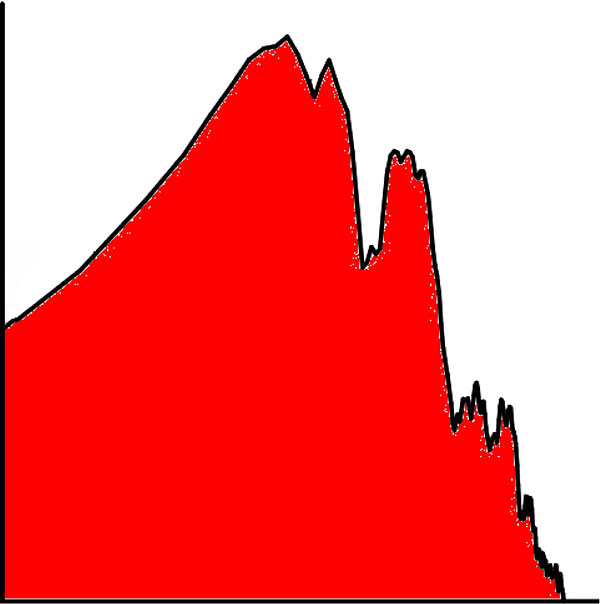
The title of this lecture asks "Where did the negative frequencies go?" Once we enter the world of digital audio, they are very much present. Here is the spectrum of the music waveform I showed earlier:
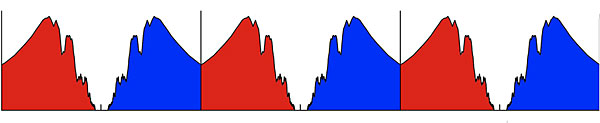
And this is the spectrum of the same signal after it has been sampled in the time domain:
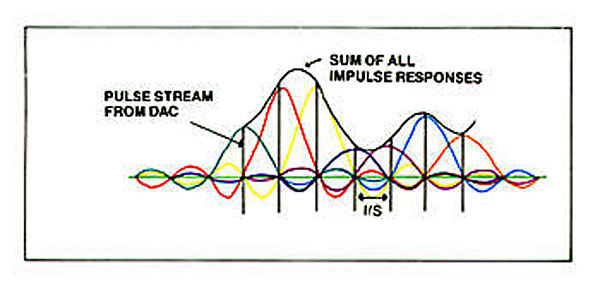
The positive (red) and negative (blue) spectra are mirrored around the sampling frequency and all of its harmonics, the latter extending to, if not infinity, then to something practically close to it. If you wish to play back time-sampled data, you need some way of eliminating all those spectral images other than the one in the baseband. Yes, a low-pass filter is required, but that filter turns out to have a very special function: it doesn't just remove the ultrasonic images, it reconstructs the original analog signal (below the Nyquist Frequency, that is, half the sample rate). The pulses representing the sampled amplitude are convolved with the impulse response of the filter to give the original signal, something that I found elegant in the extreme when I first understood it. That convolving is shown here in a diagram taken from John Watkinson's 1986 book on digital audio:
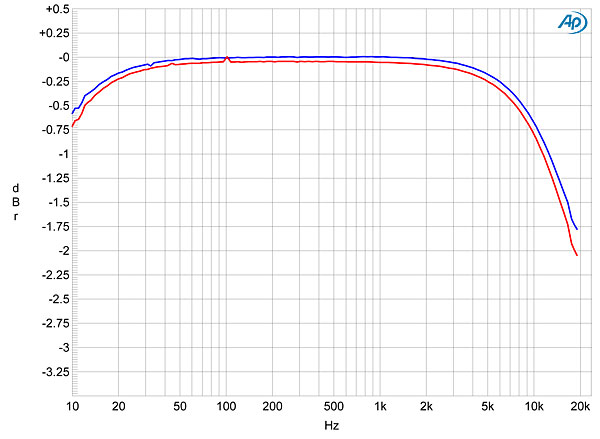
I still marvel at the elegance of this concept. But what if you don't use a reconstruction filter? The effect in the audioband is inconsequentialjust a small rolloff in the top octave, due to the aperture effect (the pulses have a finite length).

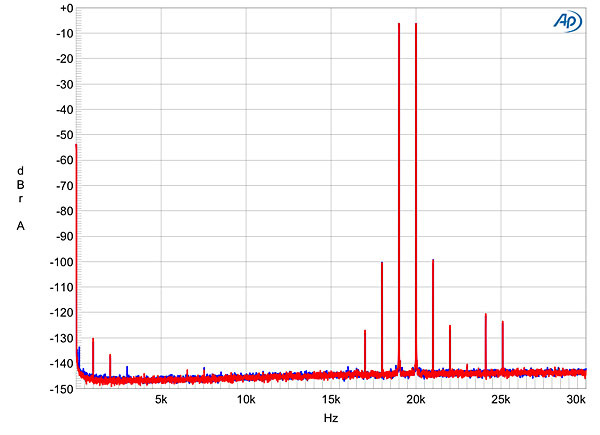
Above the audioband, the conventional reconstruction filter gives a well-behaved analog signal. Reproducing data representing an equal mix of 19 and 20kHz tones, you get a spectrum in which the inverted images of those tonesthe negative frequenciesare well suppressed.

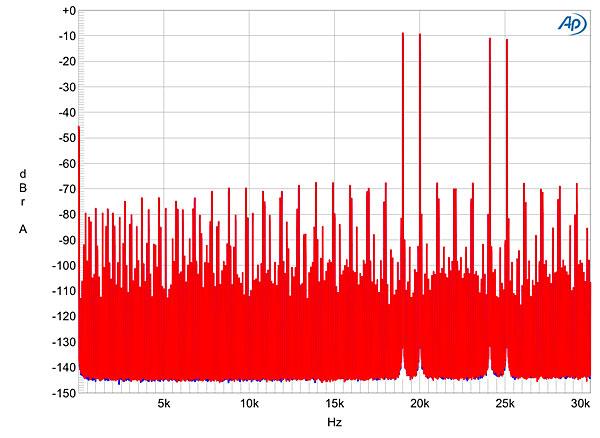
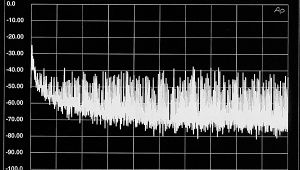
But, my goodness, when we repeat this measurement with a so-called NOS DAC (for Non-OverSampling), which has dispensed with the reconstruction filter, we get this:

Ugh! There are the negative frequencies in all their glory, as well as a host of related aliasing and intermodulation products dumped back into the audioband.
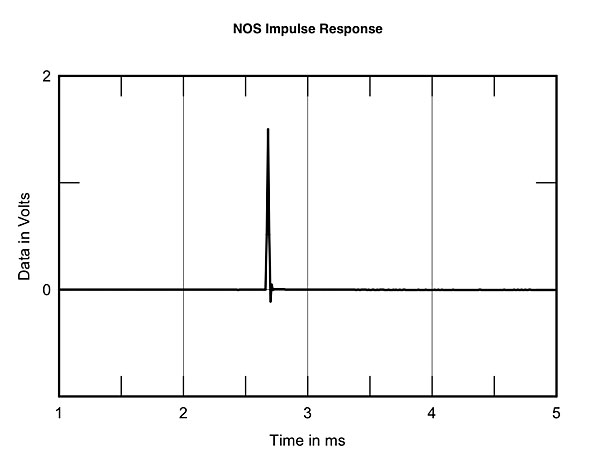
So why do listeners like this mess? It can't be the aperture effect: 3dB at 20kHz is a subtle change at best. Some propose that it is the improved time-domain behavior of the system that the listeners are responding to . . .

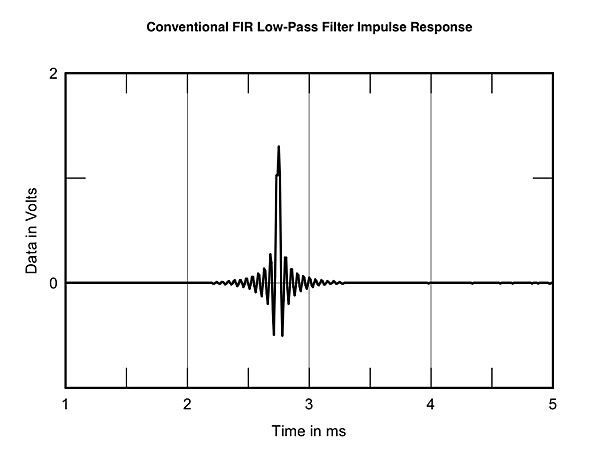
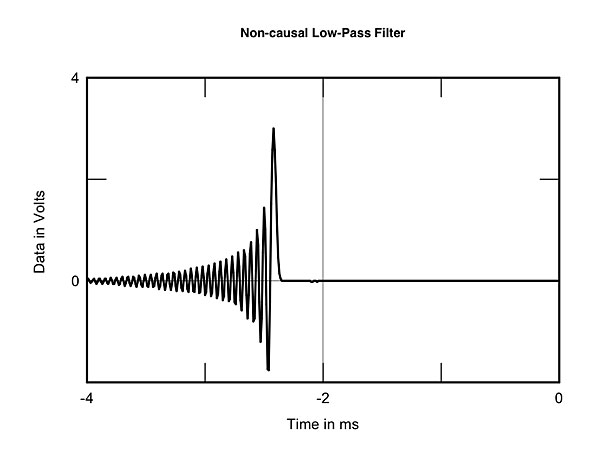
. . . compared with the impulse response of a conventional time-symmetrical FIR reconstruction filter:

Yet the differences between these two impulses all fall within the ear/brain's integration period. So unless people like the sound of their amplifiers misbehaving with the ultrasonic image energy, I have no idea what is going on here, other than to say that, whatever it is, it is not elegant.
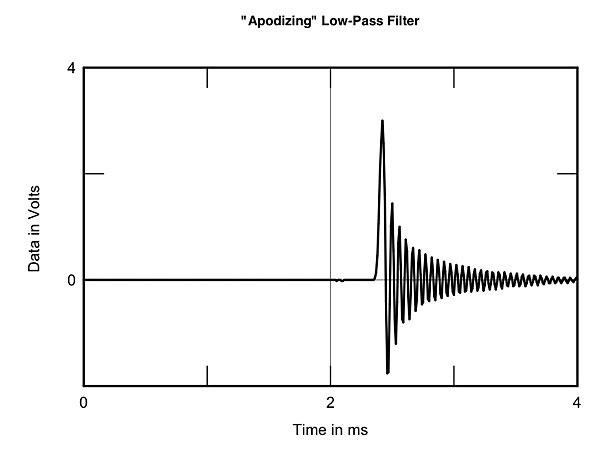
An idea I did find elegant was Peter Craven's introduction of so-called "apodizing" reconstruction filters. Compare the conventional filter's impulse response above with the impulse response of a Craven apodizing filter:

The acausal ringing of the conventional filter of both the A/D and D/A converters has been replaced by a larger degree of causal ringingit occurs after the event instead of before and afterat a slightly lower frequency. (The apodizing filter has a null at the original data's Nyquist Frequency.)
Again, people report that they prefer the sound of apodizing filters. A few years ago I published an article by Keith Howard in which he investigated the behavior of the reconstruction filter. As part of the preparation for that article, Keith sent me DVD-As of music treated with different filters. The recordings weren't identified, but Keith asked some of the magazine's writers to listen to the examples and rank them on sound quality. This was extraordinarily hard to do, but one difference did emerge as being consistently audible under blind conditions. When we were sent the key as to what filters had been used for each example, music reconstructed with the minimum-phase filter above sounded superior to music reconstructed with this filter:

Okaythe latter is nothing like we hear in nature. However, why does replacing acausal ringing at a frequency that people can't hear with causal ringing at a slightly lower frequency that people still can't hear result in better sounder, sound that people tend to like more? Again, as Dick Heyser said, "there are a lot of loose ends!" (footnote 7)

Footnote 7: In subsequent conversations, I have been told that the ear/brain also acts as a wavefront arrival detector, that an acausal filter causes mental confusion as both the initial onset of the ringing and the arrival of the maximum energy peak are incorrectly interpreted as two separate events rather than one.

- Login or register to post comments


A man sees what he wants to see and disregards the rest, eh? In the 15,000 words of this preprint, there are just a few paragraphs devoted to a discussion of blind testing.
As I say, I took part in my first blind test 35 years ago and since then have been involved in well over a 100 such tests, as listener, proctor, or organizer. My opinion on their efficacy and how difficult it is to get valid results and not false negatives - ie reporting that no difference could be heard when a small but real audible difference exists - was formed as the result of that experience.
John Atkinson
Editor, Stereophile

In other words JohnnyR, Mr Atkinson DID find excuses not to use blind testing but found them worthwhile enough to mention them in his Heyser speech funnily enough.

A. Join a band as a second rate bass player
B. Fail to get a record contract
C.Pretend he's an electrical engineer
D.Get an offer to ruin.....ermm I meant run Stereophile
E. Proceed to ruin........ermmmmm excuse me......run Stereophile like Hitler would.
F. Spend his time talking online instead of actually doing any real work.
G. Make excuss about his busy schedule and why he can't do DBTs
H Profit!!!

Johnny makes plywood boxes in his mother's basement, and then claims he is a speaker expert.
Trolls audio websites.
That is all.

JRusskie seems to have become a failed audio (and DBT) expert in one easy step...
A. Failed...

Hitler? I don't know whether to laugh or cry.

also, brings both of these to mind:
http://en.wikipedia.org/wiki/Reductio_ad_Hitlerum
http://en.wikipedia.org/wiki/Godwin's_law

I asked a question of Harman Testing Lab in the Computer Audiophile forum, and post #11 is the answer, which I thought was perfect. i.e., let the testee control the switch, so whatever adjustment time they need they can accomodate.
http://www.computeraudiophile.com/f12-headphones-and-speakers/behind-harman-testing-lab-14112/
Other observation: The comments in this Stereophile article about the noise floating free of the recording due apparently to having a higher playback bandwith - that made my day.
On R.C. Heyser: His description of the 1971 Sylmar quake, hearing a low-frequency "tone" prior to the shaking, got him started on comparing earthquakes and woofers and low-frequency playback in rooms, and he got beat up on a lot for those writings. But having been involved with both, those observations of his were like gold in the bank. Saved me lots of money.

Aren't you the dude who "tested" the Shure SRH 940 headphones and claimed they were almost as good as the 800HDs from Sennheiser?
I own the SRH940s. I was somewhat willing to believe you, but when I saw that your source was an Ipod, I just flicked your review in the trash.
You chose a 200$ source to test 325$ and 1500$ headphones? And you believe your results mean something?
![]()

My review of the 940, agreed upon by more than 95 percent of respondents, was vetted with specific music tracks listed in the review and subsequent comments, using ipods alone, ipods with analog amps, and desktop DACs and amps. Some of the naysayers are either impatient or just grumpy and disagreeable, which the comments in this Stereophile article perfectly illustrate.

How nice of you to call people who question your methodology grumpy, disagreable, etc. I question your methodology because it makes no sense to test 325$ headphones with an ipod. It makes even less sense to test 1500$ headphones with an ipod...
I actually listened to the Shure SRH940 and HD800 today, using my ipod Nano. You are correct, they both sound almost the same. They both sound like shit!
I know from experience that these headphones really shine with a good source, and especially, proper amplification. As good as the Shure is (I own them), it is no match for the HD800 when both are hooked up to decent equipment.
Your test is like testing the acceleration of a Ferrari and a Prius in your 12' driveway. You won't get much better results from the Ferrari in such a limited distance.
As for the 95% who agree with you, what gear did they use (ipod)? Were those 95% SRH940 owners and fanboys?

Saying "they both sound like shit" when one of those is a revered $1500 headphone of great pedigree and popularity among actual audiophiles is telling of your judgement. I would suggest taking a deep breath, pick a headphone and some music tracks you like, then tune out the matrix and just enjoy your music. You'll be less grumpy that way.

Don't try and hide behind my words! They both sound like shit through an ipod! What a weasel you are. I did not say the 800HD sounded like shit... BUT IT SOUNDED LIKE SHIT THROUGH AN IPOD. You rigged your test, Dale.
Again, you use insults...

A long time ago one person on a big audio site challenged people like you to be more specific instead of throwing words like s**t around. There were just two persons who offered test tracks with which to compare those headphones, but everyone else (like you) just threw out expletives, and a couple members even made serious threats. Now I have over 30 years experience comparing headphones like the Stax and Sennheiser series, and quite a bit of time invested with the Audio Engineering Society as well as reading Stereophile magazine, so even if nobody in the world were to agree with my conclusions, I'm certainly qualified to test and evaluate these devices. I'd suggest you refrain from purely ranting with words like s**t and offer specific testable facts, or just go away.
This article may help you:

BTW, and speaking of Prius and Ferrari, you may be one of the better off who don't mind paying $1500 for a headphone and then shelling out $2000 for a headphone amp. But let's pretend for a moment that you have to pinch pennies to get those luxurious goods, so when you finally have them you really appreciate what you have. In this latter case, were you to stumble across an ipod touch or iphone of recent manufacture, with the new Earpods ($29 purchased variety only) being driven by the Dirac DSP player, and had an opportunity to listen at length, it might make you ill to realize what you got for your $3500.

My headphone amp is a whopping 400$ (CI Audio VHP 2).
I do pinch pennies. The VHP 2 and the Shure 940 are mine.The Sennsheiser 800HD I borrowed from a friend.
Stop trying to cloud the issue with non relavant issues.

How about we let Stereophile test both headphones! First through an ipod, then with decent equipment!
Both headphones sound similar through an ipod.
Plug them into a receiver, they sound less like shit.
Plug them into a decent headphone amp, and they both sound MUCH BETTER. BUT the Sennsheiser pulls away and wipes the floor with the Shure.
Buy yourself a CI Audio headphone amp (the one I use), or any other decent headphone amp Dale... Before buying a 2500$ DAC to install on an ipod.
DUH...........................

The continuing saga of ChrisS being a troll and all around noncontributing poster. Classy act there ChrisS.
Mostly what I got from Mr Atkinson's article was the amount of photos of himself rather than Mr Heyser. I suppose a memorial lecture should be all about the presenter and how he sees fit to turn it into reasons why Stereophile does what it does regarding testing and the lack there of.
"Yes, what you think you are hearing might by dismissed as being imagination, but as the ghost of Professor Dumbledore says in Harry Potter and the Deathly Hallows, "Of course it's all happening in your head, Harry Potter, but why on earth should that mean that it is not real?"
Oh I see now. Stereophile's philosophy is based upon a ficticious Harry Potter character who spouts that what we hear is real.I'll be sure to let those people being treated for such voices in their heads that all is well and medication is not necessary.
"Footnote 2: For a long time, I've felt that the difference between an "objectivist" and a "subjectivist" is that the latter has had, at one time in his or her life, a mentor who could show them what to listen for. Raymond was just one of the many from whom I learned what to listen for."
Well if only that was true. Your readers tend to all be subjectivsts who aren't trained what to listen to but blindly ( I made a pun there since blind testing is not wanted at Stereophile) believe whatever they think they hear as the truth when in fact measuremnts will show that either they heard nothing related to the measurements or perhaps it's Dumbledore once more in their heads, make believe or wishful hearing.
All in all I found your presentation 90% about yourself and Stereophile and reasons why you defend subjective listening and gloss over things like cables and doing serous testing and throwing in various quotes and ambiguous stories barely related to the subect you were supposed to be talking about, unless that subject was muddling the understanding of Stereophile and telling everyone your own personal history instead of Mr Heyser's.
"Third, one well-known skeptic sitting in the audience tonight criticized my abstract a few weeks back on the grounds that I am just offering "hypotheses about stuff that might be just to stir the pot, while offering no real explanations."
Class act there Mr Atkinson, speak out and criticise someone you don't like or agree with in the audience who then has no opportunity to speak up and address the audience themselves. Very childish and immature.I already see how you do the same on here. "My way or the highway"
JohnnyR is once more sadly correct, Blind testing is not and wil not be used by Stereophile. Just because you Mr Atkinson, know how to push a few buttons to measure speakers, does not make you even close to the same league as Mr Heyser was. He furthered the cause of objectivity and made Audo magazine the best audio magizine there ever was. The Audio Critic is a very close second. Mr Aczel used to be one of the worst subjectivists around untill he admitted to being such and saw the light and spoke out against foolish subjective reviews. Testing will always be the most important part of audio magazines. Simply letting reviewers spout off about "blacker backgrounds" "lifted veils" or other such nonsense belittles both the reader and the so called reviewer not to mention the product under "test". Truth in testing is what Mr Heyser strove for not some silly review about rainbow foil, magic bowls or pebbles.

You have misunderstood the nature of the lecture, GeorgeHolland. The Richard C. Heyser Memorial Lectures are not intended to be _about_ Dick Heyser but instead are offered to honor his memory. The invitation for me to be the October 2011 lecturer clearly stated that I was free to choose any subject I felt appropriate; my triple career as a musician/audio engineer/audio editor and the conclusions I have formed as a result of my 4 decades' experience in those careers were felt by the AES Technical Council members to be an eminently suitable subject.
The skeptic in question had emailed me before the lecture to let me know he would be in the audience and would take an active part in the anticipated Q&A session. I included this mention in the preprint to give him the necessary opening. As it turned out, he didn't attend, but I saw no reason to delete the point he made.
I agree. As you can tell from my discussions of Dick Heyser's writing and thoughts in the preprint, I have an enormous amount of respect for what he achieved. I have never claimed to be his equal, nor would I. But again I must emphasize that the AES Heyser lectures are not intended to be _about_ Dick Heyser. That is your misunderstanding, I am afraid.
John Atkinson
Editor, Stereophile

Whoa! There goes another synapse! Now they're both brain dead... I duelled extensively with JRusskie re: blind testing on the Forums and I daresay, he shot himself many times with his own arguments.
Saga? Can't wait for the movie version!
Sorry, Ariel... I'll try not to let it happen again.

...which is a valuable insight, I think, from this article that Mr. Atkinson has generously preprinted. His stories--which, though I am not a longtime reader, I presume also reflect the history of Stereophile--mirror the tensions found in the philosophy of science between "reality" and "perception", and the question of whether our observations are truly disinterested or if our minds shape how and what we see (or hear). And, really, what exactly does a blind test resolve? That the reviewer likes one piece of equipment over another, presumably without factoring in aesthetics or cost? But "liking" one thing better than another is still a subjective judgment, and who's to say YOU would share that judgment? Never mind the problem of translating sounds heard by another into words on the magazine's page and then back again into the sounds heard by the reader when he or she auditions the gear. Or the issue of whether sound quality can be adequately described by a series of measurements, any more than colour can be described strictly in terms of wavelength, or consciousness in terms of vibrating atoms in your brain. That's not to say these things aren't significant, but to say that they add up to the sum of our human experience is absurd.
Thanks for a reflective and enjoyable article (at least in my mind).

The purpose of blind testing is soley to see if you can hear a difference between two units. After all the subjective rants of "oh this lifted several veils of crud from the liquid sound" or "I heard a definite improvement" I find it sad that Sterophile keeps saying that DBT or even SBT are not a valid way to test those claims. Either you can hear a difference or you can't yet those that claim they do shy away from proving that fact with a blind test. Afaid they might be shown to be wrong is my opinion, so Stereophile allows them to go merrily along in their own self delusions while spending way too much money on sham products.

In a properly set up DBT, let's say for two amplifiers, what exactly will the listener be listening for?
(And what if the lamb heard a difference, but not the shepherd boy?)

Are you seriously so dense that you can't figure it out for yourself? Perhaps that's why you depend upon Stereophile to tell you what to buy?
http://home.provide.net/~djcarlst/abx.htm
http://www.matrixhifi.com/contenedor_ppec_eng.htm
Read and learn.

So Georgie,
If the lamb can hear that Amp A can make the test system sing in a range of 10hz-60khz, but the shepherd boy can't hear in that range so can't tell the difference between Amp A and Amp B, which amp should the shepherd boy buy?

No you may address me as George or Mr Holland. Georie is an attempt at making fun but then again that's about all you know to do anyway.
Please ask a relevant question or just shut it.
The lamb would first have to prove they can hear a difference with a dbt
The shepard can buy whatever he wants.
The big bad wolf tried to convince both that the expensive boutique amp was the one to buy
They told him to shove it and bought a less expensive but well built amp and they all lived happily ever after except for Mr Big Bad who soon folded his shop due to no sales.

So Georgie,
Let's make this question relevant....
Let's say we're testing two amplifiers with two listeners. The first listener is an 18 year old young lady who is trained in classical piano at a Grade 10 music conservatory level. She can hear that Amp A has an excellent range 16hz-40khz through the test system, but even though Amp B doesn't have the same range, she likes the "sound" of it better. The second listener is the shepherd boy who's grown up now. He's 54 years old, likes big band jazz, but his hearing has been damaged by working with heavy machinery without hearing protection. He can't hear a difference between the two amps.
Which amplifier should the ex-shepherd buy?
- All Headphones Ship Free!
Shop a Huge Selection of Top Quality
Headphones at Great Prices!
www.Headphones.com
| Loudspeakers Amplification Digital Sources | Analog Sources Accessories Featured | Music Columns Features | Show Reports | Show Reports |
Recommended Components Blogs Latest News Community |
Shop Resources Subscriptions |