| Columns Retired Columns & Blogs |

Audience Adept Response power conditioner
I can't remember a time when I wasn't concerned about power quality. I grew up around finicky, home-brew ham-radio gear and labs full of instruments, and with both, power-conditioning gear was standard fare. When I moved into high-end audio, it seemed obvious that power quality was important. As a result, I've experimented with a wide range of power-conditioning equipment, from simple ferrite loops to huge isolation transformers, and even exotic laboratory power supplies that could vary the voltage, frequency spectrum, and shape of the AC signal.
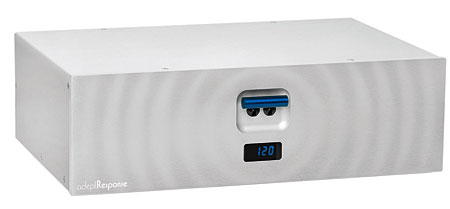
So when Audience introduced their Adept Response, I was immediately interested. I knew the company primarily through their cables, and I admired their methodical, detail-oriented approach. I also knew that they paid particular attention to power quality in their show demos, and had built their own power-conditioning system after being dissatisfied with a number of high-end units. The Adept Response incorporates everything they've learned from those show units into a new, optimized design executed with the highest possible quality of parts and workmanship. The final step, according to president and CEO John McDonald, was to enclose it in a case that matched its performance. "It's really something special," he beamed, "and we're really proud of it. It had to be beautiful."
A primer on power conditioning
The Adept Response combines three approaches to power conditioning: filtering, power-factor correction, and isolation. John McDonald is understandably reluctant to discuss the details of the AR's filter circuits, beyond noting that they're entirely passive, and that "filter designs aren't necessarily complicated, but there are a number of parameters to select and balance, as well as combinations of multiple filters, or stages. Once those parameters are set, we use the best possible passive components to ensure stability, and that the filter isn't itself adding noise or distortion."
The premise behind the AR's power-factor (PF) correction is that the AC coming from your outlet has a PF of less than one, meaning that your AC's current and voltage are out of phase. This is partly due to the utility company's gear and partly due to the load imposed by your houseful of electrical widgets, and it's important because a low PF will impair your components' ability to draw current during demanding transients. The utility company cares about this too—a lower PF means lower efficiency, so they typically estimate the load of their service areas and apply an opposing load to the circuit (which you can see on your local power poles). This global correction helps but goes only so far, and it doesn't account for the constant fluctuations that occur when all your neighbors' air-conditioners kick in and out.
The AR, provides partial passive PFC. Then, each of its 12 outlets is isolated from the input by one filter, and further isolated from the other outlets by a combination of two additional filters. This isolation, combined with circuit details that ensure a very low and constant series resistance, allows an entire audio system to be plugged into a single AR. Whenever components are plugged into different circuits, or even different outlets on a single circuit, some noise is created because the components all have slightly different potentials to ground. In addition to providing stable, clean power, the AR's 12 outlets provide 12 individual circuits—the AR acts as a single outlet in the ways that that configuration is best, and like 12 separate, completely isolated outlets in the ways that that's best.
The last aspect of the AR's design I'll note is Audience's attention to details. The use of magnetic circuit breakers instead of switches, relays, or metal-oxide varistors is one example. Another is its use of a Neutrik PowerCon connector to attach Audience's own PowerChord AC cord to the AR instead of the standard IEC plug/jack. Audience also cryogenically treats the circuitry, a process that they claim results in a sonic improvement, although the explanations I've heard are not entirely consistent with the courses in physical metallurgy I took in college and grad school.
Sound
The AC in my listening room is fed from a dedicated AC subpanel, and the system can be run on one, two, or three circuits, all with short, nearly identical wire runs to high-end outlets from Hubbell, FIM, and Shunyata Research. I thought that my audio system sounded great to start with, but its sound improved significantly when I installed a dedicated circuit, and by another, equally large jump when I put in the dedicated subpanel and optimized wiring. I'll repeat what you've heard and read here before: Your first step toward high-end sound, and your best investment, will be to provide your system with isolated, dedicated power.
I'd made all these changes, and my AC was already pretty good before the AR showed up—it wasn't going to be easy for it to have a significant effect. My electronics, mostly Halcro and VTL, all had excellent power supplies, which added to the challenge, as did my use of high-end AC cords from Shunyata Research and Synergistic Research, as well as Audience PowerChords. I did the bulk of my listening to systems connected with Audience Au24 interconnects and speaker cables, but also installed the AR in systems wired with products from Stereovox, Nirvana, Nordost, and Shunyata Research.
As is often the case, I found it easiest to first identify the Adept Response's effects by removing it from the setup after listening with it for a while. What I heard was a flattening and thickening of the sound. Images became vague, their edges less defined. Soundstage depth was foreshortened, images melting back into a slightly opaque, more two-dimensional stage. Transients weren't as clear without the AR; macrodynamic peaks were less dramatic, and a level of microdynamic subtleties was lost. The sound lost a bit of life, and didn't have quite the drive it had before. The characteristics I associate with a low noise floor—low-level resolution of details, the air around images, the blackness of the silence between notes, the subtle ambience cues that make a recording venue seem real—were diminished whenever I removed the AR from the system.
Once I had an idea of what aspects to focus on, I was able to analyze and appreciate the Adept Response's contributions when it was inserted back into the system, and over the long term change. The baseline system was very good, as I've said; I usually began a specific listening session by second-guessing my previous observations and wondering anew if the AR would really make that big a difference. Whenever I reinstalled it, however, my doubts vanished—the improvements were obvious. In one instance, I reinserted the AR while listening to a vinyl reissue of Cookin' with the Miles Davis Quintet (Prestige/Acoustic Sounds 7094). This is a mono recording, but the image of Davis' trumpet seemed to suddenly gain a dimension, as in one of those 3D pop-up books in which something stands up when you open the pages. Not only was there a greater apparent sense of depth, the spaces between soundsources were more obvious and open. There was better temporal precision, and transients were definitely larger—not on the loud end, but because their pppp beginnings were revealed by the elimination of a layer of background smog.

Low-level details, such as the movement of Philly Joe Jones' brush against a cymbal, were more obvious. Over time, I realized that Red Garland's piano simply felt more real, and I could form a clear mental image of his fingers on the keys, resting or lightly bouncing in anticipation of the next note, then snapping downward. The notes themselves, instead of being merely notes, were a much more complex, pulsating, and evolving mix of different components. Similarly, although transients were noticeably larger and had more impact, and their sharp leading edges were much clearer, the overall feel was more natural and relaxed. When I concentrated on this a bit, it became clear that the AR had removed a slight upper-midrange edginess that had been woven into Davis' trumpet and had been giving loud transients a slight hardness. The system's bottom end was more articulate with the AR. The details of Paul Chambers' bass notes were more dramatic—the instrument's warm, woody character was more dense and rich, and the notes started and stopped more precisely. The overall presentation was simply cleaner, more open, and more precise with the Adept Response.
In the years leading up to the Adept Response's arrival, I'd experimented with a number of power conditioners but had always returned to MIT's Zsystem products. Some systems worked best with everything on one circuit and running through a Zcenter, others sounded best with the amps plugged directly into the wall. In yet other setups, I found that I got the best sound with the front-end components running into the Zcenter on one circuit, and the amps running through a Zstabilizer(s) on one or two additional circuits. The MIT products provided consistent benefits, and particularly dramatic improvements in situations where the power quality was really poor to start with, or when the entire system was connected entirely with MIT wires.
In my current setup with the dedicated subpanel, however, the MIT products didn't provide the benefits I got with the Adept Response. Installing the MIT power products in my current baseline setup changed the sound without obviously improving it. (I no longer have the MIT cables, which may well have been a contributor to what I had experienced earlier.) Most of the areas where the AR most profoundly improved things—precision, clarity, and detail—weren't really affected, and the areas that were, in particular tonal density and soundstage size and depth, were different but, again, not necessarily improved.
These observations of the MITs initiated another round of introspection and second-guessing on my part, as well as several more short- and long-term auditions with and without the Adept Response in the system. Once again, my observations were confirmed: The improvements wrought by the AR were obvious, consistent, and undeniable.
So if you've got $3800 burning a hole in your pocket...
In some ways, the Audience Adept Response was exactly what I'd expected: a thoroughly thought out, well-designed, nicely executed manifestation of all that's currently known about power conditioning. What I didn't expect the AR to do was to provide the level of improvement that it did, or for that improvement to be so profound. Nor did I expect the AR to stand out so starkly from its competitors. I've used a wide variety of power-conditioning systems over the years, and have found a few that were really quite good, such as MIT's Zsystem products—but none has ever produced the type or magnitude of benefits I got with the Adept Response.
$3800 is a lot of money for a power conditioner. But in a dedicated listening room, feeding a system with $40,000 amplifiers, $20,000 digital front-ends, and $5000 phono cartridges, it's hard to condemn the AR as being insanely or even extravagantly priced. If you haven't yet installed dedicated power, you probably shouldn't be shopping for a $3800 power conditioner. On the other hand, once you've done everything possible to provide your system with clean power, spending $3800 on an AR may be the only way to further improve things.
John McDonald had it right—the Adept Response is something very special. I heartily recommend it, but be forewarned—it will change your expectations. Once you've heard what it can do for your system, there's no turning back.
NEXT: Specifications »
 | |||||||||||

|
|
| |||||||||
- Log in or register to post comments











| Loudspeakers Amplification Digital Sources | |
Analog Sources Accessories Featured | |
Music Columns Retired Columns | |
Show Reports | |
Features Latest News Community | |
Resources Subscriptions |
 © 2024 Stereophile
AVTech Media Americas Inc., USA
All rights reserved