Let me take you by the hand, and together we'll jump off an audio cliff. I promise a soft landing, though there might be some turbulence on the way down.
 When I reviewed the mbl 101E Radialstrahler loudspeakers two years ago, MBL's Jeremy Bryan asked me if I had the required double runs of speaker cables. When I told him I didn't, he said he'd bring some, but instead of cables he brought a cable manufacturer, Tara Labs' Matthew Bond. A surprise visit by a cable manufacturer is about as welcome to me as a case of head lice. Even a scheduled visit makes me itch.
Here at my place, I have enough cables to build a suspension bridge. Few manufacturers want them back, and I can't sell what's not mine. I've threatened to auction off what's here and give the money to Hurricane Katrina relief; if I can find the time, I will. Otherwise, I'll soon have to rent a storage space just for the cables I've accumulated.
So, as you might imagine, when Bond showed up, I was shaken, not stirred. I strongly expressed my displeasure, but, being a charitable fellow, and seeing how much cable he'd schlepped along for the occasion, I let Bond perform his dog-and-pony show. In the case of cable manufacturers, such events traditionally begin with a ceremony: The Removal of the Black Velvet Bag. (Don't think such show biz is restricted to our own little hobby. Go to a wine-tasting or a single-malt scotch party and you'll get the same equal mix of pageantry and BS.)
Bond replaced all of the AudioQuest Cheetah speaker cables and Sky interconnects then linking my system together with TARA's second-from-the-top The One cables and interconnects. Every one of the higher-quality interconnects I've tried has imparted a slightly different "flavor" to the sound: a bit of brightness here, a smoothness there, a full bottom here, lean but detailed there, etc. If a product under review strikes me as leaning too much in one direction, I'll try to counter it with a cable that might take it in another.
Bond finished, and we listened. I heard very little difference between TARA's The One and the AudioQuests. (For those of you who think cables don't make any difference, consider this admission a short-lived victory.) However, my cable journey began in the early 1980s when, a skeptical civilian, I heard a Petersen Litz-wire interconnect. I later heard one of the first sets of Randall Research's Teflon-dielectric cable, which I immediately bought and installed between my Eminent Technology ET 1 air-bearing tonearm and my phono preamp. I decided to stick with the AudioQuest interconnect but use the Tara The One speaker cable as originally planned.
"Thanks for coming, Matthew, and letting me hear these cables," I told him. "But what can I possibly do with them? What can I write, other than that they sound very similar to what I was already using?" I told him he'd be better off finding a reviewer new to the job who had never experienced what a well-designed cable can do for a system. Bond returned his cables to their black-velvet drawstring bags and departed.
Cut to 2006: a few weeks after setting up a single mbl 9007 amplifier in single-ended stereo mode, Jeremy Bryan returned to complete his installation of the balanced, monoblock mbl 9007s that I reviewed last September, and brought along with him another TARA Labs wire. Insistent young lad. "Forget what you heard last time," he said. "Let me just put this 1m set of interconnects into your system and let you hear them. Where do you think you'd hear the biggest difference?"
"Between the Manley Steelhead phono preamp and the Musical Fidelity kWP preamp," I muttered.
I pulled out Classic Records' astonishing-sounding, 45rpm boxed set—pressed on single-sided, 200gm, Quiex SV-P vinyl—of Ernest Ansermet and the Orchestra of the Royal Opera House, Covent Garden's famous The Royal Ballet Gala Performances, recorded in the UK's famed Kingsway Hall by Kenneth Wilkinson for British Decca and licensed to RCA for American release (RCA Living Stereo/Classic LSC-6065-45). We listened to the opening tracks: March and The Dance of the Sugar Plum Fairy, from Tchaikovsky's The Nutcracker. It's among the most exquisite orchestral recordings you'll ever hear, especially the sweeping, impossibly lush strings, which dramatically unfurl across the stage in an unusual call-and-response that raises goose bumps every time. The recording of the bell-like celeste is accomplished with impeccable purity and transient clarity. One listen and you'll know why this recording is legendary.
I listened to it through Harmonic Technology's top-of-the-line Magic Link One interconnect, and the sound of that disc was as astonishing as it's always been. Then Bryan replaced the Magic Link One with whatever TARA Labs interconnect he'd brought, which included a mysterious black box that he placed behind the Steelhead. I gritted my teeth and opened my skeptical ears.
One, Two, Three, JUMP!
When I reviewed the mbl 101E Radialstrahler loudspeakers two years ago, MBL's Jeremy Bryan asked me if I had the required double runs of speaker cables. When I told him I didn't, he said he'd bring some, but instead of cables he brought a cable manufacturer, Tara Labs' Matthew Bond. A surprise visit by a cable manufacturer is about as welcome to me as a case of head lice. Even a scheduled visit makes me itch.
Here at my place, I have enough cables to build a suspension bridge. Few manufacturers want them back, and I can't sell what's not mine. I've threatened to auction off what's here and give the money to Hurricane Katrina relief; if I can find the time, I will. Otherwise, I'll soon have to rent a storage space just for the cables I've accumulated.
So, as you might imagine, when Bond showed up, I was shaken, not stirred. I strongly expressed my displeasure, but, being a charitable fellow, and seeing how much cable he'd schlepped along for the occasion, I let Bond perform his dog-and-pony show. In the case of cable manufacturers, such events traditionally begin with a ceremony: The Removal of the Black Velvet Bag. (Don't think such show biz is restricted to our own little hobby. Go to a wine-tasting or a single-malt scotch party and you'll get the same equal mix of pageantry and BS.)
Bond replaced all of the AudioQuest Cheetah speaker cables and Sky interconnects then linking my system together with TARA's second-from-the-top The One cables and interconnects. Every one of the higher-quality interconnects I've tried has imparted a slightly different "flavor" to the sound: a bit of brightness here, a smoothness there, a full bottom here, lean but detailed there, etc. If a product under review strikes me as leaning too much in one direction, I'll try to counter it with a cable that might take it in another.
Bond finished, and we listened. I heard very little difference between TARA's The One and the AudioQuests. (For those of you who think cables don't make any difference, consider this admission a short-lived victory.) However, my cable journey began in the early 1980s when, a skeptical civilian, I heard a Petersen Litz-wire interconnect. I later heard one of the first sets of Randall Research's Teflon-dielectric cable, which I immediately bought and installed between my Eminent Technology ET 1 air-bearing tonearm and my phono preamp. I decided to stick with the AudioQuest interconnect but use the Tara The One speaker cable as originally planned.
"Thanks for coming, Matthew, and letting me hear these cables," I told him. "But what can I possibly do with them? What can I write, other than that they sound very similar to what I was already using?" I told him he'd be better off finding a reviewer new to the job who had never experienced what a well-designed cable can do for a system. Bond returned his cables to their black-velvet drawstring bags and departed.
Cut to 2006: a few weeks after setting up a single mbl 9007 amplifier in single-ended stereo mode, Jeremy Bryan returned to complete his installation of the balanced, monoblock mbl 9007s that I reviewed last September, and brought along with him another TARA Labs wire. Insistent young lad. "Forget what you heard last time," he said. "Let me just put this 1m set of interconnects into your system and let you hear them. Where do you think you'd hear the biggest difference?"
"Between the Manley Steelhead phono preamp and the Musical Fidelity kWP preamp," I muttered.
I pulled out Classic Records' astonishing-sounding, 45rpm boxed set—pressed on single-sided, 200gm, Quiex SV-P vinyl—of Ernest Ansermet and the Orchestra of the Royal Opera House, Covent Garden's famous The Royal Ballet Gala Performances, recorded in the UK's famed Kingsway Hall by Kenneth Wilkinson for British Decca and licensed to RCA for American release (RCA Living Stereo/Classic LSC-6065-45). We listened to the opening tracks: March and The Dance of the Sugar Plum Fairy, from Tchaikovsky's The Nutcracker. It's among the most exquisite orchestral recordings you'll ever hear, especially the sweeping, impossibly lush strings, which dramatically unfurl across the stage in an unusual call-and-response that raises goose bumps every time. The recording of the bell-like celeste is accomplished with impeccable purity and transient clarity. One listen and you'll know why this recording is legendary.
I listened to it through Harmonic Technology's top-of-the-line Magic Link One interconnect, and the sound of that disc was as astonishing as it's always been. Then Bryan replaced the Magic Link One with whatever TARA Labs interconnect he'd brought, which included a mysterious black box that he placed behind the Steelhead. I gritted my teeth and opened my skeptical ears.
One, Two, Three, JUMP!
What I then heard from that familiar recording I will never forget. That one stupid interconnect had completely transformed not only the sound of that recording, but my expectations of how close the playback of recorded music could come to live music. I understand that all of the cable in the chain, from the recording gear in Kingsway Hall to Bernie Grundman's mastering room, was not this new interconnect. I understand any skepticism about how one piece of wire could so dramatically alter the sound of an audio system. But it did. With the Mystery Wire installed, and before Ansermet's baton went down and the first note was played, the vastness of Kingsway Hall appeared as I'd never heard it, with the full weight of the space delineated by the "room tone" of a large venue and the sensation of air. A few measures into the music, I blurted out, "Wow!"
What had wowed me? A total absence of "electronica." An enormous addition of lushness, texture, harmonics, and warmth, especially in the massed strings. And, at the same time, a major extension in air, detail, and transparency, coupled with a sensation of phase coherence that I describe as "acoustic jell." Usually you can get improvements in warmth and textures or more extension, air, detail, and transparency. Here, simultaneously, were both: a gigantic floating apparition of detail, delicacy, air, and texture, and an even greater diminution of glaze, glare, etch, and artifact. Usually you can get rid of those with the tonal cover-up of a high-frequency rolloff. With the TARA Mystery Wire, the artifacts were gone, yet the top-end extension and openness were greatly increased.
Each note on the celeste became a full-fledged, tripartite event: first a fully defined, cleanly rendered attack; then a three-dimensional, body-defining sustain; and finally a cleanly defined, effervescent decay into blackness. That holy trinity of live sound—believable attack, sustain, and decay timed out to perfection—more or less describes the dramatic improvement the TARA IC had wrought in my system. That, and the pitch-black backdrops against which all this sonic drama was played out, was what had me yelling "Wow!"
"What is that? And what does it cost?"
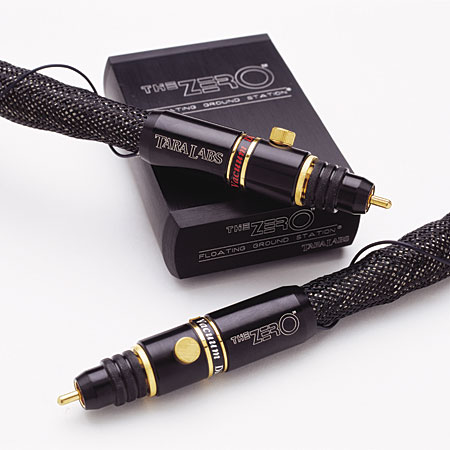
It was TARA Labs' The Zero interconnect.
Description
The Zero is the only interconnect with non-insulated conductors. Tara Labs claims it comes closest to the ideal of a dielectric-free cable. With no insulating coating to protect the wire from the oxidizing effects of air, the only way to preserve the wire's performance is to suspend it in a vacuum, and that's what TARA does.
They begin with stiff tubing of extruded Teflon, into which are also extruded three small arteries, or "galleries," at the 3, 6, and 9 o'clock positions (when looking at the tubing in cross section). These galleries run the tube's entire length. TARA calls this proprietary technology the Air-tube.
Inserted into each gallery is a run of bare RSC 2511 0.025" by 0.011" "eight-nines copper," rectangular solid-core, "Generation Two" conductor. This is relatively thin wire. Tara Labs claims its research shows that a conductor's impedance rises with frequency and that larger diameter wire will roll off higher frequencies to a greater degree than will smaller diameter wire. Tara's test system and other information can be found on the company's website.
When I reviewed the mbl 101E Radialstrahler loudspeakers two years ago, MBL's Jeremy Bryan asked me if I had the required double runs of speaker cables. When I told him I didn't, he said he'd bring some, but instead of cables he brought a cable manufacturer, Tara Labs' Matthew Bond. A surprise visit by a cable manufacturer is about as welcome to me as a case of head lice. Even a scheduled visit makes me itch.
Here at my place, I have enough cables to build a suspension bridge. Few manufacturers want them back, and I can't sell what's not mine. I've threatened to auction off what's here and give the money to Hurricane Katrina relief; if I can find the time, I will. Otherwise, I'll soon have to rent a storage space just for the cables I've accumulated.
What I then heard from that familiar recording I will never forget. That one stupid interconnect had completely transformed not only the sound of that recording, but my expectations of how close the playback of recorded music could come to live music. I understand that all of the cable in the chain, from the recording gear in Kingsway Hall to Bernie Grundman's mastering room, was not this new interconnect. I understand any skepticism about how one piece of wire could so dramatically alter the sound of an audio system. But it did. With the Mystery Wire installed, and before Ansermet's baton went down and the first note was played, the vastness of Kingsway Hall appeared as I'd never heard it, with the full weight of the space delineated by the "room tone" of a large venue and the sensation of air. A few measures into the music, I blurted out, "Wow!"
The Zero is the only interconnect with non-insulated conductors. Tara Labs claims it comes closest to the ideal of a dielectric-free cable. With no insulating coating to protect the wire from the oxidizing effects of air, the only way to preserve the wire's performance is to suspend it in a vacuum, and that's what TARA does.