Back in 2000, when Lyra introduced the Helikon moving-coil cartridge, which replaced the then six-year-old Clavis D.C., the company inexplicably retained the Clavis D.C.'s retail price of $2000. This was inexplicable because the Helikon's revolutionary design was new from the ground up, and because audiophiles—like most, if not all, consumers—perceive price to be a reflection of quality and performance.
Naim's new "statement" CD player, the CD555 ($20,300 by itself, $28,150 with PS555 power supply), breaks no new technological ground. Rather, in typical Naim fashion, it attempts to optimize 16-bit/44.1kHz CD performance by paying fanatical attention to the devilish details. It doesn't play the DVD-Video, DVD-Audio, or SACD formats, nor does it have a digital output—and it doesn't create an illusion of higher resolution by upsampling the data.
Older audiophiles remember the splash NAD made in the late 1970s with the introduction of their 3020 integrated amplifier ($175). Ridiculously cheap, it looked graceful and sounded warm, inviting, and holographic. Removable jumpers between the 3020's sections permitted enthusiasts to determine whether the magic resided in its preamp, its power amp, or in some synergy of both.
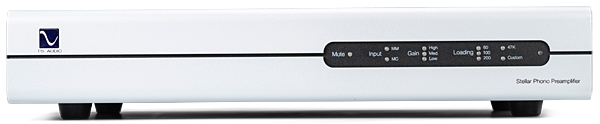
"Everybody's gotta get into the act!" Jimmy Durante used to say. That's what's happening with phono preamplifiers—they just keep being built, and I keep getting them for review. Up for evaluation in next month's column are new models from Perreaux, Musical Fidelity, Graham Slee, and a Chinese one, Ming Da. You can bet there'll be more.
Let me take you by the hand, and together we'll jump off an audio cliff. I promise a soft landing, though there might be some turbulence on the way down.
We were driving to a friend's house to celebrate her dad's 92nd birthday. Halfway there, a bright yellow, ground-hugging insect pulled in front of my car from across street. "Wow, that's a Lamborghini Countach!" I exclaimed. You don't often see one of those in my neighborhood—or in any neighborhood.
As you read this, are you listening to your stereo? Whatever the music, what you're actually hearing is your public utility's AC as modulated by your power amplifier. No matter how good the gear, the final result can be only as pure as the power feeding your components. Unfortunately, plenty of sonic schmutz usually comes along for the ride.
A four-day break between the Top Audio Show in Milan (September 14–17) and the Hi-Fi News Show in London (September 22–24) presented the perfect opportunity to accept a longstanding invitation from speaker manufacturer Focal-JMlab to visit its manufacturing facilities in France.
Best known for its omnidirectional loudspeakers, the German manufacturer mbl also produces three complete lines of high-performance electronics that, despite being large and built to jewel-like perfection, are sometimes lost in the shadow cast by the dramatic-looking—and -sounding—Radialstrahler 101E, which I reviewed in October 2004.
Still burning in my bank of childhood memories are misty images of the glowing green lettering on the McIntosh tube preamps and tuners that populated the windows of the audio stores that once lined lower Manhattan's Cortlandt Street. Leonard's and most of those other retailers are long gone—as are most of the audio brands that shared their windows with McIntosh, and that once symbolized the might of American innovation and manufacturing. Even the World Trade Center, the controversial complex that replaced Cortlandt Street's "Radio Row," where the hi-fi industry was born, is tragically gone.