Allowing Showgoers to calibrate their ears as he has done at prior AXPONA shows, pianist John Yurick did a great job in the DoubleTree's lobby. Sunday afternoon, as I was leaving for the airport, John was joined by someone playing standards from the American songbook on a chromatic harmonicluvverly music!
Yes, that's a dub LP from Bob Marley and the Wailers you can see in the Music Hall room at AXPONA. It was being played on the forthcoming Ikura turntable (price still to be decided, probably around $1000), with the new Creek EVO-50A integrated amplifier ($1195) and a pair of Music Hall's budget-priced Marimba speakers ($350/pair). The Marimba was designed by Roy Hall hisself, and is made in China; it will be reviewed by Stephen Mejias in our June issue). At $250/pair, the stands cost almost as much as the speakers!
"Updating of a legend..." read the one-sheet in Barrington retailer Essential Audio's room. It was referring to the Transmission Audio M1i speaker, a much-evolved descendant of the Red Rose Music R3 loudspeaker designed by Bo Bengtsson that Michael Fremer favorably reviewed for Stereophile back in May 2001. The M1i combines a dipole quad-ribbon tweeter with an aperiodically damped 5" woofer and costs $4500/pair.
Audioengine's small powered speakers have become my go-to recommendations for desktop situations; I bought a pair of the Audioengine 2s for use with the flat-screen HDTV in our kitchen, where they do a great job. The 2s ($199/pair) are the small white speakers in the center of my photograph; flanking them are the Audioengine 5+ speakers ($399/pair). Source was a MacBook Pro feeding the speakers 24/96 audio via the 24-bit capable Audioengine D2 streaming wireless interface/DAC ($599/set), which my colleague Michael Lavorgna enthusiastically reviewed in February 2012.
With Benchmark's high-value DAC1 D/A headphone amplifier getting a little long in the toothour original review was in July 2003it was good to hear the new DAC2 HGC ($1995) at Axpona. The DAC2 uses an asynchronous USB2.0 interface, will decode DSD files, has five digital inputs, two single-ended analog inputs, balanced and singled-ended analog outputs, two headphone outputs, and features a hybrid analog/32-bit digital volume control that preserves resolution. Analog signals are never digitized; digital signals never pass through an analog potentiometer; yet both analog and digital volume are controlled with a single knob.
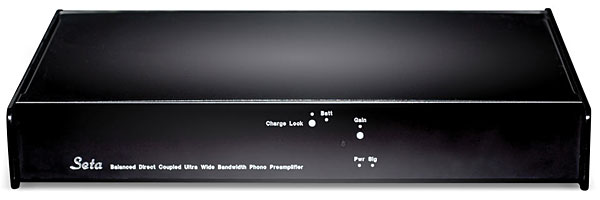
Channel D's Rob Robinson was using the same combination of Joseph Audio Pulsar speakers, Hegel amplification, and a Lynx Hilo D/A processor that he used at earlier shows to show off the LP rips made with his Pure Vinyl program for the Mac, now in its v3.1 incarnation. In honor of the late Alvin Lee, Rob played me a rip from a Kevin Gray-mastered 10 Years After LP, made with an Artemis turntable/arm, Zu DL103 cartridge, and the latest version of the Channel D SETA L solid-state phono preamplifier. I have been getting increasingly impatient with the occasional ticks and pops with my LP rips, as eliminating them is too much like work. But there was no such noise on Rob's rips, a tribute to his LP player.
MA's Todd Garfinkle always makes good music at shows and Axpona was no exception. Todd was driving a Primare PRE32 preamp and Primare A363 power amp with single- and double-rate DSD master files, played back from his Korg recorder. Speakers were the two-way Elac BS244s, which combine an AMT tweeter with a dimpled metal-cone woofer. Piano and drums had excellent jump factor combined with clarity and accurate midrange tonality, despite the modest-looking, table-top set-up.
This modest system in the April Music room actually sounded like music. Solus 2-way speakers (sorry, didn't note the price) were being driven by the new Stello S100 50Wpc power amplifier ($1200) and Stello HP100 D/A preamplifier/headphone amplifier, all wired with Verastarr cables. The Stello components are nicely finished and use enclosures manufactured in California, though final assembly is in Korea. Only disappointment was that the HP100 uses the Burr-Brown PCM2705 USB audio chip, which is limited to 16-bit data with a sample rate up to 48kHz and operates in the less-than-optimal adaptive mode.
Chicagoland dealer Quintessence devoted a large ground-floor room to the Fine Sounds groups of companiesSonus Faber, Audio Research, Wadia, and Sumko/RELalong with the superb racks from Harmonic Resolution Systems and a Clearaudio/Benz Micro LP player. A pair of the Sonus Faber Amati Futura speakers that I reviewed in May 2012 ($36,000/pair) was being vertically bi-amped with two tubed Audio Research Ref250 monoblocks driving the midrange/tweeter sections and two solid-state Audio Research DS450M monoblocks for the woofers. No fewer than four REL powered subwoofers were handling the low bass. Preamp was the Audio Research Ref5 SE that Brian Damkroger and Bob Reina raved about in Stereophile.
The mighty Focal Grand Utopia EM loudspeakers ($190,000/pair), which use field-coil energized woofers, took pride of place in one of the two big rooms on the Doubletree's ground floor sponsored by Chicagoland dealer Quintessence. Driven by two-chassis Pass Labs Xs300 monoblocks with Kubala-Sosna cabling throughout the system, both the 1950s Duke Ellington and Johnny Hodges collaboration "Back to Back" and the Reference Recordings Rutter Requiem were reproduced with a stunning combination of vocal purity and instrumental majesty. Source was a file fed by USB to a Playback Designs player/DAC.