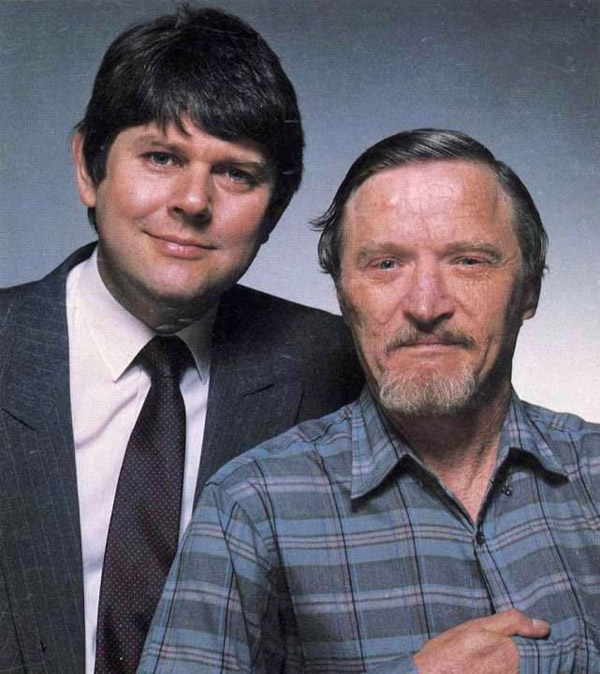
The rumors have been flying, and his arrival is imminent—a couple weeks after you read this—so it's time our readers know: John Atkinson, for the last four years Editor of Britain's prestigious Hi-Fi News & Record Review, is joining the staff of Stereophile as Managing Editor and International Editor.
Ever since Vol.6 No.3 was published in August of 1983, Stereophile has been the leading subjective review magazine in terms of circulation. At that juncture our circulation was 12,000 and has now increased to 15,000. And it's all your fault!
John Atkinson Opens
I've said it before and I'll say it again: a would-be loudspeaker designer shouldn't even start to think about the possibility of maybe designing a full-range, multi-way loudspeaker until he (and they do all appear to be men) has cut his teeth on a small two-way design. There is still as much art as science in designing a successful loudspeaker, even with all the computer-aided this and Thiele-and-Small that, that even a two-way design requires a designer either to be possessed of a monster talent or of the willingness to undergo months, even years, of tedious and repetitive work—or of both. For a would-be speaker engineer to start his career with a wide dynamic-range, multi-way design, intended to cover the entire musical spectrum from infra-bass to ultra-treble, seems to me to be a perfect case of an admittedly well-intentioned fool rushing in where any sufficiently self-critical angel would fear to tread.
Frankly it's a bit nutty for me to be doing this review. First, as Publisher of this esteemed journal, my primary duties involve financial and personnel management, as well as a good bit of public relations; I don't need and am not required to perform the exacting tedium of product reviews. Second, Jim Thiel and Kathy Gornik of Thiel are friends of mine. So what, you ask? Well, if this were going to be a uniformly positive review, I would therefore be ruled out as the reviewer; if it's to be wholly or partially negative, it will surely put a strain on one of my best audio friendships.
Thiel Audio, headed up by Jim Thiel (President and chief designer) and Kathy Gornik (Marketing Director), sets itself apart from other speaker manufacturers not only by making what I feel to be almost uniformly excellent products, but also by serving as a kind of hallmark for the good dealer: Although not all good dealers sell Thiel, just about every Thiel dealer is a good one. This comes about because, in spite of just about uniformly positive reviews and excellent customer relations, Thiel (primarily in the person of Ms. Gornik) has insisted on limited distribution through retailers they know will give their product a good demonstration. There are a few other such companies performing this hallmark function, though only Mark Levinson Audio Systems readily comes to mind. Most other successful companies prefer as wide a geographical distribution as possible, in spite of the occasional necessary compromises in dealer quality.
My eyes were inexorably drawn to a surprising headline this morning: "New Studies Say Universe Younger than Objects In It." A study by Indiana University's Michael Pierce has just been published establishing a new value for "Hubble's Constant" (the ratio of velocity to distance for distant, receding galaxies) which suggests that the universe may be as young as 7 billion years old; at the same time, researchers at Harvard are saying that the universe is somewhere between 9 and 14 billion years old. Quite a discrepancy! (A billion here, a billion there—pretty soon you're talking real age.)
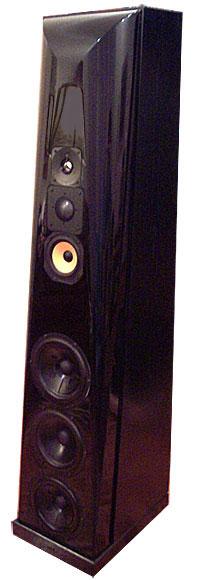
John Ötvös, the father of Waveform Research Inc. and The Waveform Loudspeaker, hesitates not at inviting ultracritical examination: "The Waveform is the most accurate, the best, forward-firing loudspeaker in the world." Period. Reviewers, of course, welcome such statements, and I'll be examining that one, but I'll also try to answer the inherent reviewing question of whether the Waveform is a good place for you to park $9800 on your way to "the highest of high-end sound" (that was our slogan for the first Santa Monica High End Hi-Fi Show).
Mirage /ma-'räzh/ n [F, fr mirer to look at. fr. L mirari] 1: an optical effect that is sometimes seen at sea, in the desert, or over a hot pavement, that may have the appearance of a pool of water or a mirror... 2: something illusory and unattainable, like a mirage.
Most readers of Stereophile are in it to read about great products—things that make the hobby and art of home sound reproduction exciting. In this respect, reviewers aren't too different—we love sound reproduction and music in general, and products that help bring this to life are the cat's meow. Reviewers that can't respond with this kind of excitement don't have a place writing for this magazine.
In 1966, two avid audiophile/music lovers—a nuclear physicist named Arnold Nudell and an airline pilot named Cary Christie—labored over weekends and evenings for 18 months in Nudell's garage to put together the world's first hybrid electrostatic/dynamic loudspeaker system. It cost them $5000 for materials, launched a company (New Technology Enterprises), and helped contribute to the popular myth that all of the really important audiophile manufacturers got started in somebody's basement or garage (footnote 1). The system was marketed as the Servo-Statik I, for the princely sum of $1795. (At the time, the most expensive loudspeaker listed in Stereo Review's "Stereo/Hi-Fi Directory" was JBL's "Metregon," at $1230.)