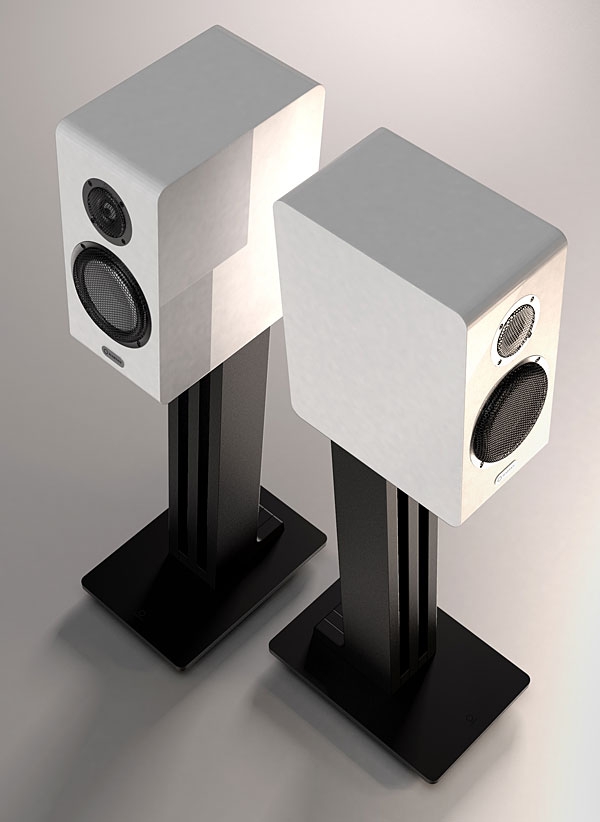
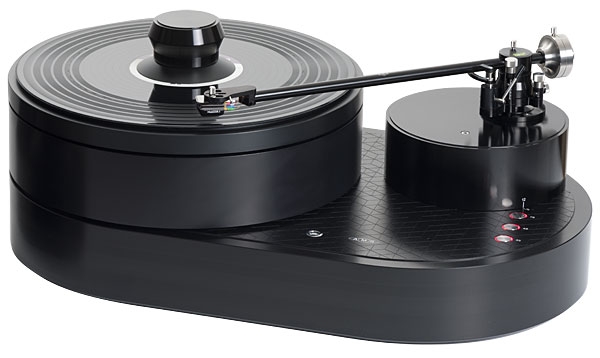
It doesn't take a genius to appreciate the audacity of naming a company after Albert Einstein, the iconic science and math whiz. Clearly, company founder and owner Volker Bohlmeier knew what he was doingthis German brand of boutique electronics has enjoyed worldwide critical and marketplace success since its founding more than 20 years ago.
Despite predictions to the contrary, the Compact Disc isn't dying anytime soon. Too many are in circulation, and until a smooth, friendly skin covers the computer interface, the music-server revolution will remain nascent. We're still in a long, shaky period of transition.
The minuscule electrical output of an analog signal from a moving-coil cartridge needs to be boosted before it can be converted to digital and equalized in the digital domain. Of course, you could use your current phono preamplifier and record an equalized signal to hard disk, but then you wouldn't get to experience Pure Vinyl's digital RIAA correctionnor would you be able to avail yourself of all the equalization curves provide by Pure Vinyl, of which there are almost too many to count.
As long as you're spinning an LP for your listening pleasure, and if digitizing it at a resolution of 24-bit/192kHz is transparent to the analog source, why not record and store the LP on your computer at that high sampling rate for future convenient playback via iTunes or for iPod use, or for burning to CD-R? And, while you're at it, why not record the LP unequalized and apply the RIAA curve in the digital domain, where you're not dependent on capacitors and resistors that are imprecise to begin with, and can drift over time? With no drift of phase or value, the virtual filter's results should be better than with any analog filter. And in the digital domain, you can program in any curve known, and select it at the click of a mouse. Aside from the sweat equity invested in programming it in the first place, it wouldn't add a penny to the program's cost.
This massive, two-box beauty from Denmark costs $60,000, and I wish I could tell you it wasn't really better in most ways than the already outlandishly priced and sonically superb Boulder 2008. I can't.
In my review in the February 2009 issue of Marantz's SA-11S2 SACD/CD player ($3599.99), I said that "buying [an SACD] player in 2009 necessitates an act of faith similar to the one turntable buyers faced back in 1992." The negative reaction to this from the besieged SACD community was as intense as it was irrational. If they're angry with me, I can only imagine how they feel about Stanley Lipshitz and John Vanderkooy, who presented a white paper at a 2001 Audio Engineering Society convention that claimed to prove that SACD doesn't qualify as a high-fidelity format (footnote 1). How many figurative bags of flaming poop did they leave at their front doors?
Why bother with three phono preamps most of us can't afford? For the same reason the enthusiast automobile magazines cover the newest Ferraris and Lamborghinis: just reading about them is fun.
Musical Fidelity's Tri-Vista kWP, introduced in 2003, was an impressive, high-tech, "statement" audiophile preamplifier. Its outboard power supply weighed almost 56 lbsmore than most power amplifiersand its hybrid circuitry included miniature military-grade vacuum tubes. As I said in my review of it in the January 2004 Stereophile, the kWP's chassis and innards were overbuilt, the measured performance impressive, and any sonic signature imposed on the signal was subtle and, essentially, inconsequential.