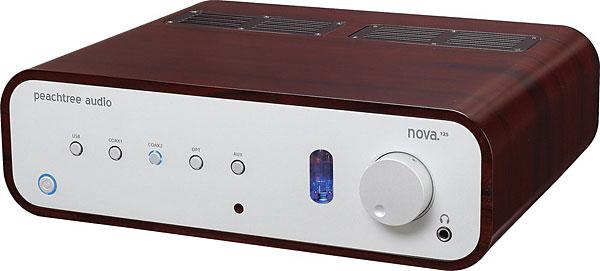
With Peachtree Audio's new nova125 integrated amplifier, most decisions are made for you.
Need a DAC with three S/PDIF inputs (two coax, one optical)? An asynchronous USB DAC? A line stage? A tubed output buffer? A power amp that should be able to drive even difficult speaker loads? Remote control? You've got them all for $1499. Just add speakers. (I assume you have a laptop computer and several disc spinners.) You may want a separate phono stage, because there is none onboard.
In April 1987, Anthony H. Cordesman had mixed feelings about the Mod Squad Passive Line Drive System Control Center. (Read his review here.) Introduced in 1984, the Line Drive offered volume and balance controls, five line-level inputs, and switching and monitoring for two tape decks. You didn't plug it into the wall; it provided no gain. Was it even a proper preamp? (footnote 1)
AHC demurred. "I'm not sure that I'm ready to advise anyone to take the risk of not buying a unit with a top-quality phono stage, no matter how well CD or DAT perform," he concluded, between commenting on Middle East wars.
There's so much uncertainty and confusion surrounding computer audio and high-resolution downloads. Which hi-rez formats will win out? How do you store the downloads you've bought? (Easy. Don't buy them.) How do you access them? Will digital rights management (DRM) cramp your style, or data-storage fees for cloud computing crumple your wallet?
Roy Hall has his famous Music Hall MMF (Make Money Fast) turntables made for him in the Czech Republic.
Roy has also long been associated with Epos Limited, since a chap named Robin Marshall started the company in 1983. Their first product was the ES-14 loudspeaker, followed by the smaller ES-11. Both were largish, stand-mounted models, and both offered a lively, expressive, unstuffy sound. The speakers have always been fun to listen to, even if they lackedand still lackthe refinement of some far more expensive speakers.
Kurt Sanderling died on September 17 in Berlin, just two days shy of his 99th birthdayof "old age," according to his eldest son Stefan. Sanderling was the last of a generation of conductors displaced by Hitleran exodus that included Otto Klemperer, Josef Krips, Sir George Solti, Erich Leinsdorf, Bruno Walter, who all went West. (Never mind that Klemperer had converted to Catholicism and that Krips was half-Jewish.) Sanderling fled East, to the Soviet Union.
"We like to make things," Roy Gandy, Rega's founder and owner, once told me. "It's what we do." Or maybe it was Rega's chairman and chief engineering honcho, Terry Bateman. Rega products are designed and manufactured in the south of England. So far as I know, no one at the Rega facility, on the Temple Farm Industrial Estate, has committed suicide; the same cannot be said of workers at the factory in China where iPods are made. Al Gore is on the board of Apple. Al, what do you think?
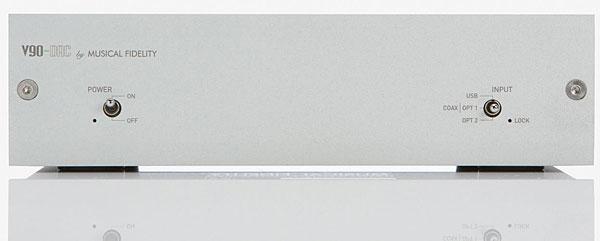
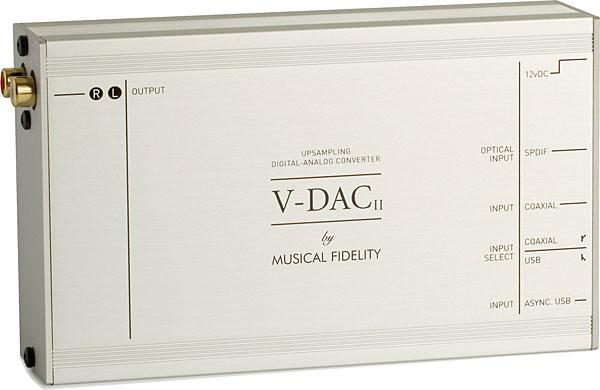
The M1 DAC is by Musical Fidelity. At $699, it's a stunning bargain. Comparing it to $995 for the Digilog in 1989. Meanwhile, the M1 is far more versatile, way better built, and, if memory serves me right, sounds vastly better.
It appears that the way to sell a DAC in 2011 is to almost give it away, in real-dollar terms. Some people pay far more than this for a set of speaker cables, a pair of interconnects, even a power cord. The M1 DAC is a piece of kit that can transform your system. I kid you not.
Roy Hall has been Creek Audio's US importer for more than 20 years. Did you know that all Creek gear is now made in China? Just like Cambridge Audio, Quad, and many B&W models. Just like some US speaker brands, for which virtually all parts are made in China but are assembled, it's claimed, in the US. Three cheers for brands like LFD, Rega, Sugden, and Harbethall still made in the UK. For French marques made in France. For Italian products produced in Italy. Etc.
If you have more than six or seven bucks to spend, you might consider the Imagine T floorstanding speaker from PSB Loudspeakers ($2000/pair). A year ago, John Atkinson reviewed PSB's Synchrony One speaker ($4500/pair; Stereophile, April 2008, Vol.31 No.4). The Imagine series is the next line down, and also includes center, surround, and bookshelf models. John Marks flipped over the Imagine B minimonitor in his column in the February 2009 issue.