Despite predictions to the contrary, the Compact Disc isn't dying anytime soon. Too many are in circulation, and until a smooth, friendly skin covers the computer interface, the music-server revolution will remain nascent. We're still in a long, shaky period of transition.
Italian manufacturer Chario Loudspeakers has never had a strong presence in the US. No wonder, then, when confronted by these exquisitely finished beauties of solid hardwood, many American audiophiles think, "Sonus Faber rip-off." Without knowing the musical history of the 1960s, had you heard Badfinger first, you might have thought the same thing when you then heard the Beatles. Similarly, Chario, by far Italy's largest maker of high-performance speakers, was founded in 1975, eight years before Sonus Faber. While SF has its drive-units built to its own specifications by other firms, Chario designs and builds its own.
With its high-end heart and home-theater brain, Chord's powerful CPM 3300 integrated amplifier ($9500 with the aluminum-cylinder Integra leg option, $8950 without) is a uniquely fascinating audio product well worth considering. High-tech innards and magazine-cover good looks don't hurt either, but what originally got me interested was the superlative sound Chord products have consistently delivered at trade and consumer shows when paired with Wilson-Benesch loudspeakers.
High-tech, compact, and lightweight, Chord's entry-level SPM 650 power amplifier ($4995) promises robust power output, low distortion and noise, flat and ultra-wideband frequency response, and bulletproof reliabilityall in what seems an impossibly small package measuring 16.4" wide by 3.4" high by 13.8" deep and weighing only 22 lbs.
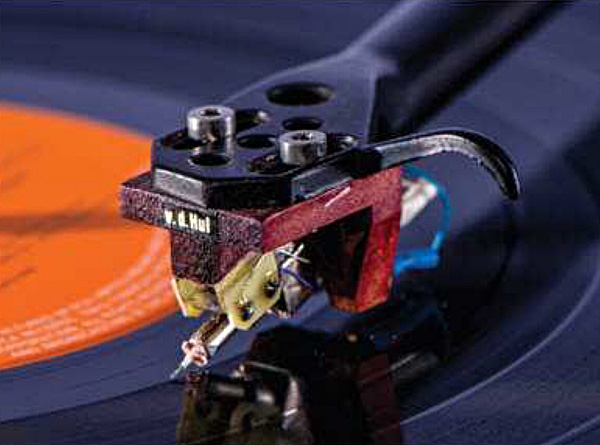
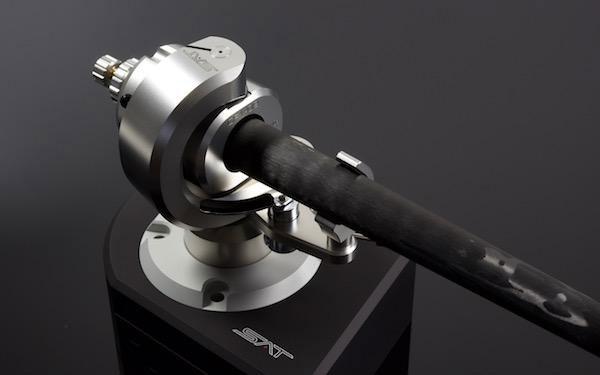
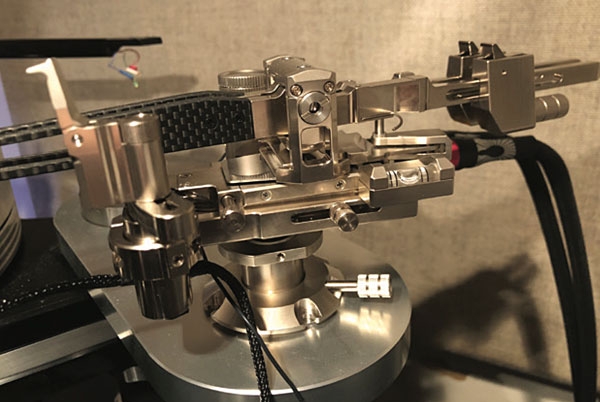
Enticing more music lovers to try vinyl requires a foolproof, plug'n'play solution. Asking a member of the digital generation to install a cartridge in a tonearm and then set up the VTA, SRA, VTF, etc. is asking too much. It's easier to make such a request of someone already bitten by the analog bug, but with turntables, wishing someone beginner's luck will not guarantee success.
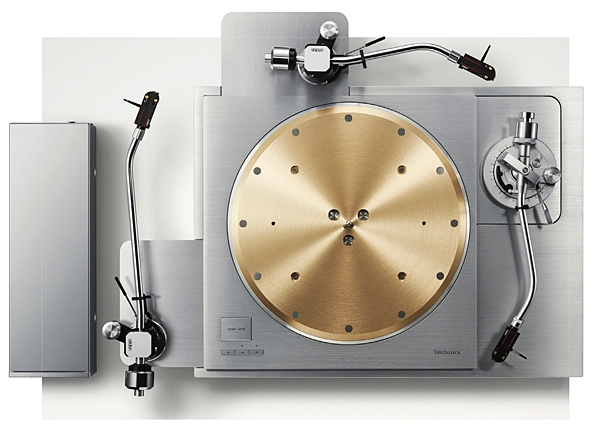
At a hi-fi show in Germany a few years ago, an audio club had set up a room filled with a dozen well-known turntable/tonearm combos. I recall seeing the Clearaudio/Souther, Immedia RPM-2 and arm, VPI TNT Mk.IV/JMW Memorial, Basis 2500/Graham 2.0, Oracle/Graham, Linn LP12/Ittok, SME Model 20/SME V, and some others I can't remember, including a few not exported from Germany.
Conrad-Johnson is one of audio's "marquee" companies, and charges accordingly. The Premier Twelve tube monoblock power amplifier, rated at 140W, sells for a rather steep $3495 each, meaning that unless you listen in mono, be prepared to lay out almost $7000 just for the amplification link in your audio chain. Apparently, many audiophiles feel the money is well spent: according to Conrad-Johnson, the Twelve has been a consistently strong seller during its approximately five-year production history.
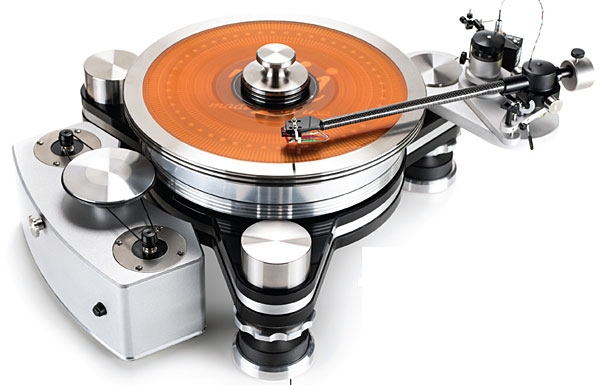
Part New Jersey diner, part Wurlitzer jukebox, with a snakelike tonearm that at certain angles looks vaguely lewd, this boxy, man-sized creation from Australia seems to have been built around its distinctive looks rather than for any functional purpose. Combine that with its sky-high price—itself almost obscene—and the result is apparently the sort of product that envious, cynical, self-loathing audiophiles love to hate, and reviewers love to write about.
Danish Audiophile Loudspeaker Industries (DALI), a relatively large maker of loudspeakers, was founded in 1982 by the peripatetic Peter Lyngdorf, who has worked with or founded Steinway/Lyngdorf, Lyngdorf Audio, TacT, NAD, etc. Audionord International, another company founded by Lyngdorf, owns DALI as well as American subsidiary DALI USA, along with yet another Lyngdorf creation: the 60 Hi-Fi Klubben stores, said to be the world's largest chain of high-end audio retail shops. Whew! The guy keeps busy.
What better way to celebrate the expiration of a noncompetition clause than to debut a product that has no competition? That's what Dan D'Agostino appears to have done with his Momentum monoblock amplifier ($55,000/pair)his first new product since leaving Krell, the company he cofounded more than 30 years ago.