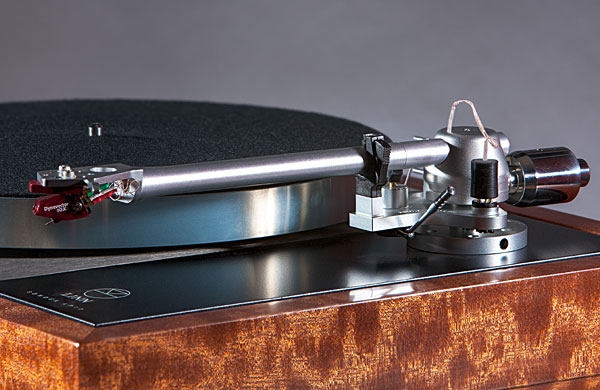
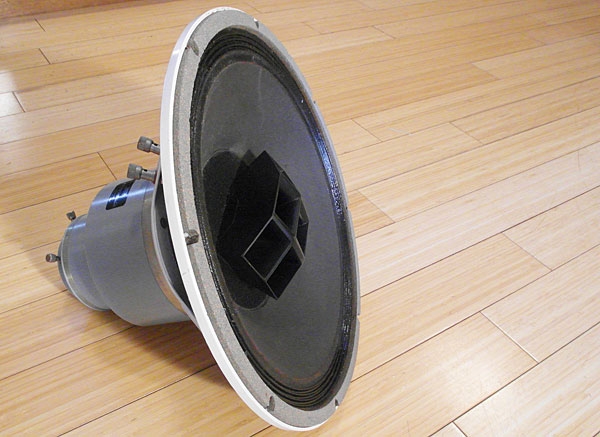
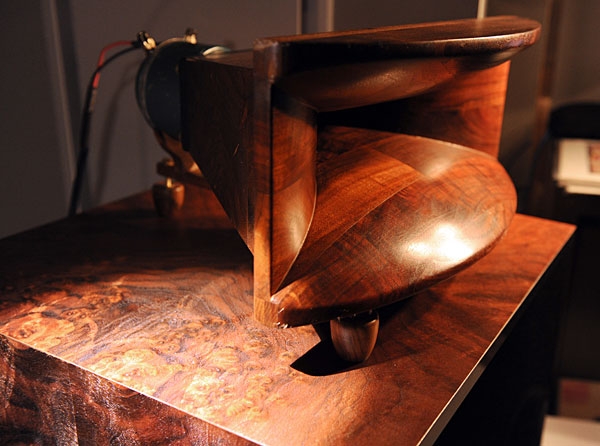
Colleen Murphy, whose first serious system was built around a pair of Klipschorns, prefers vinyl to all other formatsnot just for the superior sound, but for other, less tangible qualities. “It’s almost a ritual,” she said at NYAS 2013. “The inconvenience is one of the things that makes us give ourselves over to it.”
I thought the Raidho D-1 loudspeaker ($28,000/pair, including stands), was among the most interesting and musically impressive new products at SSI. Raidho, a Danish company known for their work with ultra-lightweight ceramics, has developed a process for bonding to their speaker diaphragms a thin coat of industrial diamond, conferring even greater stiffness and freedom from unwanted resonances. Paired with a Jeff Rowland Aeris D/A converter and Jeff Rowland 625 power amplifier, the Raidhos were impressive on a variety of material. We’ve all heard demonstrations where we came away saying, “I can’t believe they got so much bass out of such little loudspeakers,” but in terms of the sheer quality and scale of that bass, the Raidho/Rowland combination was on another plane altogether.
Granted, I know little to nothing about the home theater market, but I thought this was kind of cool: a paint called Screen Goo, available through all Sherwin-Williams dealers, that can be used to transform any flat, paintable surface into a projection screen. This two-stage treatmenta reflective undercoat, topped with a semi-translucent diffusive top coatis 100% acrylic, with a very low VOC content. Screen Goo is available with different degrees of pigmentation; the photo above compares unity-gain white, on the far right, with two other shades. This company’s biggest market? According to Kevin Nute of Goo Systems, it’s theme-park installations (eg, the Haunted Mansion at Disney World).
Seen on static display in the Canadian Pavilion at SSI: the 2A3-S single-ended amplifier from Triode Lab ($3288: an exceptionally good buy, assuming this nicely built amp sounds as good as it looks).
Red Wine Audio of Holden, MA, was the remaining link in the Sound by Singer chain: The aforementioned Bricasti D/A converter was, by means of its own volume control, used to directly drive a pair of Red Wine Liliana monoblock amplifiers ($5995/pair), wherein class-A tubed input stages are mated with class-A/B FET output stages to produce 115Wpc of very sweet-sounding watts. In this pic, Red Wine CEO Vinnie Rossi shows off the innards of his Isabella preamplifier ($3995 without phono-stage option), which uses 6H30 "super tubes," yet also supports all triodes in the 6922 family.
As names go, "Reference 3A" is awful. It sounds less like a company than it does a model number, as in the Dudco Reference 3A (on sale now wherever Fourier speakers used to be sold); I find it hard not to expect a Reference 3B with each new year. Add to that a cumbersome and somewhat meaningless model designation, "MM de Capo i"—what do the Ms stand for? what does the i stand for? haven't there been other de Capos in audio recently?—and my poor brain becomes utterly confused. And the older I get, the less I can tolerate being confused. Forgive me if, during the course of this review, I get lazy and fall back on the lazy and admittedly somewhat Clintonesque this speaker.
I see a pattern taking shape: Roy Gandy's Rega Research offered their first CD player in 1996, which was 13 years after the medium was introduced to the public. Now, in 2006, some 50 years after Joe Grado designed and sold the first moving-coil phono cartridges, Rega has released one of those. The year 2016 may see the first Rega fluoroscope, or perhaps wire recorder. And it'll be a good one, I'm sure.
You've heard it said that the early bird catches the worm, which is all well and good if you like worms. If you're more interested in music, you might want to follow the lead of Roy Gandy instead: He's the managing director of Rega Research, a 331/3-year-old audio company that was the very last of its kind to enter the CD market. Rega's first CD player, the Planet of 1996, was a success in virtually every way.
For a word that first appeared in print only 35 years ago, prequel has a lot of impact—if only in a commercial sense. The television series Smallville has become a staple of American broadcasting. Film producers gambled millions on the chance that audiences would want to know what happened when Batman began. And while moviegoers have turned their backs on the apparently awful Hannibal Rising, the book of the same name is doing brisk business indeed.
I saw it coming back in 1996. That was when Rega introduced their full-bore assault on the state of the art of record replay, the Planar 9 turntable. The P9 was and is a superb product, but because it sells for $3900—more than five times the price of the company's bread-and-butter model, the venerable Rega Planar 3—its introduction created an enormous price gap. And that's not to mention all the numbers between 3 and 9 that have languished for so long: How could you not expect Rega to fill in the blanks with Planars 4, 5, 6, 7, and 8?