Our Delta L-1011 emerged from the cloud split-seconds before its wheels touched the waterlogged ground. "How much lower does the cloud cover have to be before they divert us to another city?" I asked Tom Norton. "About an inch," came the phlegmatic reply. (Ex-F4 pilot TJN categorizes any landing you can walk away from as "good.") But at least we had reached Atlanta, after a saga of air-traffic control problems, weather delays, and missed connections. (Does anyone remember taking a flight that wasn't full, wasn't late, and wasn't sweaty and stressful? Wasn't deregulation supposed to improve service by increasing the choices available to travelers?)
Stereophile's founder, the late J. Gordon Holt, always had a thing for horn loudspeakers, feeling that these archaic beasts offered a "jump factor" that could never be rivaled by conventional, direct-radiating designs. A horn drastically increases the efficiency with which electrical power is converted into acoustic power, which means that for a given sound-pressure level, a smaller amplifier can be used compared with a direct-radiator, and that all distortions, both electrical and mechanical, can theoretically be much lower. Yet outside of a small circle of enthusiasts, horns never got much of a following in high-end audio, and as high amplifier power became plentiful and relatively cheap, horns largely disappeared from domestic audio use (except in Japan).
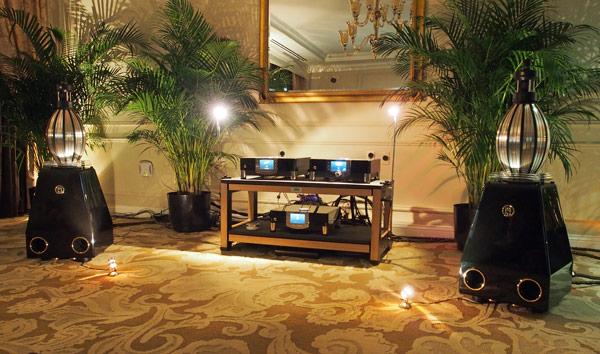
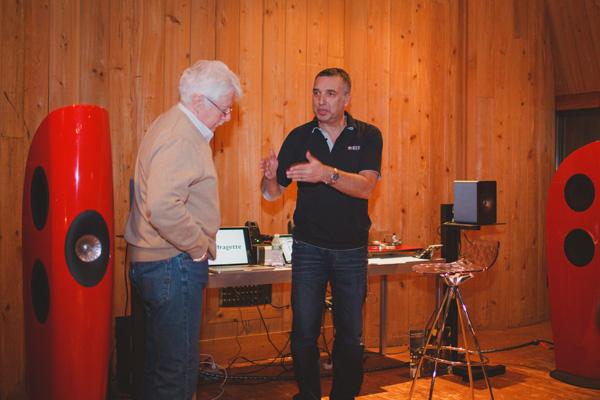
As you will see from the forthcoming May issue of Stereophile, modern horn speakers don't suffer from the colorations and idiosyncrasies that plagued the genre in earlier decades. Such was the case in the room shared by Aaudio Imports and Sanibel, FL retailer Lee Island Audio. The German Acapella High Violoncello II speakers ($80,500/pair) with their ionic tweeters, driven by Einstein The Turntable's Choice phono preamp ($9,800), Einstein The Tube Mk.2 balanced line stage ($18,400), and a pair of Einstein The Final Cut tubed OTL monoblocks ($34,900/pair), connected with Stage III interconnects, speaker cables, and AC power cords, produced a seamless soundstage and a smoothly coherent tonal picture. With the LP of Rickie Lee Jones singing "Chuck E's in Love," played on a Galibier Stevio turntable ($15,000) fitted with a Triplanar Mk.VII tonearm and a Dynavector XV1s phono cartridge ($5250), the sound was one of the best I heard at Axpona. I have asked Aaudio Imports' Brian Ackerman for review samples of the Acapella speakers.
A highlight of my reviewing year in 2010 was living with and writing about the Acapella High Violoncello II speaker from Germany ($80,000/pair). With its horn-loaded, ionic tweeter and horn-loaded midrange unit, this speaker offered both high sensitivity and some of the most satisfyingly musical sound I have experienced in my room.
Current production has been modified a little compared with the much-traveled samples I auditioned for my review. (They were the same pair I had auditioned at the 2010 CES, Axpona and RMAF Shows.) The drive-unit complement, cabinet, and crossover are all the same, but there is now a greater range of level adjustment for the ionic tweeter and isobaric-loaded woofers. But the sound of the latest version at CES. driven by Einstein electronics, sounded just as I remembered: dynamic, transparent, neutrally balanced, and not a trace of horn colorations.
"Who Stole The Bass?" asked Anthony H. Cordesman, writing about minimonitors in the April/May 1987 Stereophile (Vol.10 No.3). And for the designer of a box loudspeaker, the fundamental design decision, at any price level, is how much bass extension to aim for. It will always be possible to design a speaker with extension down to 20Hz, but will the result be musically and commercially successful? Will the designer end up with a speaker hypertrophied in that one area at the expense of every other? Will, indeed, the result be feasible technically? For example, for a given cabinet volume, gains in low-frequency extension have to be balanced against corresponding drops in sensitivity, and it is quite possible that to go for 20Hz extension will result in a 60dB/W/m sensitivity, equating with a speaker that only plays extremely quietly, and thus of no use to anyone.
One of the great divides in high-end audio concerns the question of how much bass is enough bass? The decision facing a speaker designer about how much low-frequency extension is appropriate is a fundamental one, so to speak: every extra 5Hz of bass will dramatically increase the retail price, as the speaker must be correspondingly bigger. Furthermore, the larger the speaker, the larger its problems, which in turn requires throwing more money at the design to solve those problems.
Flip flip flip]...Where the heck is it?...[flip flip flip]...Got it!" What am I looking for? There, in black and white, on p.634 of J. Gordon Holt's Really Reliable Rules for Rookie Reviewers (footnote 1), is the Prime Directive On Loudspeaker Setup: "Never, ever, choose a loudspeaker that has too much bass extension for your room!"
Back in the Spring of 1988, I was sent a pair of diminutive two-way speakers that totally redefined for me what miniature loudspeakers were supposed to be about. That model, Acoustic Energy's AE1, may have offered short measure in the low-bass department, but its apparently effortless dynamics, musically natural balance, and tangible imaging made it a winner. It also broke the mold of modern audiophile speaker design by featuring a 4.5" woofer with a metal cone just 3.5" in diameter. (Various companies have experimented with metal-cone drive-units in the past, only Ohm and pro-sound company Hartke having had any previous commercial success, though Monitor Audio now also offers a range of speakers with metal-cone woofers, their Studio line.) Since that time, Acoustic Energy has tried to produce a full-range speaker that built on the success of the AE1, but with only limited success, in my opinion. While their AE2 added a second identical woofer, and offered useful increases in bass extension and dynamic range, I felt it to be too colored in the midrange to be a real audiophile contender (see Vol.13 No.2, February 1990, p.134.)
In this issue's "Letters" column, you will find comments from readers who are bothered by what they perceive to be this magazine's emphasis on reviewing very expensive technology. Yes, we do cover a lot of cutting-edge technology, and it is, of necessity, expensive. But our experience has been that that technology invariably trickles down to products that real people can actually afford.