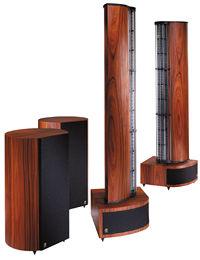
Bonnie and I decided to avoid the crowds last weekend, and instead settled in at home to watch the recent remake of Great Expectations, with Ethan Hawke and Gwyneth Paltrow. It seemed like a pretty good movie, but before long I found my thoughts drifting to the review I had in progress: my audition and analysis of the Magnepan Magneplanar MG3.6/R. True, Great Expectations is a little slow, and a few explosions or car chases might have better held my attention, but if ever there was an audio product to which the phrase "great expectations" applied, it's the Magnepan 3.6/R.
I finished my first day at THE Show, at the Flamingo hotel. (It's wonderful that CES and THE Show are now within easy walking distance.) Over the years, Magnepan has built some of the best-sounding speakers I've heard, and most often ones that perform at the level of speakers several times their price. The MG 1.6 is one of the High End's true classics and has always been one of its most spectacular bargains. One of Magnepan's demo systems was the brand-new MG 1.7. It's physically identical to the 1.6 but rather than planar-magnetic drivers for the bass and tweeter, the 1.7 use Magnepan's "Quasi-Ribbon." Both planar-magnetic and quasi-ribbon drivers are lightweight diaphragms onto which a conducting element is attached, but in the case of the planar-magnetic, the element is wire. In the quasi-ribbon, it's a very fine ribbon, or foil. The latter is lighter and covers more area, so the performance approaches that of a ribbon, where the conducting elementis the diaphragm. The 1.7s sounded truly spectacular and at just $2000/pair, destined to be another winner for Magnepan.
Brilliant designs, spectacular initial success, rave reviews, explosive growth that stretches resources way beyond limits, too much attention to technology and too little to manufacturing and business practices, long hours, quality problems, conflicts between partners, and finally...
In the last year I've written about several components of a truly engaging system: the VPI TNT Mk.IV turntable and JMW Memorial 12" tonearm (February '99), Grado Reference cartridge; the Wadia 830 CD player (October 1999); and Thiel's CS7.2 loudspeakers (February 2000). I've recounted the evolution of my listening-room setup as well, and described its optimization using ASC Tube Traps and Art Noxon's MATT test in the February issue. The final piece of the puzzle, and the one I'll tackle here, was the cable package from MIT: the MI-330 Shotgun Proline interconnects and the MH-750 shotgun speaker cables.
I've been in a nostalgic funk of late. What started it was visiting Golden, Colorado, where I spent my graduate-school days, and seeing all of the changes, not to mention the lecture halls full of kids who couldn't be a day over 12. When I commented on how young the freshmen looked, our host—a colleague of mine from grad school, now a professor—responded, "Those are seniors, Brian." I felt a little old.
If high-end audio were to carve its own Mt. Rushmore, whose faces would appear therebesides that of Stereophile founder J. Gordon Holt, of course? It's likely that no two audiophiles would ever come up with identical lists of subjects, but I wouldn't be surprised if they could agree on at least one name: Nelson Pass.
June is a always a perplexing time for me. The weather is lovely, the mountain wildflowers are blooming, things are pretty calm at work.....but it's Bonnie's birthday.
Nirvana Audio's cables have long been fixtures in my audio system: first the SL interconnects and speaker cables, and, after their debut in 1998, the S-X Ltd. interconnect. In 2002, after a long development process, designer Stephen Creamer introduced the companion S-X Ltd. speaker cable ($2780/2.5m pair, add $50/pair for biwire configuration). He explored a wide range of options, including dramatically different structures and materials, but always returned to the elements he'd used before—and ended up with a design that combined elements of his two existing speaker cables, the SL and the entry-level Royale. At its core, the S-X Ltd. has the Royale's two conductors, each a symmetrical Litz element consisting of 285 isolated strands of high-purity copper of several different gauges. In the S-X Ltd., the conductors are spaced slightly apart to minimize capacitance, wound into a twisted pair, and wrapped in FEP insulation.
Recently, I caught myself smiling at a tiny ad for Nirvana cables that proclaimed them to be "the quiet cable." My smile wasn't because the claim was outlandish, which it wasn't, but because it was so typical of Nirvana Audio Productssmall, understated, and all too easy to miss. The ad could just have easily and just as accurately have read "Nirvana...the quiet company."
One of the highlights of any Consumer Electronics Show, I have found, is Nordost Corporation's demonstration of their cables. Using a relatively modest system and non-audiophile source material, they run through a simple, straightforward sequence, climbing up through their product line, culminating with their new, just-introduced model. At each step, the system sounds distinctly better—clearer, cleaner, with more body and tonal purity—than with the previous model. There's no hype, artifice, or magic, just a clear demonstration of the progress that Nordost is making as they refine their designs.