Dick Olsher
Sort By: Post Date | Title | Publish Date
Dick Olsher Dec 22, 2009 Published: Nov 22, 1986 0 comments
Irving M. "Bud" Fried, an early contributor to Stereophile, hails from the city of brotherly love, and I must confess to finding it difficult avoiding a few brotherly jabs at Mr. Fried's name: something like "this Bud's for you" would surely not escape deletion by our conscientious Editor. And what if I should happen to complain of a dried-up or "Fried" quality in the upper mids—JA is bound to object to this breach of good taste. Well, having gotten that off my chest, you'd be interested to know that I consider it quite appropriate that someone from Phil-a-del-phia should be in love with transmission-line enclosures; the name is almost as convoluted as a trip down a folded line.
Dick Olsher May 07, 1995 0 comments
A.C. Wente of Bell Telephone Labs was apparently the first person to get the bright idea (in the 1930s) of measuring sound transmission in a small room. A loudspeaker at one point reproducing pure tones of constant power, and a microphone at another point measuring sound-pressure levels, gave him the means to assess the room's impact on sound quality. The measured frequency response was so ragged that I'm positive the venturesome Dr. Wente was duly shocked.
Tonearm Reviews
Dick Olsher Mar 26, 1995 Published: Mar 26, 1991 0 comments
Frankly, I'm fed up with the prophets of doom, those false seers who forecast vinyl's imminent demise. Some claim to have seen the writing on the wall as far back as ten years ago, sensing that the advent of the CD would perforce relegate the stylus-in-groove method of transduction to the trashpile of history. First of all, most of the music I enjoy happens to be on LP. And I'm sure I speak for many audiophiles who have also spent a lifetime building up a vinyl collection when I say we're not about to throw away our cherished treasuries of music. These LPs I expect to enjoy until the end of my time. Thus, I welcome any phono-system technological advance that will recover more information from the groove.
Dick Olsher Nov 21, 2012 Published: Jan 01, 1993 0 comments
In its comparatively few years in the marketplace, the line-level preamplifier appears to have established commercial parity with its full-function big brother. That this was inevitable was clear as far back as the mid-'80s. The advent of the CD and the proliferation of digital sources argued for a modular approach to preamp design. In such an environment, line-level sources (eg, DAT, CD, even analog tape) deserve special attention.
Dick Olsher Sep 26, 1995 Published: Sep 26, 1991 0 comments
Let me take you back some 40 years to the mono days of the early 1950s. It's unlikely that the minimonitor genus of loudspeakers, of which this French JMlab is a prime example, would have survived back then. There was the practical problem of available amplifier power. The average amp could squeeze out no more than 10 to 15W into an 8 ohm load—far less power than the typically insensitive minimonitor demands for adequate dynamic headroom. But that in itself would not have sufficed to displace the minimonitor from the marketplace. After all, "high-power" amps (50-watters) could be had at a price.
Dick Olsher, Various Sep 07, 1998 Published: Nov 07, 1986 0 comments
The Model R107 represents the flagship of KEF's Reference Series, and is second only to the Professional Series KM-1 in KEF's product line. Anatomically, the 107 resembles a person. Beneath a decorative "hat," there's a special head assembly akin to the head on the old Model R105. This head assembly contains the brains of the 107, namely a T33 ferrofluid-cooled tweeter and an improved version of the classic B110 midrange driver, featuring a better voice-coil and a new polypropylene cone. The nerve center is also here, in the form of two passive dividing networks and load-impedance equalizing network. Level equalization of the drivers is performed actively within the KUBE, the second brain of the 107—about which you'll hear more shortly.
Dick Olsher Apr 04, 2004 Published: Jan 01, 1994 0 comments
MACH 1 Acoustics? Cute name. Mach 1 is, of course, the speed of sound—the speed at which a loudspeaker's acoustic output is forever constrained to travel. Quite a fitting choice for Marc McCalmont, Marine and jet pilot turned speaker designer. Marc retired to Wilton, NH together with Melissa. (Oops, that should be MLSSA, the well-known acoustic analysis system—not Marc's girlfriend.)
Tube Power Amp Reviews
Dick Olsher Jun 30, 2009 Published: Jan 30, 1995 0 comments
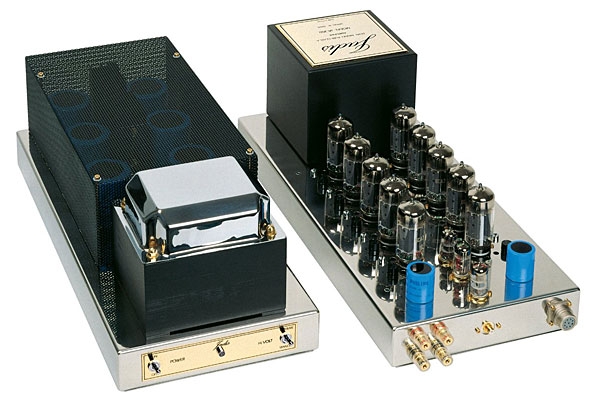
Neither its rather pedestrian name nor Manley Labs' own literature gives much of a clue as to the 175 monoblock's special pedigree. Where are the bands, the fanfare?! After all, the rolling-out of a 6L6–based high-power audiophile-grade tube amplifier definitely qualifies in my book as a momentous occasion. Deplorably, such happenings are rare indeed; the 6L6 has been unjustly neglected in high-end circles.
Dick Olsher Apr 10, 2005 Published: Oct 10, 1993 0 comments
MartinLogan's Gayle Sanders has almost single-handedly raised the electrostatic/dynamic hybrid loudspeaker to a position of prominence in the High End. First, there was the MartinLogan Monolith (reviewed in Vol.8 No.3 and Vol.9 No.3), followed by the much more affordable Sequel (reviewed in Vol.11 No.12, Vol.12 Nos.8, 9, and 12, and Vol.14 No.2). Then came the subject of this review, the Quest, and most recently the diminutive Aerius, reviewed by JA elsewhere in this issue.
Tube Power Amp Reviews
Dick Olsher Feb 19, 2013 Published: Dec 01, 1989 0 comments
666rm9amp.jpgDo you believe in beginner's luck? If so, some of your personality traits should be quite predictable. Let's see. You're very likely an optimist with a "bull-market" mentality, play the lottery, and, most important, bought a CD player within a year of its introduction, or a solid-state amp in the '60s. You're apt to mail in a profusion of bingo cards (you know, the kind Stereo Review is full of) and spend hours perusing specifications in the hope of finding a kernel of truth in all of that chaff. You'd particularly be appalled at that fellow I ran into the other day, who had bought an AR-1 in 1956 and waited another decade before buying another speaker—just to make sure stereo wasn't a fad. Hey, relax, I won't turn you in; the mere fact that you're reading Stereophile is sufficient reason for redemption.
Site Map / Direct Links