Debuting at CES 2011, Running Springs Audio’s Elgar Powerline conditioner is so new that Dan Babineau has yet to produce product literature. A trickle-down, opening price-point piece ($999/6 outlets), it can handle 1800W maximum. The 100% passive, noncurrent-limiting design employs the same filters as all other Running Springs Audio products, but uses a smaller-laminate inductor to increase dynamics.
Designed for smaller, modest systems, the Elgar Powerline conditioner is hand-built in Anaheim, CA. “It does three things really,” Babineau said. “A high quality circuit breaker, it also takes care of atrocious noise anomalies, and cleans up the power without negatively affecting the source. This has always been my goal since I started the company ten years ago.”
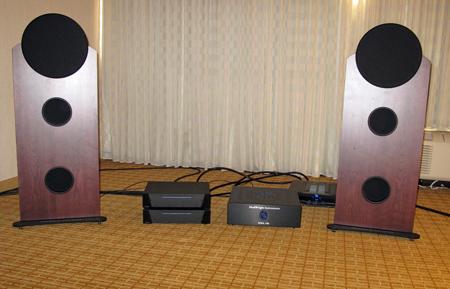
I had heard much positive buzz about the fascinating-looking Salk SoundScape loudspeakers. Equipped with the excellent RAAL custom ribbon tweeter, an Accuton midrange, and a separate Acoustic Elegance woofer, the Soundscape 10 ($9999/pair base price, or $13,999/pair with a 12" woofer) is said to perform from 21Hz60kHz, ±3dB. It also offers adjustable tweeter and midrange ambience, and looks like a baby that will attract lots of positive attention in your living room.
The magic numbers, for Salon Son et Image, are 25, 100, and 10,000. Canada's first and largest high-end audio show, whose 25th-anniversary show arrives March 2325 (press day March 22) in downtown Montreal's Hilton Bonaventure, expects to set a new attendance record as up to 10,000 visitors explore 100 exhibit rooms.
Tipped off by Stereophile reader David Goodwin, I recently visited the San Francisco Airport Museum's beautifully thought-out and executed exhibit The History of Audio: The Engineering of Sound. Installed to coincide with the 121st convention of the Audio Engineering Society, held at San Francisco's Moscone Center October 5–8, the exhibit runs through May 2007 in the North Connect Gallery of the airport's Terminal 3 (footnote 1).
In a surprising move, the San Francisco Symphony has announced plans to release the next installment in its ongoing Mahler series, the beloved Symphony 5, in download format before issuing the recording on hybrid SACD/CD. The Fifth will first become available on iTunes on September 12, and in hard format three weeks later. Such an unprecedented release schedule, from one of the few symphony orchestras in the world to regularly record in the high-resolution SACD format, can be seen as part of a near-universal recognition among record labels of the importance of online sales.
"We did this for audiophiles, really," says the San Francisco Symphony's general manager, John Kieser. "Our distributors around the world have been telling us that it would be terrific if our Mahler series were available as a complete set on vinyl. This is a major endeavor, in that we're talking about 22 LPs."
People sat up and took notice when Sanders Sound Systems released their Model 10 full-size electrostatic loudspeakers with analog electronic crossover amplifiers a few years back. The latest version, Model 10c ($13,000/pair) was delivering solid, full-range sound from a system that also includes Sanders Magtech Stereo amplifier ($5000), new preamplifier that combines both line and phono stages ($4000), and their own interconnects and speaker cables.
Although Roger Sanders was not in the room when I finally got there on the third day, his "handcrafted in Colorado" electrostats were singing as if he were. In addition to the superb transparency that one expects from a good electrostat, the bass was not just convincing, but simply amazing. The sound was a bit sharp in the small room, and at one point, in an unfortunate performance of Puccini's "O mio babbino caro," distorted on top. Since I've not had either experience in previous auditions of Sanders electrostats, I have a hunch the distortion probably due to the mikes used to record this unsuited-for-the-role-of-Lauretta soprano. (I have a number of recordings from EMI that grow harsh and noisy on vocals due to the choice of microphones).
Due to a horrible traffic jam in the bowels of the Sands/Venetian Show venue, I was only able to catch the tail end of Greenpeace's January 9 press conference. The good news is that the greenest consumer electronics products on the market today have a smaller environmental footprint than those sold a year ago. The sad news is that there is considerable room for improvement.
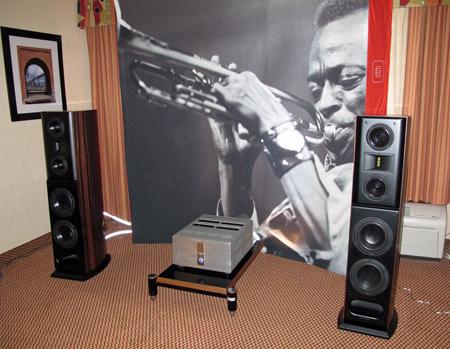
I couldn't resist the wonderful sounds of Louis Prima coming from the Green Mountain Audio room. Paired with Jaton Corporation’s Operetta AP2140A 2-channel Distributor amplifier ($1000, 140Wpc into 4 ohms, 70Wpc into 8 ohms), whose "processing filter circle eliminates 99.99% of noise at maximum volume," the intriguing-looking Green Mountain Calypso loudspeaker ($10,000/pair for the next month or so before the price increases 10–15%) was producing the kind of extremely smooth sound that draws you into the music. The speaker measures 88–89dB sensitivity, and utilizes a simple, first-order crossover to achieve "perfect" time-coherence. The midrange and tweeter are also adjustable forward and back for optimal sound in the listening position. The entire system, including the speaker, was wired with Marigo wire. I constantly find that Green Mountain's innovative designs produce lovely sound. Expect a whole new line of smaller, less-expensive speakers to appear on the Green Mountain website in another month or so.