Robert Deutsch
Sort By: Post Date | Title | Publish Date
Robert Deutsch Apr 11, 2004 Published: Dec 01, 2001 0 comments
As technology develops, things get more and more complicated. With every update of Windows, the program offers greater flexibility, but runs slower and makes greater demands on hardware. Automobiles have become so complex that only the most highly trained mechanics are able to fix even a minor malfunction. Surround-sound processors come with inch-thick owner's manuals.
SSI 2013
Robert Deutsch Mar 27, 2013 2 comments
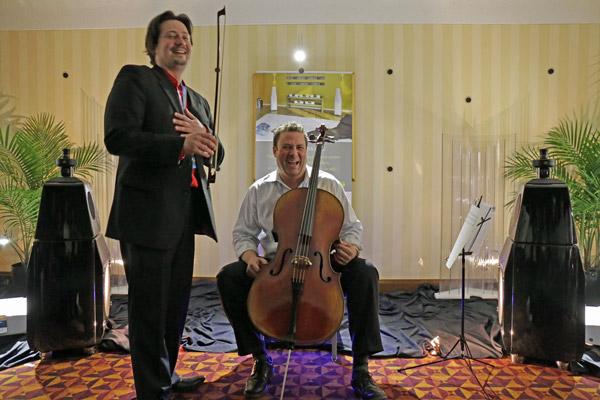
One of the most memorable musical events of SSI 2013 was the "live-plus-recorded" mini-concert by cellist Vincent Bélanger, presented by MBL. There were several of these every day of the show; Art Dudley wrote about it in an earlier blog posting. I had attended one of these events last year, and ended up playing the cello—after a fashion. This time the special guest was Stereophile publisher Keith Pray, and, as you can see in the picture, he had a great time.
CES 2011
Robert Deutsch Jan 13, 2011 0 comments
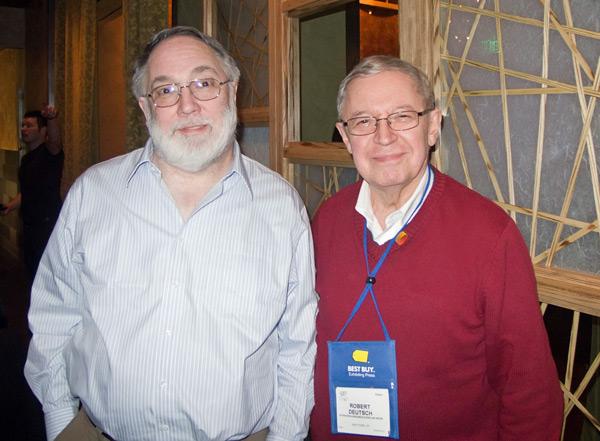
One of my more pleasant duties at this year’s CES was substituting for John Atkinson at a dinner for the press held by DTS. (JA had not arrived yet from New York.) What I was particularly looking forward to—in addition to dinner at Nobu, one of Las Vegas’ best Japanese restaurants—was the opportunity to meet the legendary “JJ”: James Johnston (left), audio researcher, who has been called “the father of perceptual coding” for his work while at Bell Labs on MP3 and MP4. JJ is Chief Scientist at DTS, and also a Forum contributor at stereophile.com, occasionally jousting with those who make claims about sound reproduction that he feels have no scientific basis.

The pre-dinner presentation dealt with the latest surround sound format from DTS: Neo X 11.1, which uses 11 channels. Yes, folks, that’s 11 speakers, 11 channels of amplification, plus a powered subwoofer. There is not definite word on exactly when software and consumer hardware for this format will be available, and DTS admits that an 11.1 channel system is not something the average consumer will likely aspire to. However, a point made by JJ was that even if DTS 11.1 does not reach broad consumer acceptance, the research on 11.1 will lead to a better implementation of surround sound with 5.1 or 7.1 systems. He made an allusion to some work that he’s doing now—which he could not discuss—that promises sonic virtual reality with a lot fewer than 11 channels.

I did get to meet and chat with JJ, and found him to be very genial—not at all like the doesn’t-suffer-fools-gladly persona that’s sometimes in his Forum postings.

CES 2008
Robert Deutsch Jan 10, 2008 0 comments
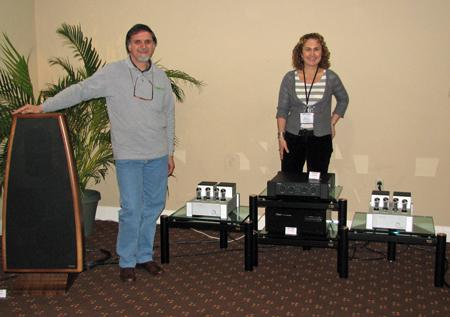
Continuing my game of guess-the-nationality-of-the-manufacturer, I walked into a demo room that had a very-nice-sounding system with the brandname Nightingale. My thought was British (I recall vaguely a British speaker designed by John Jeffries many years ago bearing that name) or Japanese (as in the Emperor’s Nightingale). However, the answer was Italian. They make electronics as well as speakers: they were demming the prototype PTS-03 battery-operated preamp ($8000), the Gala power amp ($6000), and the new CTR-2 speakers ($9000/pair). I also saw what I thought was another power amp (the one on the right in the picture), so I asked about it, and was told that it was actually the power supply for the amp. I wasn’t doing too well in my guessing here!
SSI 2010
Robert Deutsch Mar 26, 2010 6 comments
Shows like SSI are about the cutting edge in audio, with the latest and (purportedly) greatest on display and demonstration. Given this, I always get a kick out of spotting a piece of equipment that just does not seem to belong in such august company. This Sanyo JCX 2600K stereo receiver is from another era—circa 1978–1981 according to the ever-helpful Google search. Looks like it's in great shape. I spotted it on a shelf in an area of the show where they were setting up racks of LPs for sale. What was it doing there? I have no idea. Wonder how it compares sonically with the latest-and-greatest?
CES 2012
Robert Deutsch Jan 18, 2012 0 comments
Checking out the Reference 3A speakers (Grand Veena, MM de Capo i, etc.) in Divergent Technologies' room at T.H.E. Show, I noticed that the center of the midrange and mid-bass drivers looked different. Divergent's Tash Goka was not in the room, but the person who was there introduced himself as the one responsible for the modification of these drivers. He's Ricky Schultz, inventor of the Surreal Acoustic Driver Lens, a small plastic device that is glued to the drive's dustcap, and has the effect of broadening the dispersion. The Surreal Acoustic Driver Lens is being incorporated into the production of all Reference 3A speakers. It's an OEM product, not available to consumers, and, according to Schultz, it has the potential to improve the performance of many loudspeaker drivers. He proceeded to provide me with the explanation of how the device works, but it quickly went over my head.
FSI 2008
Robert Deutsch Apr 05, 2008 7 comments
There were lots of turntables at the show, but the one that intrigued me the most was the Calibre Mk.101, from Audio Excellence, the Toronto-area dealer, which is making its first foray into the turntable business. The Calibre Mk.101 has a with a marble plinth, 1.5" thick acrylic platter, AC motor with speed regulation, high-quality polished bearing, and looks elegant without being ostentatious. The price of $1999 includes a good-quality arm, with further arm upgrades available. Audio Excellences stated aim in introducing the Calibre Mk.101 is "the best reproduction of records at the lowest price possible—making turntables we would own."
SSI 2011
Robert Deutsch Apr 03, 2011 5 comments
Would you like to take "your high-end system to a whole new level of accuracy, from high-fidelity to acoustic fidelity?" That's what the Trinnov ST2-HiFi loudspeaker/room optimizer ($6200) promises. And it looks like a pretty sophisticated device, measuring the impulse response of the loudspeaker in the room, analyzing the room modes, and automatically computing FIR and IIR filters to improve the dominance of direct sound over late reverberation, equalizing the response in both frequency and time domains. The ST-2-HiFi is supplied with a calibrated microphone array; once that's placed in the listening area, all you have to do is press a button and the ST-2-HiFi does the rest. Comparing the sound of a pair of Sonodyne amplified speakers before/after Trinnov ST-2-Hi-Fi correction, I noticed that the imaging became considerable more precise after the ST-2-Hi-Fi processing, and the bass seemed tighter.
Robert Deutsch Sep 09, 2006 Published: Feb 09, 1993 0 comments
My first encounter with the Acarian Alón IV was at the 1992 Las Vegas WCES. I was doing the show report dealing with speakers, and there was already enough advance buzz about the Alón IV that I put it on my "Speakers I Must Listen To" list. And listen I did, at some length, and came away impressed with their open quality and well-defined soundstage. In discussing reviewing assignments with John Atkinson, I told him that the Alón IV was one of the speakers I wouldn't mind spending some time with. (The list also includes the WAMM, the MartinLogan Statement, and the Apogee Grand, but I'm not holding my breath.)
FSI 2007
Robert Deutsch Apr 16, 2007 0 comments
Adam Professional Audio is a German company that makes loudspeakers aimed at, as the name suggests, the professional market; their list of users include Abbey Road Studios and Lincoln Center. They're now poised to enter home audio. They had several of their speakers on display, but the only ones actually playing were in a large home theater demo room. The demonstration piece was the "chase" scene from the latest James Bond movie, Casino Royale, and all I can say about the sound was that it was loud. (Putting on my ultimateavmag.com hat, I can also say that the projector's color saturation was set too high.) However, reading the product literature, it's clear that the speakers represent a formidable amount of technology. The tweeter and midrange driver are based on the Air Motion Transformer principle developed by the late Oskar Heil, called Accelerated Ribbon Technology (A.R.T.) in Adam's implementation. (Klaus Heinz, Adam's chief engineer, worked with Heil.) The woofers have a honeycomb-structure diaphragm. The Adam Tensor Betas that served as the front L and R speakers use two 11" woofers and a 7" one, plus two midrange units and a tweeter. Powered with B&O ICE module. class-D amplifiers, a pair of Beta Tensors cost $60,000. There are two other speakers in the Tensor series, all semi- or fully active, the prices varying from $30k to $80k.
Site Map / Direct Links