For those of us who have succumbed to the enticements of surround-sound for music, Audio Research's SDP1 is both vindication and cause for rejoicing: vindication because surround-sound's acceptance by such an ultraconservative, uncompromising company as ARC will give it a respectability in the high-end community that it never enjoyed before, and cause for rejoicing because someone has finally done music surround right. High-end audio has a long history of minimalism—the view that, when it comes to active circuitry, less is definitely better than more. Tone controls disappeared from the high-end scene when it became apparent that no one could make them good enough to disappear when they were set to Flat. (Even the switching that allowed them to be bypassed introduced a measure of signal degradation that was audible under certain conditions.) Direct-coupled circuitry became popular when it was realized that every capacitor, no matter what its dielectric material, degraded the sound to some extent. Even the lowly resistor, the most boringly passive of all passive components, introduces artifacts that become audible in a high-resolution system. Surround-sound decoders did not spring from the minimalist roots of the High End. Because they were aimed originally at movie buffs and not music-listeners, Home Theater surround decoders use the same Dolby Logic steered system that movie theaters use. It works fine for soundtracks, and it's an absolute necessity in movie theaters, where 99.9% of the audience listens from everywhere but the sweet spot. But it's a disaster with most music recordings.
In order to work properly, logic steering needs unambiguous center and surround signals to latch onto. During soundtrack production, these are provided by panning mono signals into the stereo mix: an L+R sum for the center channel, and an L-R difference (a pair of anti-phase signals) for the surrounds. When the decoder detects either, it steers it to the center speaker or the surrounds, respectively, and cancels it from the adjacent channels to improve apparent separation. Music recordings that aren't specifically surround-encoded lack these unambiguous signals for the steering to latch onto. The L+R component is not a mono signal; it's the sum of the components of the stereo signal that are more or less correlated between the channels. The L-R component is roughly half—the uncorrelated half—the reverberant energy from the recording space. A steered system cannot steer to more than one channel at a time, so it must make continuous decisions as to where it should steer. When the center and surround signals are vaguely defined, the steering flails out in all directions, sending sounds here, then there, then somewhere else. The result can be impressively conducive to motion sickness. Many surround decoders don't offer unsteered surround as an option for music listening. Those that do usually mess everything up in a different way, by digitally synthesizing a surround signal—usually with a selection of simulated "room" types, from "night club" to "stadium"—from the front-channel L and R components. These effects can be fun to play with until the novelty wears off, but they have nothing to do with realism, because they don't reproduce the hall sound that's on the recording. And all these decoders are flawed in yet another way: They don't treat the critical front channels very kindly.
All of them have active circuitry in the front channels that's absent from conventional stereo systems. Even decoders that offer unsteered L-R music modes usually have at least one stage of amplification in each front channel, plus an output buffer to allow them to feed long interconnects. And no matter how sonically benign these may be, they're not as benign as no active stages at all. Audio Research is, to my knowledge, the first company to offer completely distortionless stereo channels in a surround decoder. It's all down to delay
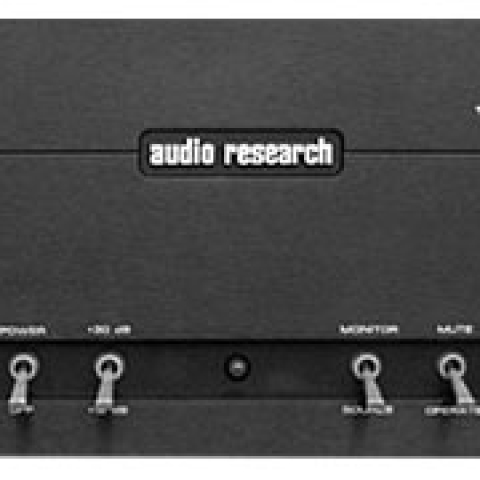
The Audio Research SDP1 is designed to connect between the power amplifiers and a conventional preamp or line controller so that the latter's volume control will affect all channels simultaneously. It provides a hard-wired, straight-through path for the front left and right signals; they don't even have a volume control. The surround signal is derived by tapping off the L and R signals and subtracting one from the other. (This was how the so-called Hafler "Dynaquad" surround decoder of 20 years ago worked, except that that operated at speaker level.) The derived signal is passed through a digital delay and then split into two paths, each of which feeds a level control and a separate output. The delay—the lack of which was the Dynaquad's major shortcoming—is to keep front sounds that leak through to the rear speakers localized at the front. For reasons I won't go into now, a derived surround system has very high separation (about 40dB) between the left and right channels and between the center and surround channels, but very poor (3dB) separation between adjacent channels—left and center, left and surround, and so on. Putting a short delay into the surround channel doesn't actually improve front/back separation, it just invokes a psychoacoustical phenomenon called the Precedence Effect.
The Audio Research SDP1 is designed to connect between the power amplifiers and a conventional preamp or line controller so that the latter's volume control will affect all channels simultaneously. It provides a hard-wired, straight-through path for the front left and right signals; they don't even have a volume control. The surround signal is derived by tapping off the L and R signals and subtracting one from the other. (This was how the so-called Hafler "Dynaquad" surround decoder of 20 years ago worked, except that that operated at speaker level.) The derived signal is passed through a digital delay and then split into two paths, each of which feeds a level control and a separate output. The delay—the lack of which was the Dynaquad's major shortcoming—is to keep front sounds that leak through to the rear speakers localized at the front. For reasons I won't go into now, a derived surround system has very high separation (about 40dB) between the left and right channels and between the center and surround channels, but very poor (3dB) separation between adjacent channels—left and center, left and surround, and so on. Putting a short delay into the surround channel doesn't actually improve front/back separation, it just invokes a psychoacoustical phenomenon called the Precedence Effect.