In just a few years, Sonic Frontiers has evolved from a parts and kit vendor to a full-line audio manufacturer (footnote 1). Their initial offerings were well received, but their kit origins were apparent in the layout and cosmetics of their products. While SF still offers kits (like their high-value Assemblage DAC-2), the new line of vacuum-tube electronics has world-class construction, design, and packaging. This generation of SF equipment is evidence of their advanced evolution, even though their constructor genome can be detected in the use of audiophile-preferred, as opposed of OEM, components.  For the past few months I've been using a nearly all-SF system consisting of the CD player, Line 2 preamplifier, and Power-2 amplifier. I began this review grudgingly because I'd made a decision a while back to no longer pursue vacuum-tube electronics. After all, today's solid-state stuff is damn good, and who needs the burdens that come with hollow-state devices: added heat, physical vulnerability, component aging, etc.? On the other hand, if the results are worthwhile, why should I care if the designer builds an amp powered by rats on a treadmill? Sure, I have to feed the rats (and clean the cage), but the bottom line is the performance. So when, in discussions with SF's Chris Johnson about DACs and chips and stuff, he extolled the virtues of the SFCD-1, Line 2, and Power-2, I really couldn't defend my old resolution. Technology
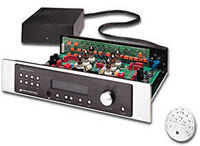
The Line 2 impressed me as soon as I opened the shipping carton. Inside, I found a large box containing the preamp, a smaller one for the power supply, and a large foam-lined tray with tools and tubes. Sonic Frontiers provides a screwdriver, six 6922 vacuum tubes (each clearly labeled to indicate where it goes in the preamp), and a pair of white cotton gloves (to avoid getting grease and oil on the tubes). You must open the preamp, put on the gloves, and insert each of the tubes in its socket, as the bias for each has been adjusted at the factory. (Though the biasing procedure is clearly explained in the manual, here's one argument against vacuum tubes shot down.) Under the covers, the Line 2 is a beauty. The general layout, parts quality, and wiring are superb. Along the rear, a bank of input relays feeds a pair of Crystal CS3310 volume-control chips. While Crystal describes these as "digital" controls, they are dual analog attenuators manipulated with digital control signals; the audio remains analog. It's possible to get gain from these chips, but SF has limited itself to the 95.5dB attenuation range. SF uses one dual-channel chip per channel to maintain the fully balanced signal paths. The main board is L/R symmetrical, with three 6922s per channel in a circuit derived from the acclaimed SFL-2 preamp. In each stage, a single 6922 serves the + and - signals with balance controlled. In addition, a DC servo on the third (output) 6922 eliminates the need for a blocking capacitor; indeed, the Line 2 is DC-coupled from input to output. Outputs are relay-routed to balanced (XLR) and single-ended (RCA) jacks. The tape buffer is the respected Burr-Brown OPA2604, also used in SF's adaptation of HeadRoom's cross-cancellation headphone driver.
Almost all the control circuitry is encased and isolated in the front panel. This keeps these pernicious logic signals away from the main board and close to the controls and the IR receiver. My original Line 2 suffered a failure of the IR receiver circuitry after a few weeks, although panel controls still functioned. Replacement consisted of removing eight screws, unplugging a single (multipin) connecter, then reversing the procedure. I appreciate this modular construction as evidence of great ease of service. A bit later, I swapped that Line 2 for the one under test because SF implemented a software change that improved the control responses. No sonic differences were noted between the two units. The Line 2's power-supply arrangements are quite extensive. The external power supply (power transformer, rectification, main reservoir, and preregulation) feeds the main chassis via a hefty screened umbilical cord. There are no fewer than 19 local power-supply regulators inside the main chassis, serving to ensure that each stage and/or functional module is optimally served. Grab the controls!
The Line 2's front panel is dominated by a large volume-control knob and a bright display window. The knob has an extremely light touch. With Mute on, the separate readouts for each channel sweep from 0 to 95.5dB in 0.5dB steps as you spin the knob. If you keep spinning, the display maintains either 0 or 95.5 with no misbehavior. The display also indicates the selected input, phase, and loop status.
To the left of the display are six input selector buttons, and buttons for the tape monitor and external processor loops. Each input can be programmed for a suitable default volume setting. Aha! Here's a problem: The Line 2 has two balanced inputs, labeled BAL-1 and BAL-2, and four single-ended inputs, labeled SE-1 through SE-4. Are these descriptive? Not to me. I had a hard time remembering if SE-1 is the SFCD-1, the AA DDE v3.0, or my FM tuner. Is the SFCD-1 on BAL-1 or SE-2, or both? Where did I plug in the phono preamp? If you're the sort who doesn't make many system changes, you'll soon learn who's on first—but I still feel like Lou Costello when I have to find a signal source. (Can you imagine how my wife feels about this?)
Footnote 1: Sonic Frontiers was acquired by the Canadian loudspeaker manufacturer, Paradigm, in August 1998.—Ed.
For the past few months I've been using a nearly all-SF system consisting of the CD player, Line 2 preamplifier, and Power-2 amplifier. I began this review grudgingly because I'd made a decision a while back to no longer pursue vacuum-tube electronics. After all, today's solid-state stuff is damn good, and who needs the burdens that come with hollow-state devices: added heat, physical vulnerability, component aging, etc.? On the other hand, if the results are worthwhile, why should I care if the designer builds an amp powered by rats on a treadmill? Sure, I have to feed the rats (and clean the cage), but the bottom line is the performance. So when, in discussions with SF's Chris Johnson about DACs and chips and stuff, he extolled the virtues of the SFCD-1, Line 2, and Power-2, I really couldn't defend my old resolution. Technology The Line 2 impressed me as soon as I opened the shipping carton. Inside, I found a large box containing the preamp, a smaller one for the power supply, and a large foam-lined tray with tools and tubes. Sonic Frontiers provides a screwdriver, six 6922 vacuum tubes (each clearly labeled to indicate where it goes in the preamp), and a pair of white cotton gloves (to avoid getting grease and oil on the tubes). You must open the preamp, put on the gloves, and insert each of the tubes in its socket, as the bias for each has been adjusted at the factory. (Though the biasing procedure is clearly explained in the manual, here's one argument against vacuum tubes shot down.) Under the covers, the Line 2 is a beauty. The general layout, parts quality, and wiring are superb. Along the rear, a bank of input relays feeds a pair of Crystal CS3310 volume-control chips. While Crystal describes these as "digital" controls, they are dual analog attenuators manipulated with digital control signals; the audio remains analog. It's possible to get gain from these chips, but SF has limited itself to the 95.5dB attenuation range. SF uses one dual-channel chip per channel to maintain the fully balanced signal paths. The main board is L/R symmetrical, with three 6922s per channel in a circuit derived from the acclaimed SFL-2 preamp. In each stage, a single 6922 serves the + and - signals with balance controlled. In addition, a DC servo on the third (output) 6922 eliminates the need for a blocking capacitor; indeed, the Line 2 is DC-coupled from input to output. Outputs are relay-routed to balanced (XLR) and single-ended (RCA) jacks. The tape buffer is the respected Burr-Brown OPA2604, also used in SF's adaptation of HeadRoom's cross-cancellation headphone driver.
The Line 2's front panel is dominated by a large volume-control knob and a bright display window. The knob has an extremely light touch. With Mute on, the separate readouts for each channel sweep from 0 to 95.5dB in 0.5dB steps as you spin the knob. If you keep spinning, the display maintains either 0 or 95.5 with no misbehavior. The display also indicates the selected input, phase, and loop status.
Footnote 1: Sonic Frontiers was acquired by the Canadian loudspeaker manufacturer, Paradigm, in August 1998.—Ed.