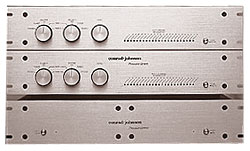
Conrad-Johnson launched the all-tube Premier 7 in 1988 as an all-out sonic assault on the state of the preamplifier art. A great deal has happened since then. For starters, C-J has gotten a great deal of feedback from customers, dealers, and reviewers. None other than J. Gordon Holt (Stereophile, November 1988, Vol.11 No.11) concluded that: "It appears that nothing which could possibly have improved its sound had been omitted....It is, in fact, about as close as any tubed preamp has come to being perfectly neutral in sound—in nearly all respects." In the now-defunct Sounds Like... (issue 3), Sam Burstein concluded that "It is, with certain reservations, absolutely delightful to one's musical senses." And, speaking of absolutes, even Harry Pearson gave the Premier 7 a rave in the first round of his preamplifier survey (TAS, issue 58). As icing on the cake, John Atkinson (Stereophile, Vol.12 No.8) concluded that the 7 had "the requisite degree of sonic magic to make it a Class A recommended preamplifier."
 In spite of universal bottom-line accolades regarding the original 7's sonic performance, there were criticisms, the most significant focusing on the 7's inconvenience in use. And, to a lesser extent, various reviewers disagreed on certain aspects of the 7's sonic performance. But for all practical purposes, C-J had clearly achieved their primary objective of offering a preamp that was at the cutting edge sonically.
Meanwhile, C-J continued to learn from the development of other products, and the competition continued to improve. The time had come for a revision. Impressively, C-J has hung tough with their stated objective of concentrating primarily (if not exclusively) on sonic excellence, avoiding ergonomic improvements if they thought such changes would threaten the sonic integrity of the basic design. I think it important to review the criticisms of the 7 to gain the necessary insights into what C-J has created in the 7A.
Technical Background & Ergonomics
In spite of universal bottom-line accolades regarding the original 7's sonic performance, there were criticisms, the most significant focusing on the 7's inconvenience in use. And, to a lesser extent, various reviewers disagreed on certain aspects of the 7's sonic performance. But for all practical purposes, C-J had clearly achieved their primary objective of offering a preamp that was at the cutting edge sonically.
Meanwhile, C-J continued to learn from the development of other products, and the competition continued to improve. The time had come for a revision. Impressively, C-J has hung tough with their stated objective of concentrating primarily (if not exclusively) on sonic excellence, avoiding ergonomic improvements if they thought such changes would threaten the sonic integrity of the basic design. I think it important to review the criticisms of the 7 to gain the necessary insights into what C-J has created in the 7A.
Technical Background & Ergonomics
JGH discussed at length the Premier 7's technical parameters in Vol.11 No.11. I suggest rereading that description, which remains germane to the 7A; Gordon has done a much better job of tackling this monster product's technical aspects than I could.
There have been two significant changes to the 7. Based primarily upon things learned in the development of other products, C-J has revised the phono stage—the only audio circuit change—and built in line filters based on the opinion that "cleaning up the line is a good thing." But what about all of those ergonomic issues raised by prior reviewers?
• Dual Volume Controls: While two volume controls may be inconvenient, they are essential for a true dual-mono design; the revised model retains them. This also holds true for the separate power cords, on/off power switches, and mute switches. On the other hand, LED indicators are provided for each channel, making accurate channel volume-matching relatively straightforward.
• Stepped Attenuators: Anything discrete will never be continuous. Even if the number of steps were increased from 23 to 100, someone would invariably want a position between two of the settings. The number of steps was not an issue for C-J; the choice of stepped attenuators was. C-J regards the resistive elements of potentiometers to be sonically inferior and, by using stepped attenuators, has minimized the number of switched contacts in the signal path. The 7A has only a single pair of resistors in the signal path at any time. Their attenuators are neither ladders of resistors nor simply detented potentiometers. While JA found the steps to be too large, I didn't find them to be a problem using either phono or line inputs—with the exception of the very high output Theta DS Pro Generation II.
• Phase Inverting: The 7A's line stage inverts polarity. Another amplification stage would be needed to provide a phase-switching capability, but would compromise the sound; C-J overruled it. If nothing in your system inverts polarity, the inclusion of the 7A will change the system's overall phase. You can simply reverse the leads at your speakers. If your system includes crossovers, separate amps, and/or subwoofer(s), things get a bit more complex. An alternative solution is to simply use the 7A with the C-J Evolution 2000 amplifier, which also inverts polarity.
• Physical Size & Weight: The 7A wasn't designed to be any specific size or weight, but to provide the best possible sound. This held true for the selection of numbers and quality of internal parts, layout, physical construction, etc. A glance inside the unit will make it clear that the available space is well utilized. Still, it's big; shipping weight of the three separate chassis is 60 lbs.
• Phono Impedance Selection on Rear of Unit: First, there is a phono impedance selection option; this is not a standard feature on all preamps. Second, while it may be on the rear of the unit, it is on the outside. For the amount of times this feature should be used, placement on the rear of the unit should pose no great inconvenience.
• Lack of an A+B Mono Switch: While Gordon complained about the lack of this switch, few others do. Lew Johnson told me that he's had only one other such request, on a different product, in 15 years. Listen to your mono records in stereo. The inclusion of an A+B switch would defeat the paramount objective of the true dual-mono design.
• Tape Feedback: No changes have been made to correct this problem identified by JGH in his review. As he described, you can, under certain conditions, experience feedback while taping and switching. Trusting Gordon's explanation, I didn't try to create this feedback.
• Noise: No, the 7A is not dead silent, or even as silent as most solid-state preamplifiers. But relative to most other tubed preamps, it's very quiet. I must point out that most tubed preamps today are significantly quieter than those of a number of years ago. I didn't find the noise to be a problem, but I've been using tubed preamps for a long time.
In spite of universal bottom-line accolades regarding the original 7's sonic performance, there were criticisms, the most significant focusing on the 7's inconvenience in use. And, to a lesser extent, various reviewers disagreed on certain aspects of the 7's sonic performance. But for all practical purposes, C-J had clearly achieved their primary objective of offering a preamp that was at the cutting edge sonically.
Meanwhile, C-J continued to learn from the development of other products, and the competition continued to improve. The time had come for a revision. Impressively, C-J has hung tough with their stated objective of concentrating primarily (if not exclusively) on sonic excellence, avoiding ergonomic improvements if they thought such changes would threaten the sonic integrity of the basic design. I think it important to review the criticisms of the 7 to gain the necessary insights into what C-J has created in the 7A.
Technical Background & Ergonomics
JGH discussed at length the Premier 7's technical parameters in Vol.11 No.11. I suggest rereading that description, which remains germane to the 7A; Gordon has done a much better job of tackling this monster product's technical aspects than I could.