I like stories with happy endings. My Conrad-Johnson story began in the mid-'80s, by which time I had a demo PV-5 hitched to a used Conrad-Johnson MV-50. Made a nice combo. They powered a rewired pair of B&W Matrix 802s, a Well Tempered Record Player, and an early CD player. 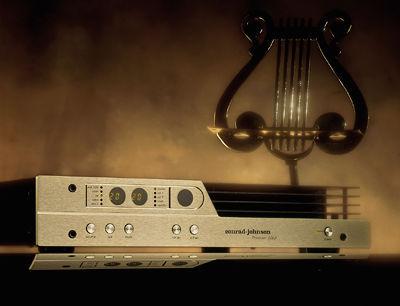 The "old look" MV-50 was fitted with a beat old set of Mullard EL34 tubes. One night, while K-10 had the music cranked way high, one EL34 let go with a spectacular light show. It was just the tube, but I clucked fretfully over the amp, all the while muttering about "power requirements." And that's how we wound up with our first Jadis Defy amp at exactly double the power. But that's another story. Inevitably, I moved on from the PV-5. My first step up was to a PV-9 after which I moved into a succession of Convergent Audio Technology preamplifiers, then Jadis preamps and amps, and eventually found myself in my present state of grace. Which brings us to the Conrad-Johnson Premier 16LS.
Was Thomas Wolfe wrong? Can you go home again? New components, new sound
The "old look" MV-50 was fitted with a beat old set of Mullard EL34 tubes. One night, while K-10 had the music cranked way high, one EL34 let go with a spectacular light show. It was just the tube, but I clucked fretfully over the amp, all the while muttering about "power requirements." And that's how we wound up with our first Jadis Defy amp at exactly double the power. But that's another story. Inevitably, I moved on from the PV-5. My first step up was to a PV-9 after which I moved into a succession of Convergent Audio Technology preamplifiers, then Jadis preamps and amps, and eventually found myself in my present state of grace. Which brings us to the Conrad-Johnson Premier 16LS.
Was Thomas Wolfe wrong? Can you go home again? New components, new sound
Conrad-Johnson's $4495 Premier 17LS preamplifier, which Brian Damkroger reviewed in the May 2001 Stereophile, is C-J's most affordable implementation of the engineering advances made with their Anniversary Reference Triode (ART) preamp (reviewed by Wes Phillips in the May 1998 Stereophile). The 17LS uses but four 6922s to implement the "composite triode" topology that C-J is committed to. The Premier 16LS uses six 6922s, but it's not just about the tube count. C-J says the 16LS is "very nearly a single-chassis stereo version of the ART." A lofty claim. Conrad-Johnson's "composite triode" philosophy boils down to an audio circuit with a single triode gain stage comprising a number of 6922 dual-triode tubes. The more tubes in parallel, the lower the output impedance. And yes, the use of a single stage means polarity is inverted at the preamp's output. The "composite triode" output stage is backed by zero loop negative feedback and no additional audio circuits, such as the often-implemented cathode follower. Either solid-state or tube, this functions as a buffer as well as lowering output impedance.
But, like most things, it's not all black or white. Victor Khomenko of Balanced Audio Technology, for instance, thinks that the idea that an amp's input impedance must be at least 10 times the preamp's output impedance doesn't give the whole picture. He points out that the interaction of the two is also much affected by the type of capacitor used and its implementation at the output of the preamp. In the event, the scant paperwork available for the Premier 16LS indicates that its arrangement of six dual-triodes achieves a "suitably low output impedance while reducing the number of active stages to the absolute minimum of one. DC voltage to this stage is supplied by cascaded discrete voltage regulators designed to isolate the audio circuit from the power line by maintaining virtually zero impedance at all audio frequencies." As Lew Johnson described it, there is also what you might call the inherent buffering of the preamp to consider, due to its input and output impedance. Thus, no cathode followers required. "To reduce infrasonic noise, tube filaments (heaters) operate on a DC voltage supplied by a separate discrete regulated power supply," according to the manual. The 16LS was absolutely the quietest tube amp I've ever auditioned, even when the gain was way up on the soon-to-be-upgraded Premier Fifteen phono stage I had on hand.
The 16LS's input selection and gain are managed by an array of microprocessor-controlled relays that are kept out of the signal path. Level and balance can be adjusted in 99 steps, achieved with a "precision, low-noise, metal-foil resistor network" handily controlled with the remote and the loudly clacking relays. The technology behind the interface isn't hype; the loudly clacking relays, increasing the volume faster as the button is held down, give a contemporary aerospace feel to what's basically old technology. The relays for source selection are right at the input connectors, minimizing crosstalk and keeping signal paths shorter. To minimize tube microphonics, critical audio circuitry is mounted on a subchassis that's isolated by a suspension system that must be released from its compressed state during setup. Parts quality in the upscale 16LS is "an exact match for the unprecedented level specified for the ART. Each part is selected on the basis of both sonic performance and durability. All audio circuitry (including the level control) is executed entirely with precision metal-foil resistors and polystyrene capacitors. Tubes have been carefully hand-selected for minimum noise and microphonics. The regulated power supplies use the same type metal-foil resistors as the audio circuitry. Capacitors for both audio circuits and DC power supplies are exclusively polypropylene and polystyrene. Switching relays are sealed with gold-plated silver contacts. Input and output connectors are machined of oxygen-free copper and gold-plated with a special process eliminating the use of magnetic materials."
Look, they're serious about it, okay?
The "old look" MV-50 was fitted with a beat old set of Mullard EL34 tubes. One night, while K-10 had the music cranked way high, one EL34 let go with a spectacular light show. It was just the tube, but I clucked fretfully over the amp, all the while muttering about "power requirements." And that's how we wound up with our first Jadis Defy amp at exactly double the power. But that's another story. Inevitably, I moved on from the PV-5. My first step up was to a PV-9 after which I moved into a succession of Convergent Audio Technology preamplifiers, then Jadis preamps and amps, and eventually found myself in my present state of grace. Which brings us to the Conrad-Johnson Premier 16LS. Conrad-Johnson's $4495 Premier 17LS preamplifier, which Brian Damkroger reviewed in the May 2001 Stereophile, is C-J's most affordable implementation of the engineering advances made with their Anniversary Reference Triode (ART) preamp (reviewed by Wes Phillips in the May 1998 Stereophile). The 17LS uses but four 6922s to implement the "composite triode" topology that C-J is committed to. The Premier 16LS uses six 6922s, but it's not just about the tube count. C-J says the 16LS is "very nearly a single-chassis stereo version of the ART." A lofty claim. Conrad-Johnson's "composite triode" philosophy boils down to an audio circuit with a single triode gain stage comprising a number of 6922 dual-triode tubes. The more tubes in parallel, the lower the output impedance. And yes, the use of a single stage means polarity is inverted at the preamp's output. The "composite triode" output stage is backed by zero loop negative feedback and no additional audio circuits, such as the often-implemented cathode follower. Either solid-state or tube, this functions as a buffer as well as lowering output impedance.