| Columns Retired Columns & Blogs |

Rogue Audio Atlas power amplifier
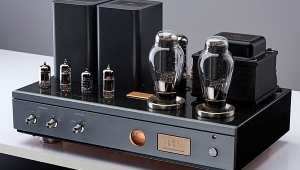
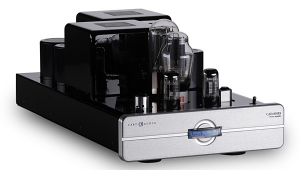
When I unpacked the Rogue Audio Atlas, I didn't know how much it cost. After examining its chassis of high-grade steel, its silver-anodized aluminum faceplate, its sleek and slightly rounded edges, and, above all, its two chunk-o'brick transformers—for such a little thing (a foot-and-a-half square by half-a-foot high), it's heavy—I guessed around five grand. Then I called Rogue Audio and learned that it retails for $1395.
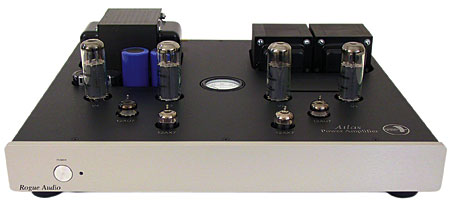
I was startled. It seemed crazy cheap. At 55 lbs and 55Wpc, that's about $25 per watt and per pound—bargain-basement for a tube amp. Then (I'm not proud of this moment) I felt miffed. I've finally joined Stereophile after all those years at The Abso!ute Sound, and this is how they welcome me? With a goddamned fourteen-hundred-dollar tube amp? I've got meter-long interconnects that cost more than that, Mr. Atkinson!
Then I reminded myself of my first reaction to this rock-solid slab called the Atlas—the cocked eyebrow, the whistle of surprise. Maybe there was more here than meets the eye. Or rather, maybe there was every bit as much as meets the eye, and more than the price tag suggests.
Description and Design
Rogue Audio has been building tube amps and preamps in Brodheadsville, Pennsylvania, since 1996. Mark O'Brien, the president and primary electrical designer, has an advanced degree in physics. Mark Walker, the operations manager, has a master's in mechanical engineering. They consider themselves more music lovers than audiophiles. All Rogue units are hand-built, fully tested, burned in for 24 hours, then retested. The company also employs an architectural designer, Deborah Regh, to create the Rogue Audio look: sleek and streamlined, with slightly rounded, elegant edges.
The Atlas, part of Rogue's Titan line, is a two-channel, vacuum-tube, push-pull amplifier. Its audio circuitry uses 1% metal-film resistors, ceramic tube sockets, and polypropylene coupling caps. A 12AX7 tube, configured as a paraphase inverter for the input stage, splits the signal and inverts half of it, thus creating a balanced signal pair. Those two signals are then fed into a 12AU7 triode driver stage, which boosts the signal voltage to a high enough level to drive the output stage, which uses a pair of KT77 or EL34 tubes. The Atlas comes with KT77s, each individually biased, which means that when one wears out you don't need to replace the entire quartet. They're the ones I used. Mark O'Brien says the KT77s have very nearly the midrange magic of EL34s and considerably better bass.
The output stage is coupled to the loudspeaker through an ultra-bandwidth output transformer, which provides both 4 and 8 ohm taps. The transformers' laminations are made of silicon steel, which has a high degree of magnetic permeability, resulting in greater bandwidth. The wires are twisted as they're wound around the transformer's core, a process that further broadens the bandwidth. O'Brien notes that some of Rogue's more expensive amps sport larger power supplies (for greater dynamic headroom), heftier binding posts, and better parts quality throughout. But the transformers, he says, are the same as those used in the Atlas. A built-in Hoyt meter makes tube biasing fairly easy. (I measured it several times; it never drifted.)
Two departures from the Atlas's otherwise solid build and operational ease: First, the binding posts are flimsy. Second, switching impedance is a pain. You have to unscrew the top of the chassis, loosen (with a 5/16" wrench) the nut that holds the positive binding post in place, pull off a green wire (for 8 ohms), replace it with a yellow wire (for 4 ohms), and retighten the nut. Your fingers should be quite slender. Then again, most normal people need to go through each of these steps—hooking up speaker cable and adjusting impedance—only once. If Rogue had to cut corners, these are reasonable places to cut them.
Sound
There's a stereotype about the sound of low-priced tube amps: gorgeous midrange, 3D imaging, depth galore, but rolled-off high frequencies and lightweight or downright flabby bass. Does the cliché apply to the Rogue Audio Atlas? Well, yes (what, you expect miracles at these prices?), but—on the negative side of the ledger—not nearly to the degree you might think.
A killer test for bass response is David Zinman and the London Sinfonietta's recording of Górecki's Third Symphony (CD, Nonesuch 79282-2). It's an ideal reference disc all round: It reveals almost all the strengths and weaknesses of a stereo system, and its musical pleasure is proportional to your system's sonic prowess. That is to say, the music sounds a bit schmaltzy through a so-so stereo, but glorious, even stirring, through a stereo capable of unraveling the orchestral detail. On mediocre or remarkably bass-shy systems, you can barely hear the first 30 seconds or so of the first movement, as the double basses growl the melody in a very low octave, very quietly. The theme is repeated, over and over, as ever-higher strings enter the picture, some in unison, some in harmony, still others in counterpoint. A great system can track every one of these parts with equal clarity and focus; as the pitch climbs higher and the parts multiply, each string section bowing at different intervals from the others, the tension builds yet never snaps.
By this measure, the Atlas was not a great amplifier but a quite good one. The deepest bass notes were a bit indistinct, but only in that I couldn't sense the accents of the bowing or the texture of the wood; I could hear the notes. When the cellos came in, they sounded louder than they should have. I'm not sure whether this was due to a slight midbass bulge, a deep-bass rolloff, or both. The effect wasn't severe—it wasn't a bloat—but it was there. The violas enter four minutes into this movement, and they sounded voice-like, clarion-clear, with a warm vibrato—but the lower strings were rumbly. I suspect something in the midbass might have been subtly amiss—if not a bulge, then a slight shortfall of harmonic detail.
NEXT: Page 2 »
 | |||||||||||

|
|
| |||||||||
- Log in or register to post comments








| Loudspeakers Amplification Digital Sources | |
Analog Sources Accessories Featured | |
Music Columns Retired Columns | |
Show Reports | |
Features Latest News Community | |
Resources Subscriptions |
 © 2024 Stereophile
AVTech Media Americas Inc., USA
All rights reserved