| Columns Retired Columns & Blogs |

VTL S-400 Reference power amplifier
When I reviewed VTL's MB-750 monoblock amplifier in the December 1997 Stereophile (Vol.20 No.12), it was a transitional time for the company. Luke Manley had recently taken it over, and he and his wife and partner, Bea Lam, were aggressively retooling. They introduced new business systems, including rigorous inventory and quality control; rebuilt VTL's dealer network around top-rank dealers; and systematically upgraded the products themselves to improve their consistency, reliability, manufacturability, and performance. VTL's goal, Luke explained to me at the time, was to build amplifiers that competed with the very best, and to "make the tubes invisible to the customer."
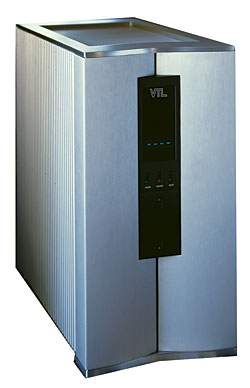 The plan rolled out just as Manley had envisioned, and VTL amplifiers evolved through several iterations: the MB-750 saw both Signature and Reference editions, and the flagship MB-1250 Wotan set a new standard in tube amplifier performance. However, having to bias the tubes manually—in the case of the Wotans, 24 per amp—didn't exactly make them user-friendly. So in the background, a multidisciplinary team of VTL engineers was already working on a completely new generation of products. The first to appear was the sensational TL-7.5 line preamplifier, which Paul Bolin raved about in the October 2003 issue. The next to break cover were two power amplifiers, the 800W Siegfried monoblock and the subject of this review, the two-channel S-400 Reference.
Talkin' 'bout a g-g-generation we've not seen before
It's hard to know where to start in describing the $20,000 S-400, so different is it from what's come before. You could start by listing everything you might want a tube amp to do, and that's just what VTL did. Then they turned their engineering team loose on the project.
A few things are obvious: balanced and single-ended inputs, a rear-panel 0°/180° phase switch, fully differential input, low idle-current standby, and mute, and a soft-start mode to extend tube life. And, like most VTL amps, the S-400 can be run in tetrode (300Wpc/8 ohms) or triode (150Wpc/8 ohms) modes. It also has extensive protection circuitry, with a fuse for nearly everything—and even a rear-panel socket and switch for testing the fuses. The S-400's sleek, tower-style shape echoes the TL-7.5's, and its component quality, fit, and finish are superb.
The list goes on. The S-400 biases itself for you, checking and setting each tube's bias during the power-up cycle, then tweaking it whenever the amp senses that no signal is present. It also constantly monitors the tubes and, if a fault is detected, indicates which tube is ailing and whether or not the amp is in danger. If it is, the S-400 shuts down; if it isn't, the problem tube is effectively removed from the circuit, and the amp rebalances and continues without it. The S-400 also checks for overheating, indicates if there's a problem, senses and displays several types of power-supply faults, and shuts down the amp, or not, accordingly.
Pretty impressive, but we're just getting started. Removing a small panel reveals a cluster of six buttons and LEDs that provide still more information and access to additional diagnostic and programming functions. From here, a user can turn various displays and indicators on or off, and display total tube or amplifier hours, input voltage or voltage set point, and rear heatsink temperature. These buttons also allow the fault indicators to be cleared.
The user can also display the bias level for each tube, then use these data to juggle tubes to create the most closely matched pairs. Because bias level is an early indicator of tube degradation, plotting bias levels against time can help determine when it's time to retube. When you do retube, be sure to reset the tube time to zero and clear the preset bias settings. You want the S-400 to gently raise the bias level to find the new tubes' optimal points, rather than risk damaging them by starting at the old tubes' bias levels.
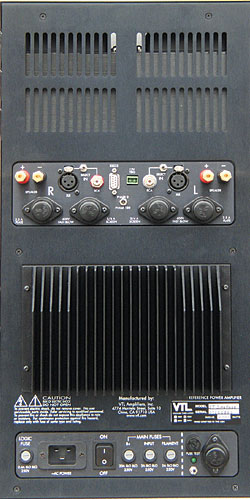 If by now your eyes are glazing over and you're starting to think that this would be a lot easier if you could just hook up a laptop, VTL's engineers have beaten you to it. An RS-232 connector on the rear panel allows you to read, log, and control all of this from your computer. All of the displays, codes, functions, and software commands are explained wonderfully in VTL's comprehensive user's manual.
New cosmetics, more buttons and features—same old circuit?
Not even close. Making the tubes "disappear" was one of VTL's goals for the S-400; the other was to set a new standard in sonic performance. When I called Luke Manley to walk through the circuit's details, the conversation quickly moved from what to the much more interesting questions of why and how. "The business has changed," he explained. "There's a new generation of amplifiers that sound fast and very neutral, and although we could achieve that to an extent [with older designs such as the Wotan], it was very intimidating, and our target customer doesn't want to fiddle with their equipment.
"Our first choice was to use tubes. They're inherently linear voltage amplifiers and require a very small amount of feedback. Then, to get the neutrality we wanted, the tubes had to be kept at their optimum operating point—hence the autobias. However, to keep the signal path simple, the autobias circuitry had to be completely removed from the audio circuitry during operation, so we needed to come up with a way to do that.
"All these things, and the need to manage current inrush during startup, required the use of microprocessors. And then we were quickly in a position that required totally new design expertise, but also enabled us to do a lot of things that we couldn't have otherwise. We were able to manage everything that we needed to to ensure optimum operation and maximum tube life. Then we added all of the diagnostics and indicators to monitor conditions and satisfy the customer's curiosity."
I asked Luke what made the S-400 sound the way it did—what's the magic?
"There are really three things that contribute. The first is the collection of everything we learned and developed during the evolution of our other amps. There are the wide-bandwidth output transformers, with single-tap outputs. We had a good starting point for parts selection from before, based on matching and extensive listening, and knew how to optimize feedback. The second piece was developing a true balanced differential input, with 60dB of common-mode noise rejection.
NEXT: Page 2 »
 | |||||||||||

|
|
| |||||||||
- Log in or register to post comments







| Loudspeakers Amplification Digital Sources | |
Analog Sources Accessories Featured | |
Music Columns Retired Columns | |
Show Reports | |
Features Latest News Community | |
Resources Subscriptions |
 © 2024 Stereophile
AVTech Media Americas Inc., USA
All rights reserved