Computer Audio Reviews

Sort By: Post DateTitle Publish Date

ASUS Xonar Essence One Muses Edition D/A processor–headphone amplifier
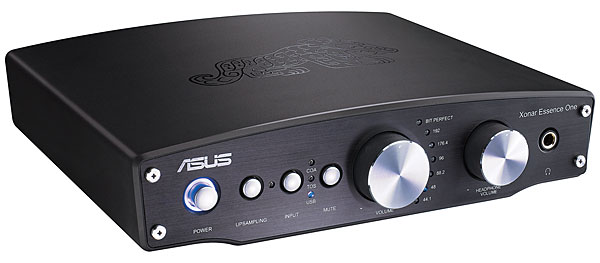
Back in the summer of 2009, USB-connected D/A processors that could operate at sample rates greater than 48kHz were rare. Ayre Acoustics had just released its groundbreaking QB-9, one of the first DACs to use Gordon Rankin's Streamlength code for Texas Instruments' TAS1020 USB 1.1 receiver chip. Streamlength allowed the chip to operate in the sonically beneficial asynchronous mode, where the PC sourcing the audio data is slaved to the DAC. But high-performance, USB-connected DACs like the Ayre were also relatively expensive back then, so in the January 2010 issue of Stereophile I reviewed a pair of soundcards from major computer manufacturer ASUS , the Xonar Essence ST and STX, which, at $200, offered a much more cost-effective means of playing hi-rez files on a PC.
Channel Islands Audio Transient Mk.II & VDC•5 Mk.II USB D/A processor & power supply

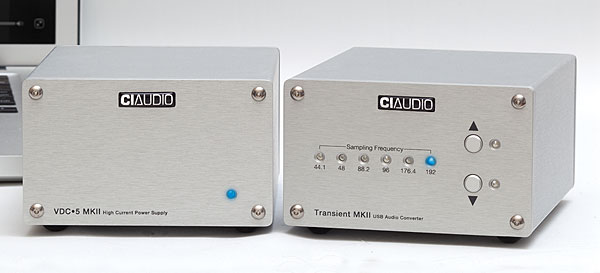
Most folks don't even know they exist, but the Channel Islands are a chain of eight moderately sized mountains poking through the Pacific Ocean along the coast of southern California, between Santa Barbara and San Diego. The most famous of these is Catalina Island and its city, Avalon, which sit opposite San Clemente. The other Channel Islands are relatively wild and have been preserved mostly uninhabited.

Benchmark ADC1 USB A/D converter


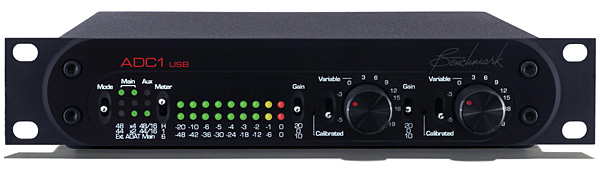
Erick Lichte's review of Benchmark's DAC2 HGC D/A converter in this issue gave me an ideal opportunity to spill some ink on the company's ADC1 USB A/D converter. The ADC1 is housed in the same small case as the DAC (one rack unit high, half the rack unit width), and is offered with a black front panel with rack ears, or a silver aluminum panel without ears, either for $1795.

HRT Music Streamer HD USB D/A processor

No history of the computer-audio marketplace could be complete without some mention of High Resolution Technologies, the California company whose Music Streamer was, in 2009, the first perfectionist-quality USB digital-to-analog converter to sell for as little as $99. One could argue that HRT's entire business model has contributed to shaping our attitudes toward the hobby: Because digital-audio technology continues to evolve at such a rapid pace, HRT has introduced a succession of newer and ever more effective Music Streamers, occasionally to the obsolescence of their predecessors; yet because those products have all been so affordable—remarkably and laudably so, given their thoroughly American provenance—we tend not to mind.

iFi Audio iDAC & iUSBPower USB D/A processor & outboard power supply

Bratty, mollycoddled, and altogether spoiled consumers such as you and I have inflicted on computer audio the same injustice that laparoscopic surgery, antilock brakes, mobile telephones, word processors, e-mail, microwave ovens, and over-the-counter proton-pump inhibitors have suffered at our hands in recent years: In less time than it takes to say "ho-hum," we've knocked it from the pedestal to which all such breakthroughs are entitled and begun taking it for granted.

Ayre Acoustics QA-9 USB A/D converter

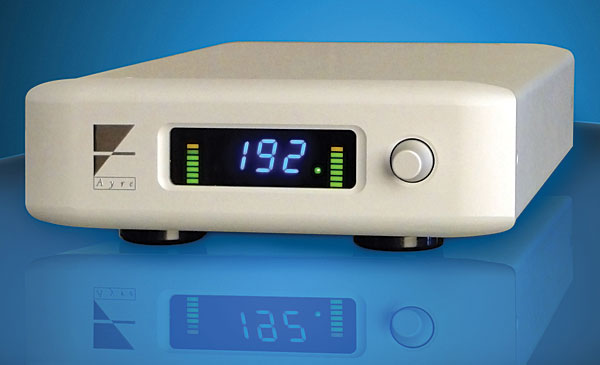
Since its founding in 1993, Colorado-based Ayre Acoustics has made its name with amplifiers and preamplifiers based on truly balanced, solid-state circuitry that didn't use the ubiquitous panacea of loop negative feedback to produce linear behavior. Their first digital product was the D-1x DVD player, reviewed for Stereophile by Paul Bolin in February 2003, which offered unusually good video performance. The D-1x was followed by the C-5xe and DX-5 universal players, respectively reviewed by Wes Phillips (July 2005) and Michael Fremer (December 2010). But the most intriguing digital product to come from Ayre was the QB-9 digital processor. Reviewed by WP in October 2009, the QB-9 has just one input, USB, and uses Gordon Rankin's proprietary Streamlength code to give asynchronous operation, which in theory offers the best jitter suppression. "The QB-9 isn't a computer peripheral," said Ayre's marketing manager at that time, Steve Silberman. "It makes computers real high-end music sources"—a statement with which WP agreed.

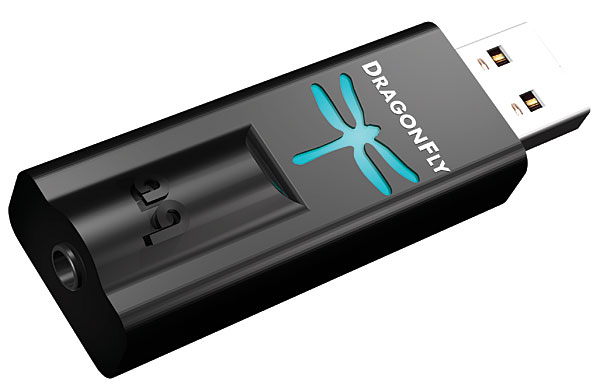
AudioQuest DragonFly USB D/A converter

"This product is an industry disrupter."


Thus spoke AudioQuest's Steve Silberman, VP of development, of their brand-new USB D/A converter, the DragonFly. "There are a lot of very good DACs out there," he continued. "There are even a lot of very good affordable DACs. But the problem is, people outside of audio don't want them: They don't want old-style components like that.

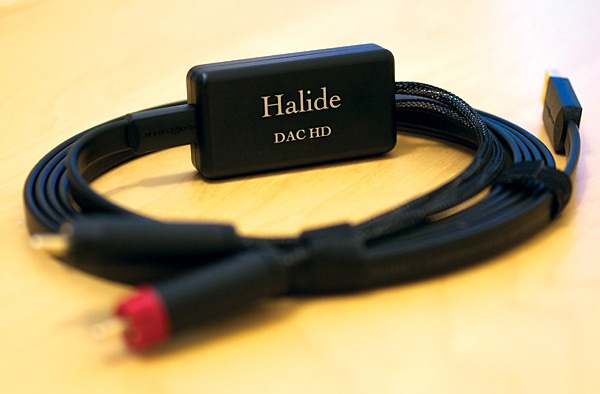
Halide Design DAC HD D/A converter

When it comes to getting audio from a PC via its USB port, the buzzword du jour is asynchronous. This cryptic term refers to which device has control over the timing of the audio data being streamed from the computer: the computer itself, or the device receiving the data. It might seem logical to have the computer control the timing, but this is not so. When digital audio data are converted to analog by a D/A converter, control over exactly when each dataword is converted is critical for the best quality of sound. Any uncertainty in that timing manifests itself as analog distortion, aka jitter.

Weiss DAC202 FireWire D/A converter

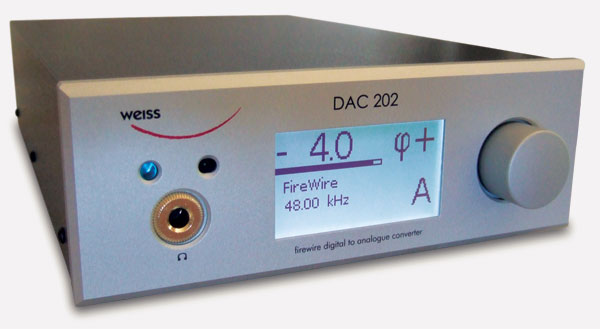
One of the better digital front-ends I've ever heard was demonstrated for me a number of years ago at the house of an audiophile friend: a Weiss Engineering combo of Jason CD transport and Medea digital-to-analog converter. That front-end remains in my mind as one of the only digital systems I've heard that could compete with the very best that vinyl has to offer while still doing what digital does best. In other words, there were warmth and musicality, staggering dynamics, and real silent backgrounds. When, recently, I saw that the Swiss company had come out with a DAC featuring onboard volume control, a headphone amp, and a FireWire input, I knew I had to give it a listen.
Advertisement
Advertisement
Advertisement