Phono Cartridge Reviews

Sort By: Post DateTitle Publish Date

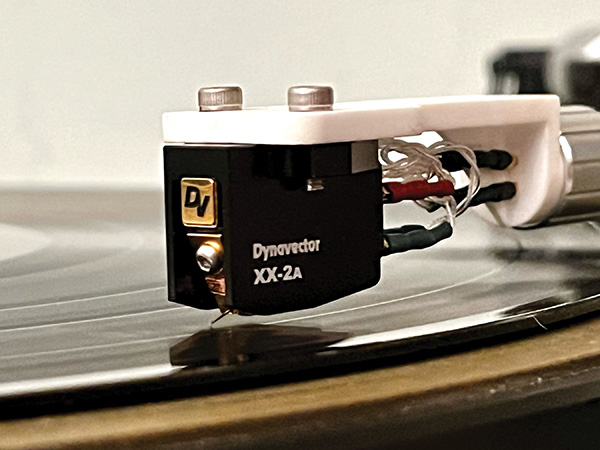
Spin Doctor #16: Sutherland Dos Locos Phono Preamp, Dynavector XX-2A Phono Cartridge
Ron Sutherland makes a strong case for being crowned the king of all phono preamps, though I expect he would blush at any such suggestion. In 1979, with degrees in physics and electronic engineering (where his final project involved designing and building a digital logic–controlled preamp), he teamed up with Gayle Sanders to found electrostatic speaker company MartinLogan. ("Martin" and "Logan" are Sanders' and Sutherland's middle names, respectively.) But after a few years, he found the increasingly corporate mindset at M-L a bit stifling, so he decided to go his own way. Ron wanted to build gear he thought was cool and fun while not being directed solely by its commercial potential. He joined up with his brother to start Sutherland Engineering, creating hi-fi equipment that piqued his own interest and hopefully that of a bunch of customers.


At first, Sutherland made a wide range of components, including preamps, power amps, and DACs, but gradually he focused more and more on phono preamps. Today that's the only thing he makes...

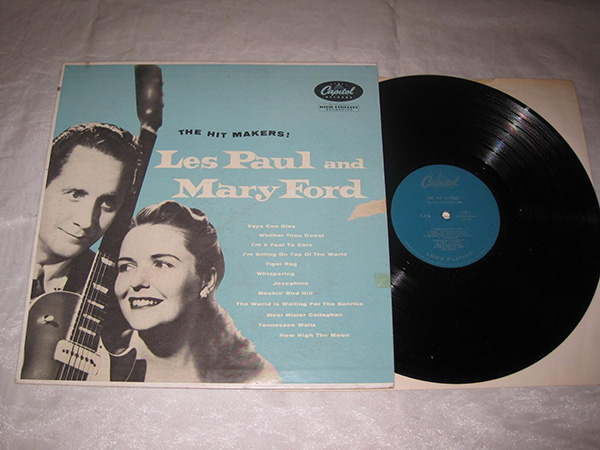
Brilliant Corners #18: Adventures in Schwabylon, Ortofon Cadenza Mono Phono Cartridge

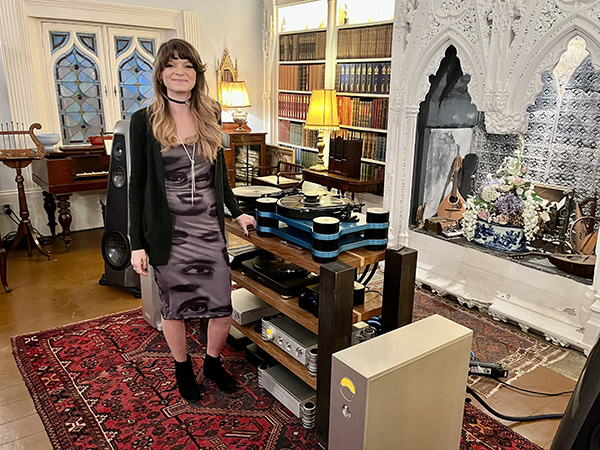
Meeting up at High End Munich: Grover Neville (left), a contributor to Stereophile's late headphone blog InnerFidelity, with his dad, Craig, a civil engineer from Chicago.


"Schwabing isn't a neighborhood, but a state of being," declared the Countess Fanny zu Reventlow, an early feminist who scandalized German society by parenting out of wedlock, carrying a revolver, and practicing what today tends to be called ethical nonmonogamy. Thomas Mann described the fellow denizens of this northern corner of Munich as "the most singular, the most delicate, the boldest exotic plants." At the turn of the last century, Schwabing was on its way to becoming the artistic epicenter of Europe, a laboratory for the most progressive social ideas, and arguably the birthplace of modernity. Kandinsky made Western art's first abstract painting while living there; local cafes once patronized by Lenin would soon host a young Adolf Hitler. Some called it Schwabylon.


These days, Schwabing's spotless, freshly paved streets are lined with the glass-and-steel facades of Hiltons and Marriotts. Its proximity to MOC, Munich's titanic convention center, has turned the neighborhood into a destination for business travelers from near and far.

Brilliant Corners #17: Monomania! The Miyajima Zero Mono phono cartridge

Stereo is the most successful audio gimmick of all time. While dashboard record players, quadraphonic LPs, and MQA have gone the way of Ron Popeil's hair-in-a-spray-can infomercials, stereo remains king. And I am guilty of loving it.


That old expression "men love with their eyes" applies to listening, too. Enabled by the advent of a second channel, the fanning out of musicians across a soundstage fills the room and gives the eyes—and not only the ears—something to do. And I happen to enjoy the soundstage. It may be an utterly artificial delight, but who doesn't love hearing a tambourine coming from 10' to the left of the left speaker? So when I came across an article in which someone likened mono to listening to music through a hole in a wall, the metaphor made sense. Why would anyone want their music congealed in a blob directly in front of them when they could hear it separated out in space?


As always, though, it turns out that things aren't quite so simple...

Gramophone Dreams #87: Deejay Coolosities, AudioQuest Yosemite tonearm cable, Nagaoka MP-110 phono cartridge

SME’s Kathryn "Kat" Ourlian deejays a turntable shootout. Photo by Michael Trei.


One August night in 1965, I parked in the driveway of my best friend Derf Marko's house and let myself in the back door. As I entered, I could see to the bottom of the basement stairs, where I observed a loud pulsing darkness with plumes of agreeably acrid smoke floating up through the stairwell. Back in the darkness, I heard Derf/Fred and another person making declarative statements in loud unintelligible bursts. When I reached the bottom of the stairs, Marko's basement rec room looked like a trashed-out tiki bar illuminated by a single red Christmas light hanging just above a Dual turntable. The room was dark to a point where it was impossible to walk without stepping on records or to make out who was there and what was going on. I slouched on a couch, closed my eyes, and let my mind follow the sounds of rock drummers wailing like angry cats.


Soon it was obvious: Marko was frantically playing one drum solo after another while some crazy old dude kept hollering for the next solo before the last one finished. The revved-up stranger kept slapping his knees, muttering, and drumming along with each different drummer. Stacks of unsleeved LPs littered the linoleum floor and pink wool couch I was slumping on. But unbelievably, Marko adeptly—without cursing, fumbling, or hesitation—located every solo he wanted.


I found out later that the crazed "old guy" was Ginger Baker!

Spin Doctor #14: Lyra Atlas λ Lambda phono cartridge and fixing footfall problems

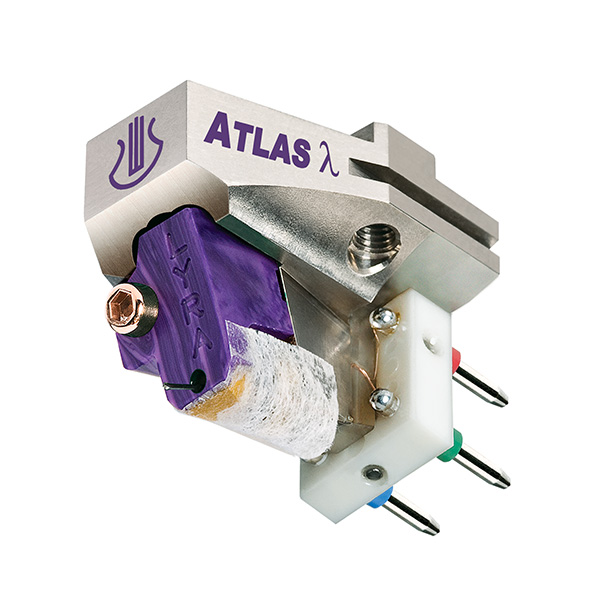
It has been more than a decade since 2012, when Lyra launched the original Atlas moving coil cartridge as the company's flagship, but in the intervening years, there have been a few updates. First, in 2016, Lyra introduced what they call the SL versions of the Atlas and also the Etna. These cartridges were designed to take advantage of a new crop of transimpedance phono preamps like the CH Precision P1 and the Sutherland Phono Loco, which boast exceptionally low noise levels but work best with cartridges that have very low impedance. Cutting the number of turns on each of the cartridge's two coils in half reduces the moving mass and inertia, allowing the stylus/cantilever assembly to respond more accurately to the tiny groove modulations. This results in improved tracking at the cost of a lower output level, which, thankfully, transimpedance phono preamps are well-equipped to handle.


Then in 2020, both Atlas and Etna versions were updated to new λ Lambda versions, with a redesigned suspension and damper system that Lyra says delivers enhancements in clarity and resolution.

Gramophone Dreams #83: Benz Micro Gullwing SLR, Goldring Ethos phono cartridges, Meze 109 Pro headphones

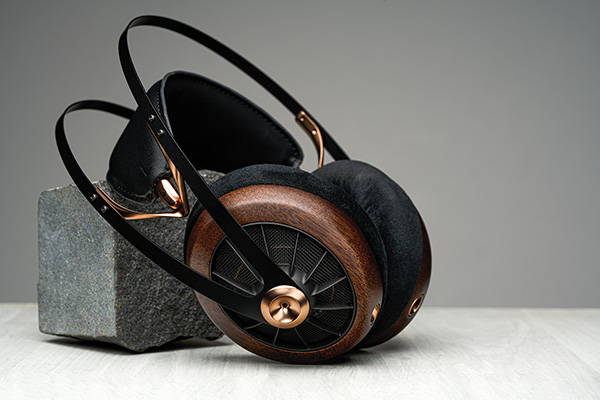
It was almost Christmas, a perfect, chilly, blue-sky day to visit the Met Museum and see the Manet/Degas show before it ended. On my way, walking north on Madison Avenue, I passed the uptown branch of Gagosian Gallery and noticed a brightly lit poster behind thick glass announcing their exhibition of American artist Brice Marden's last paintings. The title of the show was "Let the painting make you," which sounded like an invite and a challenge, so of course I had to go in. I was in the perfect mood to ride in Gagosian's swanky private elevator and see how a famously serious painter with a six-decade career chose to communicate his last thoughts.

Spin Doctor #11: Alternative Phono Cartridge Technologies and the DS Audio DS-W3 optical cartridge system

Over the last 50 years, I must have installed well over 1000 phono cartridges, but I still remember the very first one: a Goldring G850 I put into the family Garrard Autoslim turntable when I was 11 years old. In 1973, the G850 was the least expensive moving magnet cartridge Goldring made. The change from the flipover-stylus ceramic cartridge that came with the Garrard wasn't an attempt to satisfy a youthful audiophile itch but, rather, a result of my first encounter with a system compatibility problem.


A few months earlier, I had convinced my nonaudiophile dad to upgrade the family stereo. We went from our ancient Monacor SMX-50 tube receiver to a pretty weird but less ancient Sony all-in-one cassette system called the TC-133CS. I failed to understand that the new Sony's magnetic phono input was incompatible with our old ceramic cartridge. Once I figured that out, I tried to convince my dad that what we really needed was a Shure M75ED. After all, that cartridge came from the same company that made the legendary V-15 Type III, widely regarded as the best cartridge in the world at the time. My dad, however, had different plans. Guided by his home-product purchasing bible, Consumer Reports, he decided we should go instead with the less-costly Goldring.

Brilliant Corners #12: Balanced Audio Technology VK-80i integrated amplifier, Ortofon Cadenza Bronze phono cartridge

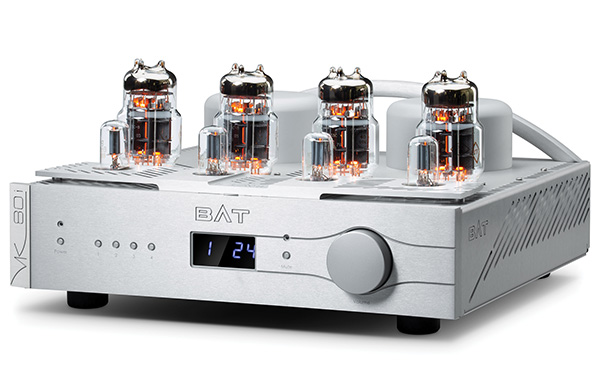
In 1976, a Soviet fighter pilot named Viktor Belenko made an emergency landing in Hokkaido, Japan. He was flying a MiG-25 supersonic interceptor jet and, upon touching down, requested political asylum. This proved to be a stroke of brilliant luck for the Americans. The MiG-25 remains one of the fastest and highest-flying aircraft ever produced, and Belenko's defection allowed them to have a tantalizing look at the technology inside.


Among the top-secret loot found inside the Soviet jet was a large, heavy triode vacuum tube used as a regulator in the power supply of the MiG's radio. It was known as the 6C33C. (The enormous electromagnetic pulse caused by a nuclear explosion would fry a transistor. Tubes were used in military equipment with such an eventuality in mind.)

Spin Doctor #9: Soviet-era Hi-Fi & 2 Aidas phono cartridges

In 1985, I visited what was then known as Soviet Estonia with my family. My paternal grandparents, Mimi and Pop, had emigrated to the US from this small Baltic country in 1929. Fifty-six years later, after more than a decade of rejection, the family was granted permission by the Soviet authorities to visit our ancestral homeland, and the whole family, including Mimi, made the trek. (Pop died in 1962.)


Once we were there, we were more or less free to move around in the capital city Tallinn, but leaving the city was strictly forbidden, except as part of a planned group excursion with our KGB minders—er, "Intourist guides."

Spin Doctor #7: Korf Audio TA-SF9R tonearm, Zu Audio DL-103 Mk.II Rev B phono cartridge, Gates CB100 transcription turntable

About four years ago, the stand-alone tonearm market went through a bit of a crisis. First, in December 2019, SME announced that it would stop selling tonearms separately, effective immediately. From that point on, SME tonearms would be available only in combination with SME turntables. . .


Five months later, in May 2020, we received the second blow in this double whammy of bad tonearm news. That's when the Ichikawa Jewel Company of Japan, maker of Jelco tonearms, announced without warning that they were shutting down operations, closing their doors for good. They blamed a combination of an aging workforce, worn-out tooling that needed to be replaced, and the coronavirus pandemic. . .


We lost two key players all at once, but it's not as if we suddenly had nowhere to turn for tonearms. Turntable manufacturers like Acoustic Signature, Clearaudio, Origin Live, Pro-Ject, Rega, and VPI all sell their tonearms separately . . . A number of smaller tonearm specialists have popped up in recent decades: Acoustical Systems, Graham, GrooveMaster, Kuzma, Reed, Schick, Schröder, and at the ultrahigh end, Swedish Analog Technologies. Now we can add Korf Audio to the list.

Advertisement
Advertisement
Advertisement