Finding myself in the Northwest on business, I reckoned I'd grab some Seattle dim sum with my nephew before heading my rental car south on I-5 to visit old friends in Oregon. "You live here," I said to Sean. "What are the good radio stations?"
It's called the "Cocktail Party Effect." You may be immersed in the middle of a crowd of audiophiles all talking at once, but when someone says something that catches your attention, such as your name, you can focus on the sound of that person's voice and exclude the babble. The noise suppression can be 9–15dB; ie, the sound being concentrated on seems to be three to four times louder than the ambient noise, according to Wikipedia. The exact mechanism of the Cocktail Party Effect is not known, but it is conjectured that it has something to do with the binaural nature of human hearing: the fact that we have two ears allows us to apply spatial discrimination to what would otherwise be a jumble of sound.
"You listen to these modern records, they're atrocious, they have sound all over them. There's no definition of nothing, no vocal, no nothing, just like—static."—Bob Dylan, interviewed by Jonathan Lethem. Rolling Stone, September 7, 2006
It's a jungle out there. The shrinking shelves of your neighborhood newsstand drip with the blood and corpses of magazines that have gone under in the intense battle for browsers' eyeballs. And only if we can make our latest issue's cover sufficiently eye-catching to get enough newsstand browsers to pick up and buy a copy do we get to play another round of the game. (Conventional publishing wisdom holds that, at most, a magazine's cover has six seconds to get its message across.)
It seemed a bit like the game of Telephone: Someone at the head of a long line of people whispers a sentence or two into the ear of the next in line, who in turn passes it along. By the time the last person in line repeats aloud what they think they've heard, the message is often barely recognizable to the first person.
High-end audio is not a rational construct. It is a sensory experience that leads to emotional engagement. In slightly different words: High-end audio is not about a concept, but about the experience of having our emotions engaged. The difference between reading about a high-end audio system and hearing great recordings played on one is almost as big as the difference between reading a love poem and falling in love.
Tom Swift is a talented young loudspeaker designer. Tom believes that he has never been able to prove exactly how talented he is, because the company he works for refuses to build the cost-no-object loudspeaker he's been doodling designs for (on company time).
Getting a name check from the mainstream press can be a good thing. But as Wes Phillips wrote in his blog on February 5, "to paraphrase Mason Williams on winning an Emmy Award, 'It's like being kissed by a girl with bad breath—you appreciate the honor, but...'"
The debates may be old, but they're not tired. They rage on with a virulence that suggests there's plenty of life in these old dogs yet. Online forums and Letters to the Editor are filled with them: objectivist vs subjectivist, engineer vs audiophile, double-bind vs doubly blind. The divisions may be artificial or downright specious—false dichotomies perfectly set up for cheap shots—but that doesn't dissuade people from drawing sides, driving stakes into the ground, and firing off volley after volley of accusation and retaliation.
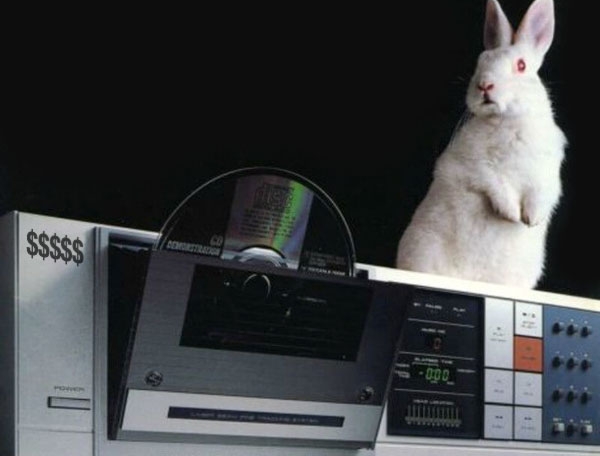
The mechanical toys were very superior, and looked down upon every one else; they were full of modern ideas, and pretended they were real.—Margery Williams, The Velveteen Rabbit