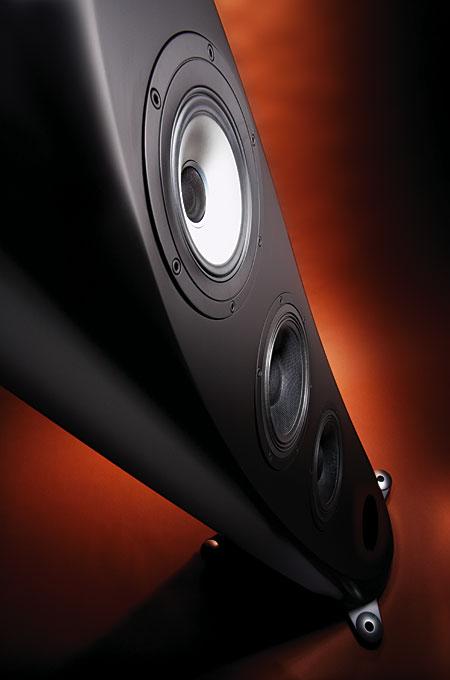
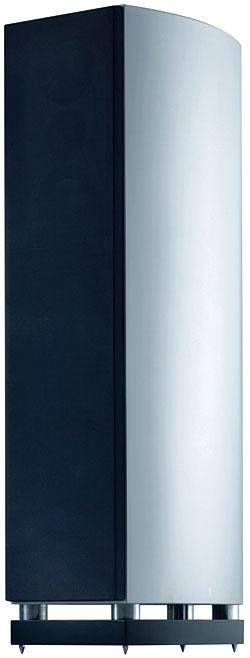
It's been five years since David Wilson's X-1/Grand SLAMM speaker system invaded our audio consciousness with its 500W power capacity and very high (95dB/W) sensitivity (footnote 1). Capable of an earsplitting 123dB at 1m, with a bandwidth to match, this was one speaker system that refused to be ignored. The X-1 has since evolved to $70,000/pair Mk.II form. It now provides some flexibility of tonal balance for different room acoustics, and is distinguished by greater subtlety in its differentiation of timbre. Beneath the X-1 in Wilson's range comes the WATT/Puppy ensemble, now in its 5.1 iteration (footnote 2). The WATT/Puppy has survived for over 10 years, and sets a benchmark for the Wilson line at its $17,270 system price.
Who knows not Circe, The daughter of the Sun, whose charmed cup Whoever tasted, lost his upright shape, And downward fell into a groveling swine? —John Milton, Comus
On a very special Saturday night in early September—late winter in Australia—I was deeply moved by hearing Brahms' Symphony 1 in the concert hall of the Sydney Opera House complex. Perhaps it was Marek Janowski's fiery, inspired conducting, but I keep recalling the hall itself. Earlier that day, I had photographed—first from my hotel room, later from a ferry—the huge, nesting sail-like roofs, covered with a million white ceramic tiles, that enclose an opera theater, concert hall, and restaurant. Twenty-five years in construction and costing over $107 million, the Sydney Opera House is described in my Fodor's '98 Australia guide as "the most widely recognized landmark of urban Australia." Attending the concert that night—all 2679 seats were occupied—I found the acoustics lovely, dark, and rich.
When Pioneer commissioned Allen Boothroyd, a British industrial designer best known for his work with Meridian Audio, to come up with a unique appearance for its new surround-sound speaker system, they apparently knew what they didn't want: another boring set of square boxes. Nor did they want a speaker system that would blend into Ethan Allen surroundings.
Note: This review appeared in the February 1999 issue of Stereophile Guide to Home Theater (issue number 22) and is appearing here until SGHT completes its own Archives database.
On the occasion of a recent major birthday, my significant other, Bonnie, gave herself a "mid-life crisis" present—a beautifully restored, bright yellow Porsche 911. She'd spent the previous several weeks wading through reference books to figure out exactly which year and model she wanted, and each night we'd discuss the pros and cons of various models, options, and points in the 911's +30-year evolution. Bonnie explained to me that, throughout its production run, the 911 maintained the same basic design and a consistent set of engineering goals, but was continually updated and refined. In her mind, the 1973 Targa was the one to have, the last and fastest of the lightweight 2.4-liter models.
If, as some would have it, Audiophilia nervosa is like the dark night of reason, then certain audio epiphanies must necessarily stand out from a distance, like a grove of trees 20 miles away thrown into stark relief by prairie lightning. And make no mistake that Audiophilia is a disease---I treasure the memory of the first time my wife and I heard Quad ESLs with tubes far more than the memory of my first kiss (although not more, I hasten to add in case Joan is reading this review, than the memory of our first kiss). I know men who stare into their flickering fireplaces on long winter nights and remember all the women they've known. Myself, I'm more likely to reminisce about my first tube preamp, or list the great-sounding systems I've owned.
Really Big Hi-Fi came to live with me for a couple of months this past spring in the form of a pair of Tannoy Churchill loudspeakers. They were trucked directly to San Rafael, California from Kitchener, Ontario, in flight cases so bulky they could double as coffins for NFL offensive linemen. Once ensconced chez moi, the Tannoy dreadnoughts provoked bewilderment, alarm, curiosity, envy, admiration, awe, and amazement in all who heard and saw them.
The first time I encountered Dunlavy's Signature Collection loudspeakers was at the 1993 Chicago Summer CES. I was familiar with, and had a lot of respect for, the speakers John Dunlavy had designed for the Australian Duntech brand, but I thought this new line clearly transcended his previous efforts—and at significantly lower prices. The model that I ended up reviewing—and, after the review (Vol.17 No.4), buying—was the SC-IV, subsequently honored as Stereophile's 1994 Loudspeaker of the Year and Product of the Year. In 1995, the SC-IV underwent changes, including a new woofer and a modified tweeter, resulting in some sonic improvements (see my Follow-Up review in Vol.18 No.3).
You might recall that ditty from childhood about the little engine that could (I think I can, I think I can, I think I can...). It's an apt metaphor for high-end audio. In traversing the aural sepulchers of last winter's Consumer Electronics Show and the summer's HI-FI Show, I routinely encountered one divine sound system after another. Yet while I never tire of transcendent sonics, eventually I become inured to the procession of celestial, cost-no-object speakers. It's like having a white-light experience, then returning to the gritty reality of life on earth, where for most of us cost is not merely the object, but the determining factor in finding an optimal balance among audio components.
It was one of those uncommonly warm late winter Sundays when you hardly need a coat. The fine weather had set aside any critical listening sessions, the door to the kitchen was open, and I was playing my audio system—then equipped with a pair of Spendor BC-1 loudspeakers—at moderate levels. Playing on the Linn turntable was an LP that the kids loved—"The Magic Garden Song," sung by the two female leads from the children's television show of the same name (footnote 1), My wife doesn't often comment positively on audio equipment, but that day she walked in from the kitchen to say, "Those voices sound real—as if two people just walked in our living room and started singing."
I've never heard a pair of the Italian Sonus Faber speakers I didn't like. What I've never liked was the US price: too high. And then you have to put them on costly stands. Plus, you're paying a premium for the magnificent woodworking and exquisite design—something I wasn't into, since I live with my stereo in a basement office/workshop/listening room some (who shall remain nameless) refer to as the "habitat for inhumanity."
I first met Jacques Mahul (the JM in JMlab/Focal) when my wife Kathleen and I traveled to Paris to cover HiFi (Hee-Fee) '96. The sound produced by the JMlab Grand Utopias—on a collection of many-chassis'd YBA electronics—got my enthusiastic vote for best of show (footnote 1). JMlab's large demo room was always packed to the rafters with avid listeners. (As a group, melomanes, as audiophiles are called in France, exactly mirror their stateside brethren in appearance and general demeanor. Yes, they're a raucous and demanding bunch!)
A reviewer's life is not all fame and fortune. There are downsides, too, one of which is that, while many great-sounding components pass through your listening room, only a few get to stay there on anything like a permanent basis. (And that involves money changing hands, as in [gasp!] "purchase.") Before I bought my long-term reference loudspeakers—a pair of B&W John Bowers Silver Signatures—back in 1994, the speakers that had spent the most time in my 2900-cubic foot listening room were a pair of Thiel CS2 2s. I reviewed the '2 2 in the January 1993 issue of Stereophile (Vol.16 No.1), and although it was relatively affordable ($2250/pair at the time of the review), it did most of what I wanted a speaker to do. Other than a limited dynamic range in the bottom audio octave and a slightly exaggerated top octave, the CS2 2 sounded effortlessly smooth and free from coloration throughout the midrange and treble. It was also a real imaging champ.